The Nuclear Power Thread

Nicodeamus

Honorary Master
Joined
Sep 20, 2006
Messages
14,477
Reaction score
4,530
I have argued for case for Nuclear Energy on this forum before and I believe that we are living in interesting times, there is new innovation happening in the sector, SMRS, Thorium Reactors, the Chinese heat extraction etc,

The Nuclear Sector has long been overdue for a bit of new innovations and I would like to tidy up my posts a bit by putting them under one thread.

Worldwide there is an acknowledgement among the big powers that we need to get off fossil fuels, the last time that the world had such an energy transition we fundamentally changed the way that our society operates. I don't think that many of us have yet come to terms with what a cost of resources it would be.

I am actually optimistic that Nuclear Energy will see a bit of a renaissance in the coming years.
 

Plans in the United States to invest heavily in nuclear R&D to prepare for the next generation of power generating technology will continue despite a chaotic political transition between increasingly polarized parties, industry insiders and bureaucrats say.

The U.S. Senate Appropriations Committee has earmarked some $42 billion for the DOE for 2021, with $1.5 billion put aside for nuclear energy research, development, and demonstration activities. That is an increase of $11.9 million above that enacted in 2020 and $325.4 million above the budget request.
 

The UK Government is looking for a location to put their first operating fusion plant that is planned to be completed by 2040,

Prime minister Boris Johnson last year committed an extra £200 million to flesh out the possibility of building the project, known as the Spherical Tokamak for Energy Production (STEP). The UK Atomic Energy Authority (UKAEA), the government body overseeing STEP, hopes construction could begin around 2030, with the plant operating as soon as 2040.

Ian Chapman at the UKAEA says STEP may cost around £2 billion, the equivalent cost in today’s money of building the Joint European Torus (JET), an existing fusion reactor in the UK that was constructed in the 1980s. Francis Livens at the University of Manchester, UK, says the cost and timeline are “ambitious but not implausible”.

Jet is that has served the Fusion industry well for the last few decades is finally getting an upgrade.

The EU is investing heavily into hydrogen fuel, and the two elements that are required to make fusion work at an industrial scale are the hydrogen isotopes deuterium and tritium.


Whoever is advising Boris Johnson on Energy knows exactly what he is doing.
 
I am for it. They just need to somehow standardize a design for a power plant and not having each plant have its own design and building plans. If every power station uses the same design and building plans, surely it would become a lot cheaper to build also.
 
I am for it. They just need to somehow standardize a design for a power plant and not having each plant have its own design and building plans. If every power station uses the same design and building plans, surely it would become a lot cheaper to build also.

There is acknowledgement by now that there were too many disorganized designs, but another reason that the price went up is that the industry lost many of the critical skills, we stopped building powerplants for 20 years and then when we wanted to kickstart the industry again all those guys retired.

Modular construction techniques that are now being used by Rolls Royce is a complete game changer, Nuclear's advantage is its cheap operations cost and its stability, but what held it back was an industry that went too big and that ended up overcomplicating everything.
 
Suggest read this years report, its detailed, and worthy of a read.


First, although the raw number of worldwide reactors is well below its all-time high of 438, their actual combined electricity generation came close to setting a record. As a whole, they generated 2,657 terawatt-hours of electricity in 2019, only three terawatt-hours below the historic peak in 2006. The United States, Russia, and China all hit individual country records for total electricity production from nuclear energy. Nevertheless, nuclear energy’s share of the energy market is in long-term decline, as other forms of energy witness rapid expansion.

Second, China continues to be the main driver of new nuclear energy, but over the long term its intentions are uncertain. The number of new projects there appears to be slowing. Whereas two years ago there were 20 units under construction, today there are only 15. Moreover, China missed its nuclear energy goals for 2020 by a sizeable margin: It planned to have 58 gigawatts of installed nuclear capacity and 30 more gigawatts under construction, but it currently has about 45 gigawatts capacity online and only 14 more under construction.

Third, reactor construction delays and cost overruns continue to plague the nuclear industry and, notably, early indications suggest that small modular reactors may be no exception.
 
I read an article on Liquid Thorium plants 4-5 years ago, has anything progressed from the theoretical designs since then?

The most advanced Thorium reactor at the moment in my view is the Moltex Reactor in Canada, but getting these projects of the ground is difficult.

Bill Gates put a lot of money into Terrapower's traveling wave reactor and the US Government has pumped a lot of money into it, but their deadlines were entirely optimistic.

South Africa's HTMR100 is also due for a revival, but the team had lots of issues with it and many of the members left to work on other projects world wide.

There were lots of ideas regarding thorium, using molten salt, helium etc, but they all have their particular issues and non of them are anywhere close to being commercialized.


I don't see thorium at the current rate replacing the basic PWR design. Rolls Royce, Argentina, Nucscale etc are all going for the PWR on a smaller basis.
 
Last edited:
As an aside, this just finished testing:
Currently CSP is about on-par in costs with nuclear, that 10-15% efficiency gain while allowing for higher temps will bring down the cost to below nuclear, so I'd expect it to cause less new nuclear to be considered.

CSP has quite a few breakthroughs that are currently in testing and will soon hit commercial, expect the price to drop substantially over the next decade, while I don't expect nuclear to change much in cost.
 

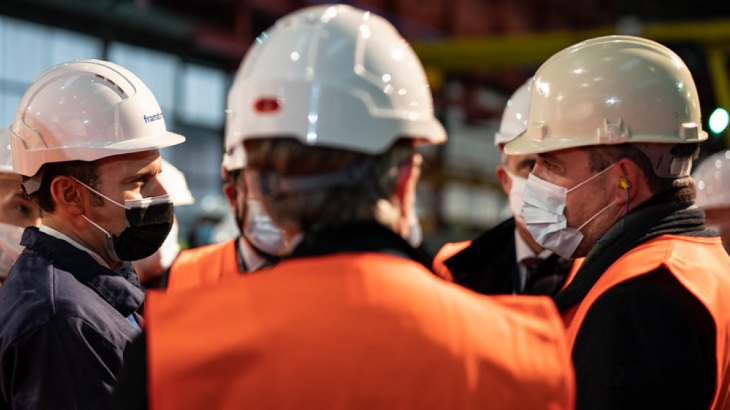
By generating more than 41% of the energy in France, "nuclear makes us autonomous", Macron said. "It also preserves French purchasing power, with a kWh on average 40% cheaper than in our European neighbours." Nuclear energy must therefore "continue to be a pillar" of the French energy mix "for decades to come", he said. French nuclear know-how is exported all over the world and has a trade surplus of EUR7 billion and this "major asset needs to be consolidated".

France is set to dominate the EU market,


France is set to dominate the EU market,

Suggest read the French report and tell me with a straight face you can still say that.
 
The Tiny, Simple Nuclear Reactor That Could Change Energy: https://www.popularmechanics.com/technology/infrastructure/a30225278/tiny-nuclear-reactor/

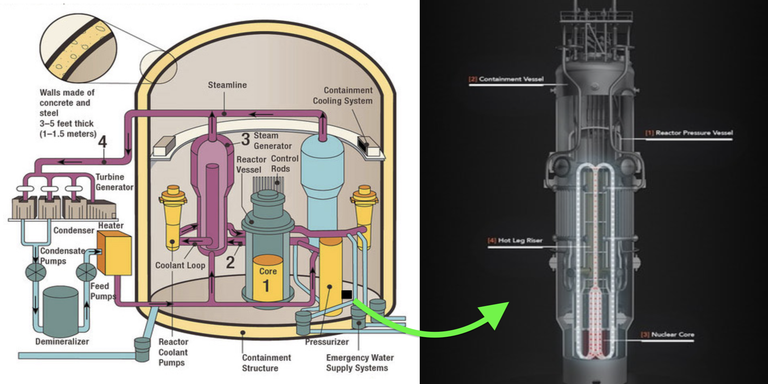
reactors-1576272645.png


"... In the NuScale reactor, a core is kept cool by circulating normal fresh water, as happens in today’s operating nuclear plants on a much, much larger scale. Inside huge nuclear towers, most of the space is dedicated to cooling. The NuScale reactor uses gravity and buoyancy to naturally circulate the cooling water. The size difference is staggering: “About the size of two school buses stacked end to end, you could fit around 100 of them in the containment chamber of a large conventional reactor,” Wired reports. The reactor technology itself isn’t completely different than before, it’s just wildly more efficient and up to date.

The Byron plant generates 2,450 megawatt electrical (MWe) with two gigantic traditional towers. The largest reactors in the world top out at about 8,000 MWe. Each NuScale reactor rates 60 MWe, which sounds small because the reactor is small by design. Plants can install dozens at a time. ..."
 
Top
Sign up to the MyBroadband newsletter
X