


Dolby
Honorary Master
- Joined
- Jan 31, 2005
- Messages
- 39,231
- Reaction score
- 6,201
For some of the owners that may not have seen this sneak in ...
 www.victronenergy.com
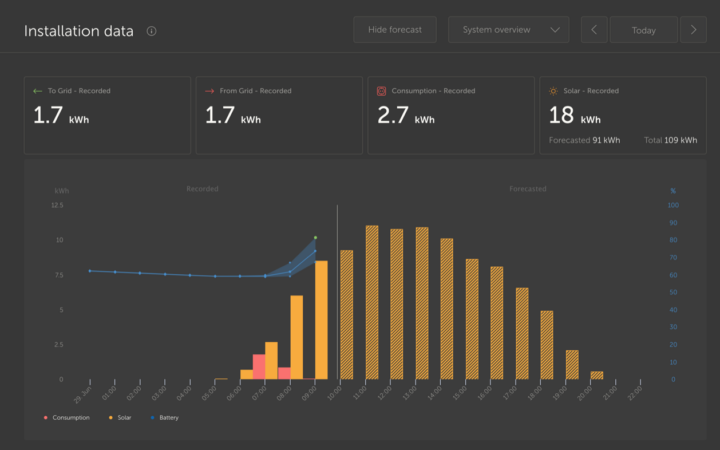
This feature combines a model of your sites solar production potential with irradiance forecasting data from Solcasts global fleet of weather satellites. This feature uses location data as a 4 km² grid, and doesn’t link any personally identifiable information or co-ordinates of your Victron site. This is accurate enough for the solar data while still maintaining your location privacy. We have created a machine learning model that compares historical solar production and the irradiance at the time of day and then calculates the future projected solar production based on the estimated irradiance forecast. This automatically takes into account factors like system sizing, panel orientation & pitch, efficiency degradation, and shading without requiring any user input.
This means that over time the model will get more accurate, even as panels degrade and trees grow. The model goes even further, accounting for when MPPT trackers were at maximum production, or limiting themselves (for example when batteries are full in an off-grid system). In addition to the dashboard estimate, we also have the underlying Solar Irradiance Forecast (W/m²) available as a new advanced VRM widget
Introducing Solar Production Forecast - Victron Energy
VRM Solar Forecasts combines Victron's model of your sites solar production potential, and integrates irradiance forecasting data from Solcasts global fleet of weather satellites.
www.victronenergy.com
This feature combines a model of your sites solar production potential with irradiance forecasting data from Solcasts global fleet of weather satellites. This feature uses location data as a 4 km² grid, and doesn’t link any personally identifiable information or co-ordinates of your Victron site. This is accurate enough for the solar data while still maintaining your location privacy. We have created a machine learning model that compares historical solar production and the irradiance at the time of day and then calculates the future projected solar production based on the estimated irradiance forecast. This automatically takes into account factors like system sizing, panel orientation & pitch, efficiency degradation, and shading without requiring any user input.
This means that over time the model will get more accurate, even as panels degrade and trees grow. The model goes even further, accounting for when MPPT trackers were at maximum production, or limiting themselves (for example when batteries are full in an off-grid system). In addition to the dashboard estimate, we also have the underlying Solar Irradiance Forecast (W/m²) available as a new advanced VRM widget


