ARM introduces their first 64-bit processor architecture

As for the ARM 64 notion, I don't honestly see it really working for ARM. I suspect to be entirely honest that its a bit of a chicken game between ARM and Intel on the whole Atom routine. Microsoft is extending major support to ARM and a clash of the small processors is brewing. Even if 64 bit word lengths has no real benefits the marketing hype is sure to have some spin. Although I still think that there is a major gap waiting in the old-fashioned hard core workstation market.

Ooh I see a market for them:

http://www.theregister.co.uk/2011/11/01/hp_redstone_calxeda_servers/

Sorry way to much text to post, but basically its server racks filled with ARM cpu's. if you look at parallel computing I dont think Intel will be able to come close.

Imagine a rack filled with em puppy's
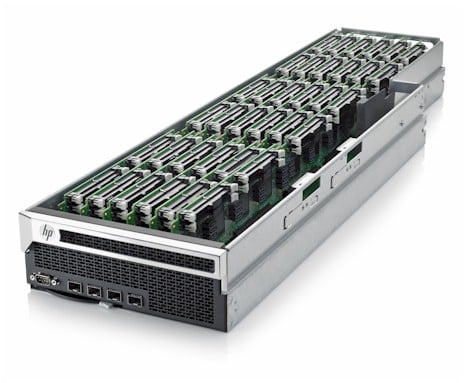
hp_redstone_server_tray.jpg
hp_redstone_chassis.jpg


That gives you 288 server nodes in a 4U rack space, or 72 servers per rack unit. That's 20 per cent more server density than the alpha test machine from Calxeda could do earlier this year with very early samples of its ARM chips.
 
Ooh I see a market for them:

http://www.theregister.co.uk/2011/11/01/hp_redstone_calxeda_servers/

Sorry way to much text to post, but basically its server racks filled with ARM cpu's. if you look at parallel computing I dont think Intel will be able to come close.

Imagine a rack filled with em puppy's
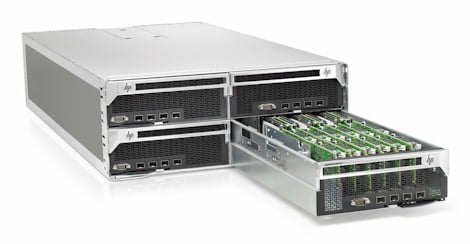
hp_redstone_server_tray.jpg
hp_redstone_chassis.jpg

Would be interesting to see a performance benchmark on those machines but I find it difficult to believe they'll beat Xeons and Itaniums on raw FLOP performance. The big issue that comes to mind is that if you want to parallelise that much, you want to crunch a lot of data and the best way to do that is to just get a few GPGPUs (like nVidia Tegra). A few of those will easily beat the ARM system mentioned.
 
The problem with the extended beast ARM puppies for parallel is that they simply don't stack up to a POWER based architecture.

The idea of a array of inexpensive ARM devices operating in parallel makes a ton of sense - which is partly why I think ARM is playing the game of hype somewhat.
 
Does anyone else think that ARM could actually be a bigger threat to AMD then Intel? Intel's niche is mainstream performance computing. ARM's is mobile devices. ARM will gradually scale up in performance, while Intel will scale down for mobile. Where does that leave AMD? Somewhere in the middle where it will be crushed on two fronts? Or perhaps HPC with its emphasis on extreme parallel processing? On that front, AMD would have compete with IBM's Power architecture.

AMD unable to compete with Intel on raw processing power is trying to change the game by focusing on integration between CPU and GPU. Well Nvidia is doing the same, but doing it with ARM. The Tegra's got multiple, low power ARM cores paired with Nvidia GPU technology. As ARM scales up, what will AMD be left with?

For now, ARM and x86 are kept separated by desktop vs mobile operating systems... but just wait... when Microsoft releases Windows and Office for ARM, and Apple starts putting ARM into Macbooks...
 
Ooh I see a market for them:

http://www.theregister.co.uk/2011/11/01/hp_redstone_calxeda_servers/

Sorry way to much text to post, but basically its server racks filled with ARM cpu's. if you look at parallel computing I dont think Intel will be able to come close.

Imagine a rack filled with em puppy's
hp_redstone_server_tray.jpg
hp_redstone_chassis.jpg
The K Computer, built by Fujitsu, currently combines 68544 SPARC64 VIIIfx CPUs, each with eight cores, for a total of 548,352 cores
Of the top 500 Super computers a total of 19 systems on the list are using GPU technology

The entry level to the list moved up to the 40.1 Tflop/s mark on the Linpack benchmark, compared to 31.1 Tflop/s six months ago.
The last system on the newest list was listed at position 262 six months ago. This turnover rate has steadily increased during the last few lists and is now above average.
Total combined performance of all 500 systems has grown to 58.88 Pflop/s, compared to 43.7 Pflop/s six months ago and 32.4 Pflop/s one year ago.
The average concurrency level in the TOP500 is 15,550 cores per system, up from 13,071 six months ago and 10,267 one year ago.
The U.S. is the leading consumer of HPC systems with 256 of the 500 systems (down from 274). The European share (125 systems ) is still larger than the Asian share (103 systems – up from 84). Dominant countries in Asia are China with 62 systems (up from 42) and Japan with 26 systems (unchanged). In Europe, Germany, UK, and France are almost equal with 30 (26), 27 (24), and 25 (26) respectively.
http://www.top500.org/lists/2011/06/press-release
 
Does anyone else think that ARM could actually be a bigger threat to AMD then Intel? Intel's niche is mainstream performance computing. ARM's is mobile devices. ARM will gradually scale up in performance, while Intel will scale down for mobile. Where does that leave AMD? Somewhere in the middle where it will be crushed on two fronts? Or perhaps HPC with its emphasis on extreme parallel processing? On that front, AMD would have compete with IBM's Power architecture.

AMD unable to compete with Intel on raw processing power is trying to change the game by focusing on integration between CPU and GPU. Well Nvidia is doing the same, but doing it with ARM. The Tegra's got multiple, low power ARM cores paired with Nvidia GPU technology. As ARM scales up, what will AMD be left with?

For now, ARM and x86 are kept separated by desktop vs mobile operating systems... but just wait... when Microsoft releases Windows and Office for ARM, and Apple starts putting ARM into Macbooks...
ARM didn't start off in the mobile world IIRC the Acorn Archimedes ran an Advanced RISC Machine II. We are now on ARM v7 or something.

The idea that ARM will offer up competition to AMD has several areas and I don't think AMD will be driven out of all markets: I do think ARM will take out Geode or whatever AMDs Atom player is called, the major area of this horse will be ruled by Intel Atom (which will have the x86 notion carried) and big bad ARM systems. I doubt however that ARM will bring out machines that can keep the PC gamers happy and the console manufacturers will probably use various processor platforms and ARM won't get a major hold. Don't forget AMD owns Ati and nothing stops them from implementing ARM processors if it serves them well.

One thing to remember about ARM, it doesn't make processors it has designs. This means that the platform lends itself very well to systems developers who want to build specific systems. Apple will probably quite seriously look at the prospects of going with an ARM solution although whether they will platform switch for their Mac line is a different story. Intel used to be an ARM player but left largely while promoting their Atom solution. I don't think any exclusively ARM processor fab company will be able to escape being a niche player.
 
Intel can almost stick a complete motherboard on their cpus and their heading for 16nm. One of these days they will take on Nokia where you can OC your smartphone lol
 
I think Nokia has a few very useful insurance policies including a Microsoft partnership. A key to Intel's success has been the adoption of Intel's mainstream line by software implementers (compare to MIPS etc ...). Nokia has recently abandoned a collaborative project with Intel (Meego) although I suspect they have more to sit comfortably around the table on.

Microsoft's expanding support to ARM processors in the PC world is significant (and will probably include sourcing technology or human capital from Nokia) will give Intel a bit to ponder on although I do see a lot of gameplay at hand. Most significantly of course is Nokia's big patent library and ownership of Qt - which gives it the power to have big proprietary discussions with players.
 
It looks like Apple will be switching to AMD's fusion based chips in their MacBooks. If apple switch maybe the other oems will stop being so scared of Intel and we can start seeing some real competition in the cpu market. The problem with Intel is they know nothing of graphics, 10 years ago they knew nothing of graphics and in 10 years time they will still know nothing of graphics, Jobs said it himself; Intel is slow to innovate. NVidia + Arm and AMD + ATI. I got an AMD E350 Lenovo laptop, got it for R3000 new. And the things that I can do on that little chip, 1080P video, StarCraft 2, a little left for dead, some counter strike, don’t need no I7. Just a little cpu with a nice GPU in the same 18W packages. Maybe Arm can bring balance to the force and bring an end to those horrible Celeron laptops with the Intel 3000 graphics everybody is buying.

Think about it: Everybody said COPE would take the DA’s votes in the 2009 election but ended up taking that of the ANC and the DA did almost twice as good. (Disclaimer: no political whoopla intended)
 
Top
Sign up to the MyBroadband newsletter
X