-
- News
-
Categories
- 5G
- ADSL
- AI
- Banking
- Black Friday
- Broadband
- Broadcasting
- Business
- Business Telecoms
- Cellular
- Cloud and Hosting
- Columns
- Cryptocurrency
- Energy
- Enterprise
- Fibre
- Gadgets
- Gaming
- Government
- Hardware
- Industry News
- Internet
- Internet of Things
- Investing
- IT Services
- Motoring
- Reviews
- Science
- Security
- Smartphones
- Software
- Technology
- Telecoms
- Trending
- Wireless
- Press Office
- Forum
- Industry News
- What's Next
- Company hub
- Speed Test
- About us
- Advertise with us
- Contact
- Careers


-
Join the MyBroadband community
South Africa’s biggest forum. Discuss, discover, and connect with thousands of members.
-
Question of the Day: Will you be subscribing to the new Disney+ R49 streaming package?

- Forums
- General discussions
- Motoring and Transportation: Cars, Bikes and Plane
- General Motoring News and Reviews
You are using an out of date browser. It may not display this or other websites correctly.
You should upgrade or use an alternative browser.
You should upgrade or use an alternative browser.
Bentley Mulliner Batur
- Thread starter FiestaST
- Start date


FiestaST
Honorary Master
FiestaST
Honorary Master
Bentley Batur starts testing ahead of 2023 launch
Mulliner-built limited-run special packs 730bhp W12 but design previews new-era EV
Bentley has begun testing of its new, ultra-low-volume Mulliner coupé, the Batur, which previews how its future electric models will look.
The launch of the limited-run car also signals the end of production for the ubiquitous 6.0-litre Crewe-built W12 engine that has powered its cars for 20 years.
Now the car, limited to just 18 units, is undertaking 58 weeks of European testin, with Car #0 taking on an extensuive 1553-mile drive from Germany, through Italy, France and Spain. The Batur will reach its first customer in mid-2023.
It is a two-door fixed-head coupé based on the underpinnings of the latest, longer-wheelbase Bentley Continental GT launched in 2018 and is powered by the punchiest W12 ever, still under development but claimed to make at least 730bhp and 740lb ft of torque. This will make it Bentley’s most potent road car yet.
To go with its mighty engine, the Batur offers Bentley’s most advanced chassis available, as well as Bentley Continental GT Speed-level tuned three-chamber air suspension, 48V electric active anti-roll control, an electronic limited-slip differential (with torque vectoring) and unique 22in wheels with rear steering.

 www.autocar.co.uk
Mulliner-built limited-run special packs 730bhp W12 but design previews new-era EV
Bentley has begun testing of its new, ultra-low-volume Mulliner coupé, the Batur, which previews how its future electric models will look.
The launch of the limited-run car also signals the end of production for the ubiquitous 6.0-litre Crewe-built W12 engine that has powered its cars for 20 years.
Now the car, limited to just 18 units, is undertaking 58 weeks of European testin, with Car #0 taking on an extensuive 1553-mile drive from Germany, through Italy, France and Spain. The Batur will reach its first customer in mid-2023.
It is a two-door fixed-head coupé based on the underpinnings of the latest, longer-wheelbase Bentley Continental GT launched in 2018 and is powered by the punchiest W12 ever, still under development but claimed to make at least 730bhp and 740lb ft of torque. This will make it Bentley’s most potent road car yet.
To go with its mighty engine, the Batur offers Bentley’s most advanced chassis available, as well as Bentley Continental GT Speed-level tuned three-chamber air suspension, 48V electric active anti-roll control, an electronic limited-slip differential (with torque vectoring) and unique 22in wheels with rear steering.
Bentley Batur starts testing ahead of 2023 launch | Autocar
Mulliner-built limited-run special packs 730bhp W12 but design previews new-era EV
www.autocar.co.uk
FiestaST
Honorary Master
Bentley’s W12 engine confirmed to bow out in 2024 with Batur
Production of the twin-turbocharged engine will stop next year as firm moves towards Beyond100 strategy
Bentley will end production of its famed W12 engine after producing the most powerful ever version for the ultra-limited-edition Bentley Batur.
Production of the twin-turbocharged unit will stop in April 2024 as the British firm looks to accelerate its move towards its Beyond100 strategy, under which every Bentley model will be electrified by 2030.
Bentley will now focus its efforts on its V8 and V6 hybrid line-up and will convert its W12 production line to an “expanded area” for these powertrains.
When production ends next year, more than 100,000 examples of the W12 will have been produced since it was introduced in 2003.
The final 6.0-litre W12 will power 18 Mulliner-crafted Batur coupés, with updated intake, exhaust and cooling systems. Producing 739bhp and 737lb ft, it will be the most powerful ICE ever fitted to a production Bentley,
The engine also gains a redesigned turbocharger compressor, with new ducts that are 33% larger than before, in addition to a new transmission calibration.
https://www.autocar.co.uk/car-news/new-cars/bentley’s-w12-engine-confirmed-bow-out-2024-batur
Production of the twin-turbocharged engine will stop next year as firm moves towards Beyond100 strategy
Bentley will end production of its famed W12 engine after producing the most powerful ever version for the ultra-limited-edition Bentley Batur.
Production of the twin-turbocharged unit will stop in April 2024 as the British firm looks to accelerate its move towards its Beyond100 strategy, under which every Bentley model will be electrified by 2030.
Bentley will now focus its efforts on its V8 and V6 hybrid line-up and will convert its W12 production line to an “expanded area” for these powertrains.
When production ends next year, more than 100,000 examples of the W12 will have been produced since it was introduced in 2003.
The final 6.0-litre W12 will power 18 Mulliner-crafted Batur coupés, with updated intake, exhaust and cooling systems. Producing 739bhp and 737lb ft, it will be the most powerful ICE ever fitted to a production Bentley,
The engine also gains a redesigned turbocharger compressor, with new ducts that are 33% larger than before, in addition to a new transmission calibration.
https://www.autocar.co.uk/car-news/new-cars/bentley’s-w12-engine-confirmed-bow-out-2024-batur
FiestaST
Honorary Master
Bentley Will Build its Last 12-Cylinder Engine Ever in April 2024
The British automaker says its legendary W12 engine will be replaced by V8s and hybrid V6s as the company aims for full electrification.
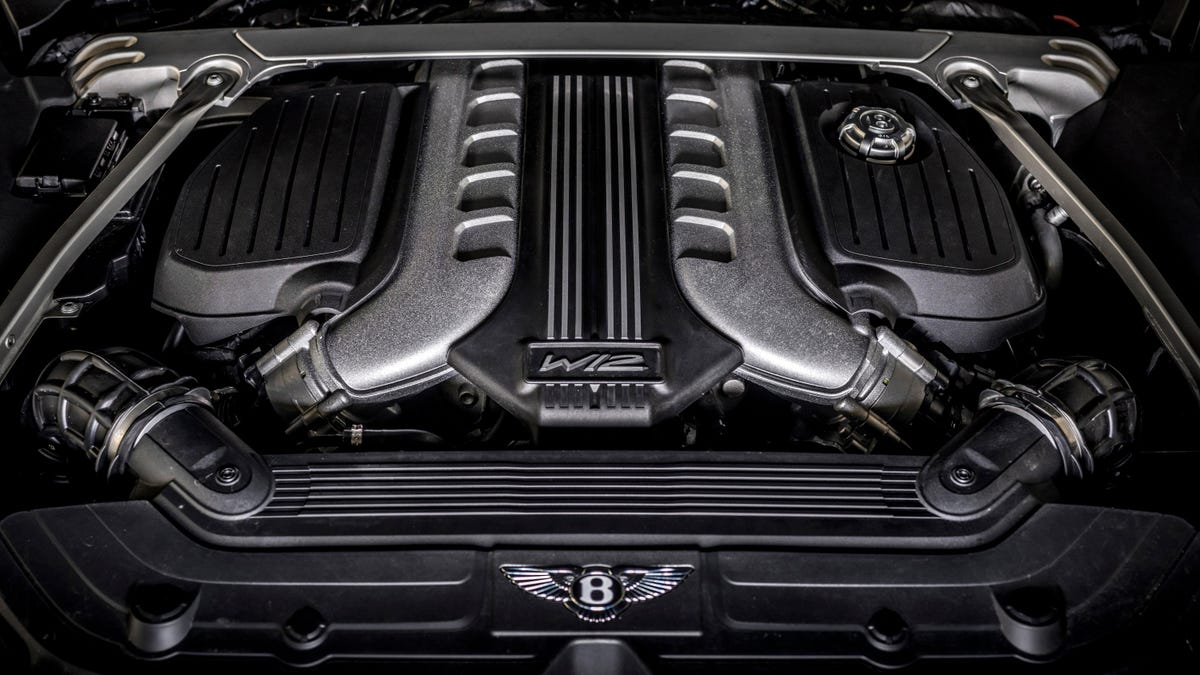
The W12 engine is one of the most unconventional powerplants in recent automotive history. Essentially two narrow-angle V6s merged together at the crankcase, it makes it possible to fit 12-cylinder power in a space not much bigger than you’d need for a V6. The W-configuration engine is a signature Volkswagen Group innovation, having appeared in 8-, 12-, and 16-cylinder forms throughout VW Group’s many brands. Now, Bentley is announcing that it will end W12 production in April 2024, capping off an era that began in 2003 with the brand’s first 6.0-liter twin-turbo W12.
Bentley said in a press release that, when the final W12 rolls off the assembly line next year, the company will have built more than 100,000 examples of the compact 12-cylinder engine. The British automaker also claims that, in the nearly 20 years since it began producing W12s, it has improved the engine’s horsepower output by 37 percent, torque by 54 percent, and reduced emissions by 25 percent.
But there’s no room in Bentley’s “Beyond100" sustainability strategy for a honking 12-cylinder. The company hopes to have its entire lineup “fully electrified by the start of the next decade,” said today’s press release, reducing fleet average emissions to zero grams of CO2 per mile. “Electrified,” in this case, means hybrids to start, the W12 being replaced with V8s, plug-in hybrid V6s, and eventually, full EVs. Bentley is the last automaker in the VW Group portfolio to use the W12, so this is well and truly the end of the line for this engine.
Of course, the beefy W12 won’t go out without a celebration. Bentley previously announced the ultra-limited-edition Batur, a hyper-expensive machine powered by the company’s most powerful W12 yet, cranking out 740 horsepower and 737 lb-ft of torque. Just 18 examples of the Batur will be built, and as is usually the case with cars like this, they’re all sold out already — which no doubt contributed to Bentley having its best year ever in 2022.
 jalopnik.com
The British automaker says its legendary W12 engine will be replaced by V8s and hybrid V6s as the company aims for full electrification.
The W12 engine is one of the most unconventional powerplants in recent automotive history. Essentially two narrow-angle V6s merged together at the crankcase, it makes it possible to fit 12-cylinder power in a space not much bigger than you’d need for a V6. The W-configuration engine is a signature Volkswagen Group innovation, having appeared in 8-, 12-, and 16-cylinder forms throughout VW Group’s many brands. Now, Bentley is announcing that it will end W12 production in April 2024, capping off an era that began in 2003 with the brand’s first 6.0-liter twin-turbo W12.
Bentley said in a press release that, when the final W12 rolls off the assembly line next year, the company will have built more than 100,000 examples of the compact 12-cylinder engine. The British automaker also claims that, in the nearly 20 years since it began producing W12s, it has improved the engine’s horsepower output by 37 percent, torque by 54 percent, and reduced emissions by 25 percent.
But there’s no room in Bentley’s “Beyond100" sustainability strategy for a honking 12-cylinder. The company hopes to have its entire lineup “fully electrified by the start of the next decade,” said today’s press release, reducing fleet average emissions to zero grams of CO2 per mile. “Electrified,” in this case, means hybrids to start, the W12 being replaced with V8s, plug-in hybrid V6s, and eventually, full EVs. Bentley is the last automaker in the VW Group portfolio to use the W12, so this is well and truly the end of the line for this engine.
Of course, the beefy W12 won’t go out without a celebration. Bentley previously announced the ultra-limited-edition Batur, a hyper-expensive machine powered by the company’s most powerful W12 yet, cranking out 740 horsepower and 737 lb-ft of torque. Just 18 examples of the Batur will be built, and as is usually the case with cars like this, they’re all sold out already — which no doubt contributed to Bentley having its best year ever in 2022.
Bentley Will Build its Last 12-Cylinder Engine Ever in April 2024
The British automaker says its legendary W12 engine will be replaced by V8s and hybrid V6s as the company aims for full electrification.
jalopnik.com
FiestaST
Honorary Master
Official: Bentley will stop building its ‘iconic’ W12 engine in 2024
And in its place will come an expanded area for building hybrid V8 and V6 motors
Bentley has announced production of its 6.0-litre W12 engine will come to an end next year.
It’s part of the company’s mission to level the average emissions across its entire range of cars to 0g/km of CO2 from 2030 onwards. Building a monster twelve-cylinder petrol leviathan – even with its history – is kinda unhelpful to that lofty goal.
And so the big lug’s gotta go. And it is big, in every sense. Six-litres of historic muscle that has, over the years, powered everything from a mid-engined VW concept to an A8, a VW Phaeton and even a Spyker, but most famously they’ve nestled comfortably inside a raft of top-spec Bentleys.
Indeed over the years Bentley has steadily increased the power output of the 6.0-litre by 37 per cent, and torque by 54 per cent, noting how emissions have come down over the same period by 25 per cent. Clearly not enough for the future, of course. The two-decade long evolution of the W12 has taken in oil and cooling redesigns, better turbo tech, better injection and combustion processes and in 2015, a complete overhaul from the ‘sump up’.
The company tells us when it stops building the ‘iconic’ W12 by April 2024, it will have churned out more than 100,000 units over some twenty years.
“When we first launched the W12 back in 2003, we knew we had a mighty engine that would propel both our cars and the brand forwards at speed,” Bentley boss Adrian Hallmark said. “20 years and more than 100,000 W12s later, the time has come to retire this now-iconic powertrain as we take strides towards electrification, but not without giving it the best send-off possible, with the most powerful version of the engine ever created.”
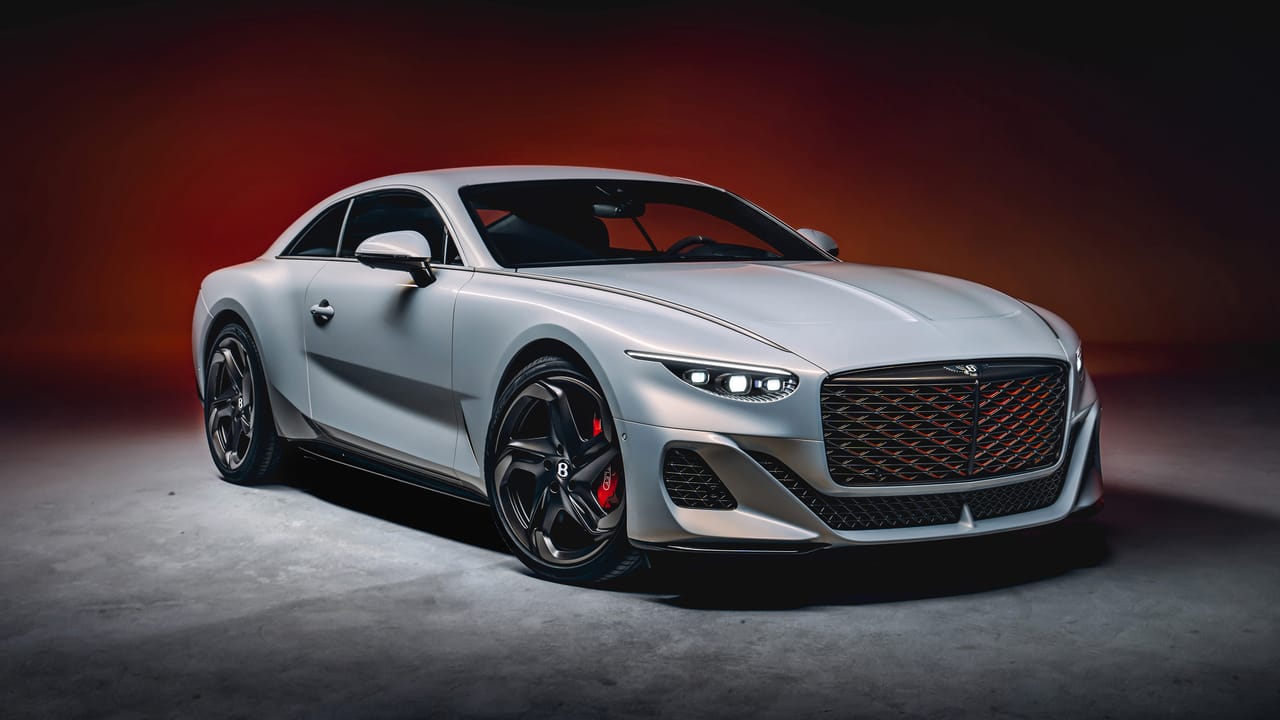
He's pointing to the final act for the W12, where it will sit inside the astonishing Bentley Batur (pictured above) and realise its most powerful iteration – a heady 740bhp and 738lb ft of torque. The power has been liberated via bigger turbo ducts, redesigned turbo compressors, bigger charge-air coolers and revised engine and transmission calibrations. Should be sprightly, one suspects.
 www.topgear.com
And in its place will come an expanded area for building hybrid V8 and V6 motors
Bentley has announced production of its 6.0-litre W12 engine will come to an end next year.
It’s part of the company’s mission to level the average emissions across its entire range of cars to 0g/km of CO2 from 2030 onwards. Building a monster twelve-cylinder petrol leviathan – even with its history – is kinda unhelpful to that lofty goal.
And so the big lug’s gotta go. And it is big, in every sense. Six-litres of historic muscle that has, over the years, powered everything from a mid-engined VW concept to an A8, a VW Phaeton and even a Spyker, but most famously they’ve nestled comfortably inside a raft of top-spec Bentleys.
Indeed over the years Bentley has steadily increased the power output of the 6.0-litre by 37 per cent, and torque by 54 per cent, noting how emissions have come down over the same period by 25 per cent. Clearly not enough for the future, of course. The two-decade long evolution of the W12 has taken in oil and cooling redesigns, better turbo tech, better injection and combustion processes and in 2015, a complete overhaul from the ‘sump up’.
The company tells us when it stops building the ‘iconic’ W12 by April 2024, it will have churned out more than 100,000 units over some twenty years.
“When we first launched the W12 back in 2003, we knew we had a mighty engine that would propel both our cars and the brand forwards at speed,” Bentley boss Adrian Hallmark said. “20 years and more than 100,000 W12s later, the time has come to retire this now-iconic powertrain as we take strides towards electrification, but not without giving it the best send-off possible, with the most powerful version of the engine ever created.”
He's pointing to the final act for the W12, where it will sit inside the astonishing Bentley Batur (pictured above) and realise its most powerful iteration – a heady 740bhp and 738lb ft of torque. The power has been liberated via bigger turbo ducts, redesigned turbo compressors, bigger charge-air coolers and revised engine and transmission calibrations. Should be sprightly, one suspects.
Official: Bentley will stop building its ‘iconic’ W12 engine in 2024
And in its place will come an expanded area for building hybrid V8 and V6 motors
FiestaST
Honorary Master
It’s the end of the road for the Bentley W12 engine
In an era of rapid electrification and engine downsizing, 12-cylinder engines are on a fast-track to extinction, and the latest we have to bid farewell to is Bentley’s iconic W12.
The British carmaker has announced that it will end production of its 12-cylinder petrol engine in April 2024, by which time more than 100 000 examples would have been produced in the company’s Dream Factory in Crewe, England.
The decision comes as part of Bentley’s Beyond100 strategy, which will see the company’s entire model line fully electrified by the start of the next decade. This journey has already begun, with the introduction of the Bentayga and Flying Spur Hybrid models for which demand is reportedly exceeding the company’s expectations.
When production of the W12 ceases next year, Bentley’s entire model line will be available with the option of a hybrid powertrain. Meanwhile, an engine first made available in the sector-defining Continental GT, will be consigned to history.
Bentley isn’t letting the W12 bow out without a dramatic send-off. Development work has concluded recently on the most powerful version of the W12 ever created. The ultimate iteration of this mighty engine – destined for just 18 examples of the Bentley Batur to be handcrafted by Mulliner – is now confirmed as developing 552kW and 1000Nm of torque.
In an era of rapid electrification and engine downsizing, 12-cylinder engines are on a fast-track to extinction, and the latest we have to bid farewell to is Bentley’s iconic W12.
The British carmaker has announced that it will end production of its 12-cylinder petrol engine in April 2024, by which time more than 100 000 examples would have been produced in the company’s Dream Factory in Crewe, England.
The decision comes as part of Bentley’s Beyond100 strategy, which will see the company’s entire model line fully electrified by the start of the next decade. This journey has already begun, with the introduction of the Bentayga and Flying Spur Hybrid models for which demand is reportedly exceeding the company’s expectations.
When production of the W12 ceases next year, Bentley’s entire model line will be available with the option of a hybrid powertrain. Meanwhile, an engine first made available in the sector-defining Continental GT, will be consigned to history.
Bentley isn’t letting the W12 bow out without a dramatic send-off. Development work has concluded recently on the most powerful version of the W12 ever created. The ultimate iteration of this mighty engine – destined for just 18 examples of the Bentley Batur to be handcrafted by Mulliner – is now confirmed as developing 552kW and 1000Nm of torque.
FiestaST
Honorary Master
FiestaST
Honorary Master
FiestaST
Honorary Master
New Bentley Batur themed models foretell a more sustainable future for bespoke cars
The Bentley Mulliner Batur was first unveiled in 2022 as an exclusive new creation of the brand’s bespoke division, and one that points the way forward for the British marque’s design language.
And now Bentley is giving us more insight into the way its future models will be made using more sustainable materials, and how customers will personalise them, with the release of four specifically-themed Batur models.
The carmaker’s Colour, Materials and Finishes team have taken inspiration from the cosmos for these new specifications, using space-era materials and finishes.
For instance, Bentley has found an alternative to carbon fibre which, while renowned for being extremely strong and light, is not considered a sustainable material.
Bentley says newer and more natural alternatives to carbon fibre are now possible thanks to high-performance composites made from flax - a sustainable ‘super-fibre’. Known for being strong as well as incredibly light, this material has proved suitable for use throughout the Batur, from the exterior body kit to the internal hard surfaces.
The Bentley Mulliner Batur was first unveiled in 2022 as an exclusive new creation of the brand’s bespoke division, and one that points the way forward for the British marque’s design language.
And now Bentley is giving us more insight into the way its future models will be made using more sustainable materials, and how customers will personalise them, with the release of four specifically-themed Batur models.
The carmaker’s Colour, Materials and Finishes team have taken inspiration from the cosmos for these new specifications, using space-era materials and finishes.
For instance, Bentley has found an alternative to carbon fibre which, while renowned for being extremely strong and light, is not considered a sustainable material.
Bentley says newer and more natural alternatives to carbon fibre are now possible thanks to high-performance composites made from flax - a sustainable ‘super-fibre’. Known for being strong as well as incredibly light, this material has proved suitable for use throughout the Batur, from the exterior body kit to the internal hard surfaces.
FiestaST
Honorary Master
Autocar review of the Batur
FiestaST
Honorary Master
FiestaST
Honorary Master
Top Gear review of the Batur
FiestaST
Honorary Master
WHAT'S THE BENTLEY BATUR REALLY MADE OF? TIME TO LOB IT AT A VOLCANO (AND A STORM)
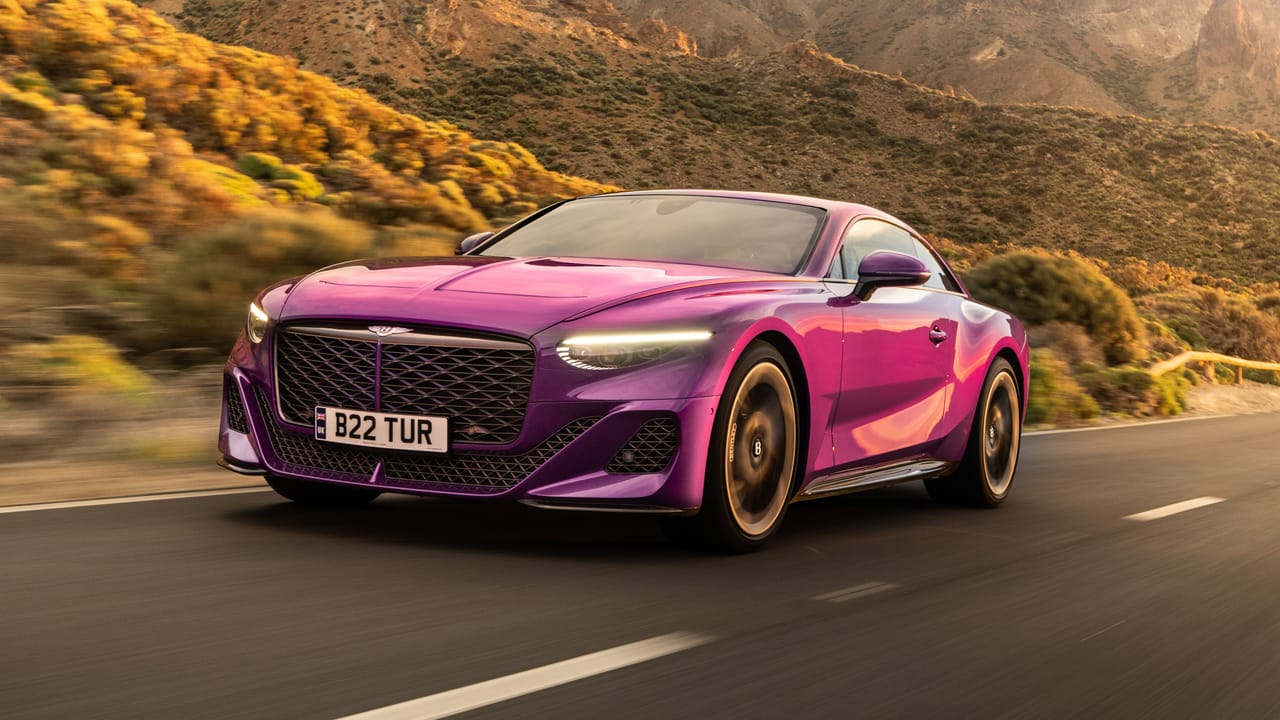
Do you find a standard Bentley a bit... mass produced? Well, meet the very exclusive (and very purple) new Batur
Do you find a standard Bentley a bit... mass produced? Well, meet the very exclusive (and very purple) new Batur


dualmeister
Honorary Master

dualmeister
Honorary Master
I actually prefer the BentleyA Koenigsegg Gemera is the same price as this, why TF would you buy this?

FiestaST
Honorary Master
Both can coexist, 1 is clearly a hardcore intense GT & 1 is focused about pure luxury & prestige.A Koenigsegg Gemera is the same price as this, why TF would you buy this?