CES 2026

I see NVIDIA has allowed their board partners to go crazy with the 5090. MSI and Gigabyte now also have halo products built on that, knowing that the ASUS card is sold out, and see them selling like hotcakes too.
 
Nice thread @Fulcrum29 👌
All the announcements in one place.

Saw a guy already reporting performance metrics for DLSS 4.5 on non-FP8 accelerated cards (pre-40 series).
15-25% drop in performance compared to TransformerV1 on 3080 Ti.
 
NVIDIA dropped DLSS 4.5


For those interested in the whole "Community Update".


There is not much there, but do expect more games to adopt Ray... sorry Path Tracing. This will lean more towards DXR 1.2 and Vulkan (new tech).
 
Nice thread @Fulcrum29 👌
All the announcements in one place.

Saw a guy already reporting performance metrics for DLSS 4.5 on non-FP8 accelerated cards (pre-40 series).
15-25% drop in performance compared to TransformerV1 on 3080 Ti.

I am sure that there will be improvements in time, also as newer technologies are being adopted. It won't be radical, but RTX 20, and 30 could still be in an okay spot. RDNA 1, 2, and 3... they will all be challenged by path tracing. RDNA 1 and 2 should be avoided, and RDNA 3 is in a grey area.

Also when I said improvements, it will only really be applicalbe to new games that are adopting the new tech stacks, as well as those that could be updated. All I know is, some GPUs will start to rapidly age.
 
RTX 20, and 30 could still be in an okay spot.
It's worse. This is the frame time table from the official Nvidia DLSS programming guide so devs can gauge what to expect.

New DLSS 4.5 is doubly slow on 20 and 30 series. Not looking good. The issue with this is that there are only two ways to achieve higher quality with new transformer models. Bigger model, or smaller quants. There's no real way for performance to improve on 20 and 30 series, and soon 40 series when Nvidia naturally moves DLSS down to FP4.

1767703095646.png

Also when I said improvements, it will only really be applicalbe to new games that are adopting the new tech stacks, as well as those that could be updated. All I know is, some GPUs will start to rapidly age.
The 40 series will be the big loser. FP4 is going to be a sort of big wall for a while. FP1 and FP2 are just not there yet. Nvidia's plans out to 2027 (Vera Rubin) are still leaning on FP4, and the 50 series is the first consumer generation to implement acceleration for it.

 
It's worse. This is the frame time table from the official Nvidia DLSS programming guide so devs can gauge what to expect.

New DLSS 4.5 is doubly slow on 20 and 30 series. Not looking good. The issue with this is that there are only two ways to achieve higher quality with new transformer models. Bigger model, or smaller quants. There's no real way for performance to improve on 20 and 30 series, and soon 40 series when Nvidia naturally moves DLSS down to FP4.

View attachment 1875882


The 40 series will be the big loser. FP4 is going to be a sort of big wall for a while. FP1 and FP2 are just not there yet. Nvidia's plans out to 2027 (Vera Rubin) are still leaning on FP4, and the 50 series is the first consumer generation to implement acceleration for it.

Those are rough estimations that aren't dependent on a game engine and its integrations. Not all engine implementations work the same. The guide you see there is NVIDIA running the DLSS library without a 3D renderer. Though I can agree that it is still indicative as to what execution times can be expected, varying GPU to GPU, this can still be optimised per architecture. It is not a best case scenario, other tech stacks will also have its impacts coming with pros and cons. There is also documented usage to reduce the allocated memory which could improve latencies.

It is also worth noting that Blackwell has bespoke hardware that its predecessors don't have. Naturally it will be excel at some OptiX applications.

RTX 20 is now more than 6 years old, I think it released in late 2018. RTX 30 is 2020.

Six years... architecture does have its limits, and there is only that much you can do to optimise pipelines on the driver end. Is the 2080 Ti even a 1440p capable path tracing GPU? I don't think so.

9FHRJbciTpV4d1MyjQwUej6nYIVCYDombhHS9IhV.gif
 
It is also worth noting that Blackwell has bespoke hardware that its predecessors don't have. Naturally it will be excel at some OptiX applications.
The whole MFG thing, which I very much like.

RTX 20 is now more than 6 years old, I think it released in late 2018. RTX 30 is 2020.

Six years... architecture does have its limits, and there is only that much you can do to optimise pipelines on the driver end. Is the 2080 Ti even a 1440p capable path tracing GPU? I don't think so.

9FHRJbciTpV4d1MyjQwUej6nYIVCYDombhHS9IhV.gif
Thing is, even with Preset K... I mean...it's pretty damn good. A 20/30 user really shouldn't be dooming. Sure it's not the latest but who cares.

And now we have rumours that Nvidia are restarting 3060 production....?

Speaking of VRAM usage, Nvidia still have neural texture compression in the works, as if this post it's at version 0.9.1 with the big hold up being Microsoft's cooperative vector release. That's expected to reduce VRAM usage by 4-6x. But again, that's even more load on an ever heavier tensor pipeline. Also slated for 40/50 series.
 
The whole MFG thing, which I very much like.


Thing is, even with Preset K... I mean...it's pretty damn good. A 20/30 user really shouldn't be dooming. Sure it's not the latest but who cares.

Yes, but we have reached a point where rasterisation is not the be-all. Though newer GPUs are better at raster, logical reasoning is becoming ever more crucial.

And now we have rumours that Nvidia are restarting 3060 production....?

They would only consider doing so where it is viable.

Speaking of VRAM usage, Nvidia still have neural texture compression in the works, as if this post it's at version 0.9.1 with the big hold up being Microsoft's cooperative vector release. That's expected to reduce VRAM usage by 4-6x. But again, that's even more load on an ever heavier tensor pipeline. Also slated for 40/50 series.

I have discussed that in the AMD Radeon thread. I don't think that it is MS holding them back, but that it is a cooperation between NVIDIA, Intel and AMD. Cooperative Vectors have only recently been introduced to RDNA 4. Let's say that NVIDIA are way ahead with the Shader Model. Intel and AMD don't have OMM, and only have SER workarounds. MS can't advance their Agility SDK without leaving Intel and AMD behind. Vulkan is now also getting there.

This is NVIDIA's RTX Kit technical blog,


and their RTX NTC SDK:


The NTC system requirements are a interesting quote:

System Requirements​

Operating System:
  • Windows 10/11 x64
  • Linux x64
Graphics APIs:
  • DirectX 12 - with preview Agility SDK for Cooperative Vector support
  • Vulkan 1.3
GPU for NTC decompression on load and transcoding to BCn:
  • Minimum: Anything compatible with Shader Model 6

  • Recommended: NVIDIA Turing (RTX 2000 series) and newer.
GPU for NTC inference on sample:
  • Minimum: Anything compatible with Shader Model 6 (will be functional but very slow)

  • Recommended: NVIDIA Ada (RTX 4000 series) and newer.
GPU for NTC compression:
  • Minimum: NVIDIA Turing (RTX 2000 series).
  • Recommended: NVIDIA Ada (RTX 4000 series) and newer.
[*] The oldest GPUs that the NTC SDK functionality has been validated on are NVIDIA GTX 1000 series, AMD Radeon RX 6000 series, Intel Arc A series.

Nvidia also have non-Cooperative Vectors DX12 decompression. This will come with cons, it enables compatibility, but at a big cost. Reading their SDK's NVIDIA is transparent, and is not hiding anything and I hope that tech reviewers are sharper than they make themselves out to be.
 
I am going OT now, and this to my knowledge isn't yet introduced in the main AMD Radeon branch. This is AMD's MS Agility SDK dev driver:


Highlights​

  • Expanded AgilitySDK Support
    • AMD Radeon™ RX 7000 and 9000 series graphics products will support:
      • Advanced Shader Delivery
        • Target AMD’s plugin DLL directly using --plugin <Your_Path>\amdxc64.dll
    • Application-Specific Driver States (PIX)
    • Fence Barriers
    • Shader Execution Reordering 
      • Limitation: “MaybeReorderThreads” does not move threads
    • Tightening Placed Resource Alignment
    • Tiled Resource Tier 4
  • Only AMD Radeon™ RX 7000 series graphics products will support: 
    • Video Encoding Update to DDI 112  with the following features:
      • Video encode subregion (e.g slice/tile) notifications
      • Video encode GPU texture input QP map
      • Video encode Dirty map full frame skip
      • Video encode GPU texture/CPU buffer motion vector hints
    • AppSpecificDriverState + RecreateAtGPUVA
  • Only AMD Radeon™ RX 9000 series graphics products will support:
    • Cooperative Vectors 1.0

I have already made my remarks about this in the AMD Radeon thread. Looking at those highlights RDNA 3's shader cores should still have some legs. The question though, and I have asked AMD directly without receving a response is whether RDNA 3 could and will support Cooperative Vectors.

RDNA 3 being able to support all that, also having the ability to do SER (though with limitations) I can't see it not having FSR "Redstone" though it would have to be dependent on the INT8 model. That model can be improved, and I am sure AMD did.

There is also some things on that list some said RDNA 3 can't do. It is a dev driver...
 
I am also starting to pity the tech reviewers. They have long had an emphasis on gaming, and now gaming is the third wheel. Their reporting is akward. Taking digs at AI won't keep them relevant. Odd pivots coming up. At a time they hated upscaling, then they hated FG, and now it is all comparitive reviews. The market moves.

I am concerned with gaming becoming spoiled by AI assistants. I don't have an issue with it in general, but in competitive gaming it could potentially become pay to win. Now some would argue that there are better keyboards, mice, headsets, and hardware, but they do not provide in-game assistance, except those peripherals that enable scripting. Peripherals that allow scripting are disallowed at most esports events.

All in all I am not against it as it does have its place, but that place isn't everywhere. As long as it can be localised I am good with it. Just don't use it to cheat against other human players.
 
So it's not that Preset M/L is meant to supersede Preset K completely but rather be alternate 'better' choices aimed at specific quality presets.

1767712488298.png

So Preset K (TransformerV1) is still the preferred choice when using DLAA/Quality/Balanced.
Preset M (TransformerV2a) is meant for Performance mode.
Preset L (TransformerV2b) is meant for Ultra Performance mode.

That makes sense then for them to be heavier than Preset K. A heavier model but used at lower qualities, so you still get some of the performance benefit but much better (lets assume) image quality than with Preset M\L at Perf and UltraPerf settings. This makes much more sense as to why Preset L is so heavy in NVIDIA's documentation.
 
Last edited:
ASUS's (non-ROG) launch event will be in an hour at 19h00.


Do expect AI and mobility. This is what CES 2026 is all about. Many things seen now at CES 2026 are things already seen at CES 2025, but improved. Nothing revolutionary, yet.
 
ASUS's (non-ROG) launch event will be in an hour at 19h00.


Do expect AI and mobility. This is what CES 2026 is all about. Many things seen now at CES 2026 are things already seen at CES 2025, but improved. Nothing revolutionary, yet.
I would lol if they announced 1st-party DRAM.
 
HyperX has partnered with Nuerable to make a gaming headset that is supposedly made to make a gamer to be "locked-in." Everyone who has reported on this has stated to have had their aim and reaction time improved by it. I am saying it now, it is not the headset, nor the exercise. It is because there is a pattern to the AimLabs demo.

It doesn't take two runs to improve. Stop being paid shills. That headset needs some time with its user, and the exercises need to be repeated.
 
Lenovo's keynote is during the early morning hours.


There agenda seems to be all AI, since this is what they want their audience to see:
  • Hybrid AI Advantage to help business succeed in their AI adoption
  • Agentic AI powered by Lenovo and Nvidia
  • Partnerships to bring smarter AI to everyone
More hybrid AI talk, more agentic AI talk, and more AI to make people smarter every day...

From every vendor I have seen, it seems that almost everyone is partnering with Intel. This is a sign that AMD is pivoting towards enterprise. Intel targets the business consumer void. Time will tell.
 

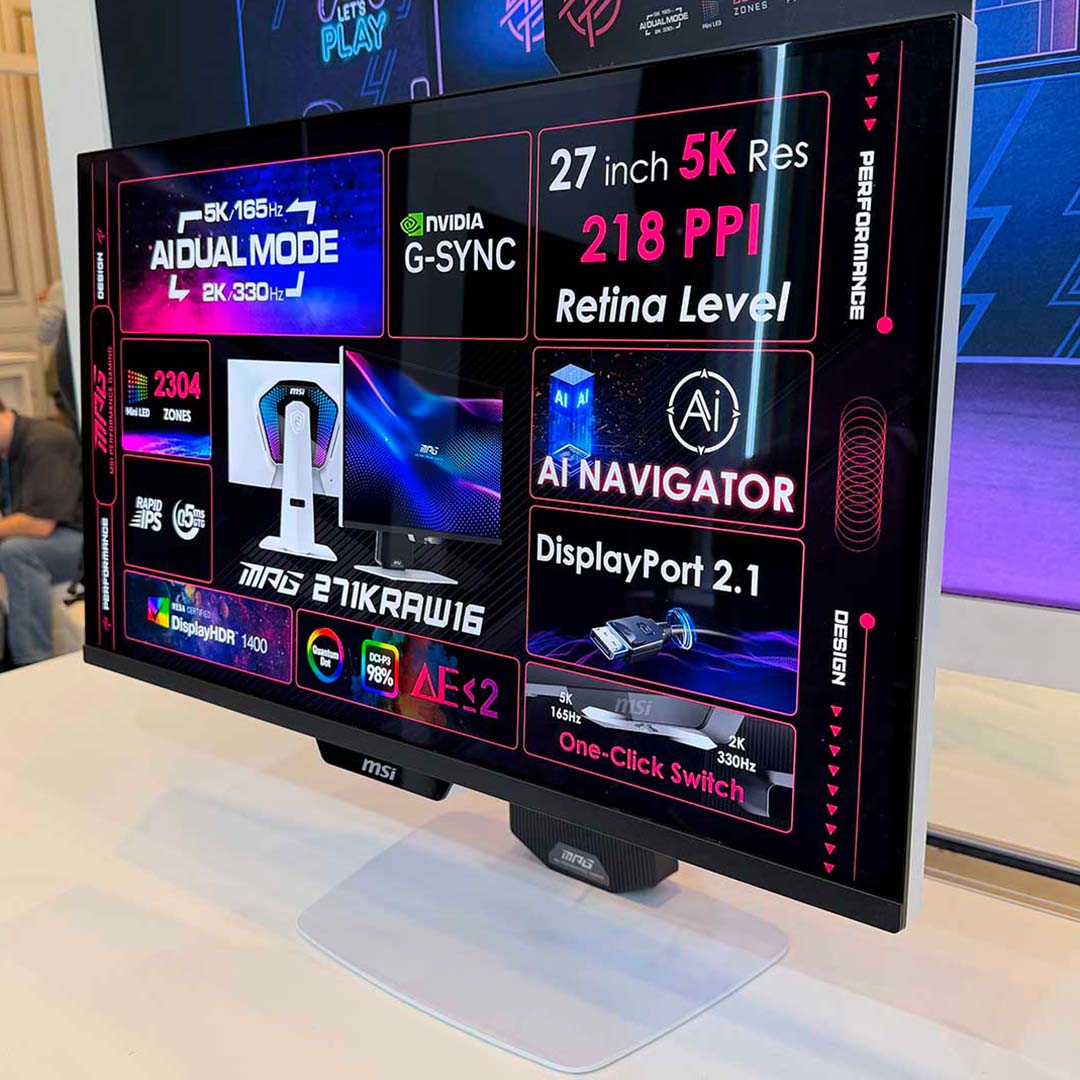
Where the MEG X separates itself from its close relative is in its AI features. In addition to the AI Care Sensor, the monitor boasts on-screen smarts that aim to improve visual fidelity as well as provide you with competitive advantages. Without spoiling too much, you’ll want to keep the latter tech strictly offline.

There are six features that make up the suite with MSI recommending the majority of them for first-person. ‘AI Tracker’ automatically highlights enemies, while ‘AI Goggle’ saves your screen from the blinding effects of a flashbang. Meanwhile, ‘AI Scope’ automatically zooms in for more precise aiming, and ‘AI Gauge’ purportedly provides an indication as to enemy health states. How well all this works remains a bit of a mystery, but hey, I’ll try anything once.

MSI knowingly recommends users only enable these features for single-player titles, as many of them inarguably come close to sounding like outright cheats for competitive environments. However, the remaining two options are less detrimental to your standing against anti-cheat measures.

Oh, my...
 
The Siemens keynote is slated to be a good one:


They are very much involved in everything.
 
Top
Sign up to the MyBroadband newsletter
X