CSGO Sticky thread

Seeing how challenged FACEIT is, I don't want to know what is going with the public Valve CS servers.
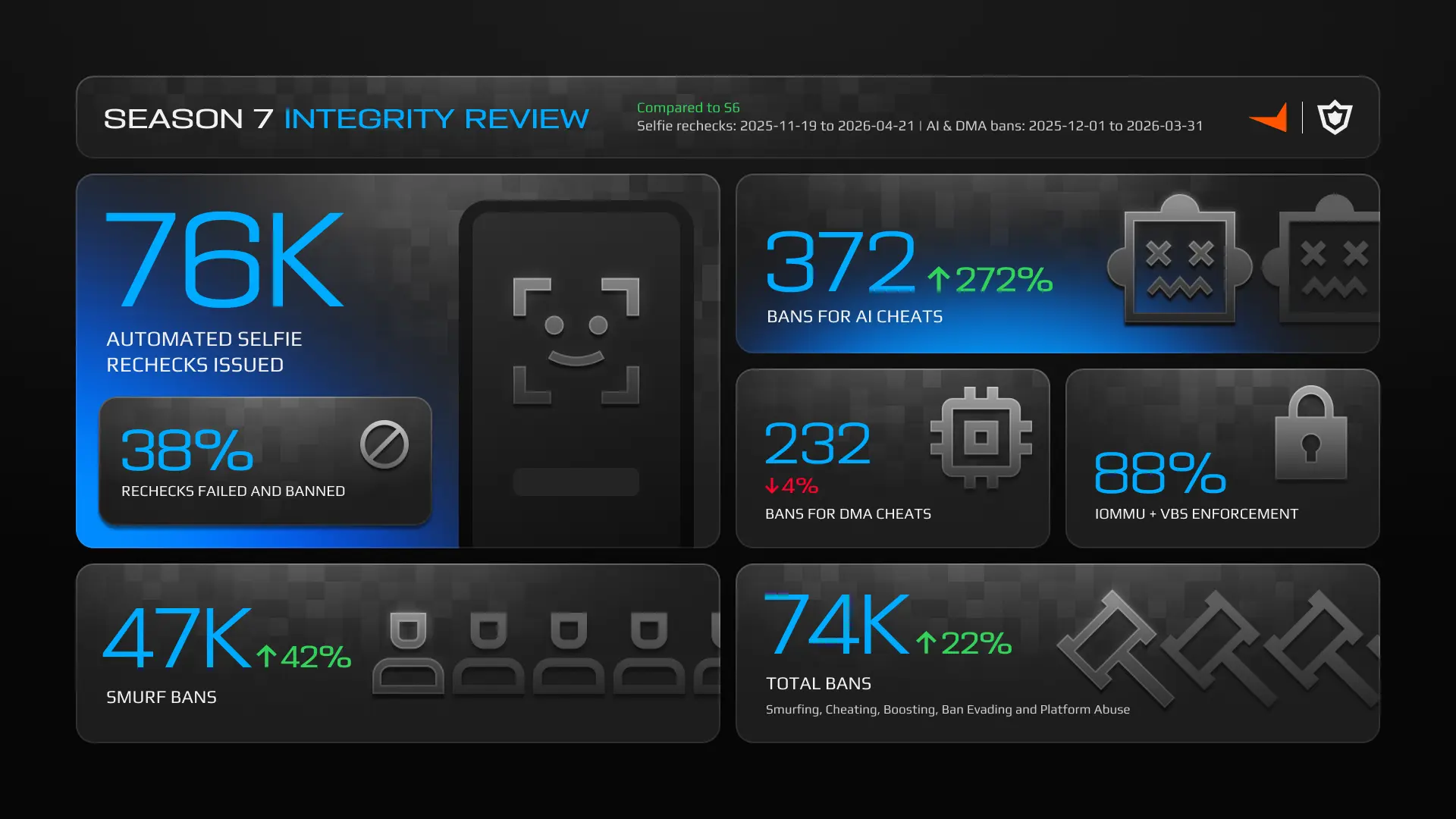
Integrity_S7_Review_16_9_1_892ae3daf6.webp


Seasonal Integrity Report: Season 7 Review and Season 8 Update

This is our first Seasonal Integrity Report detailing the enforcement actions taken to detect and block cheating, smurfing, and account abuse during Season 7 (November 19, 2025, to April 21, 2026), alongside the Integrity updates that went live on April 22 for Season 8.

Season 7 smurfing bans increased by 42% and cheating bans by 14% compared to Season 6, driven by new detection techniques. The data below also includes our first enforcement results from automated selfie re-checks and the expansion of our Advanced Windows Security Settings requirement rollout, which helps block the communication channels used by DMA hardware. For Season 8, we are expanding selfie re-checks and requiring an active Anti-Cheat connection for all identity verifications to disrupt account selling.

Season 8...

Season 8: What's New​

Last week, we banned 23,680 smurf accounts to return Elo before Season 8’s placement matches began. We are issuing additional selfie re-check waves in the coming weeks to accounts flagged since the previous cycle. The FACEIT Anti-Cheat client must now be active to complete identity verification. This directly links ID verification to a specific device, combating account sharing and reselling.

DMA hardware has become so good now, and is almost untraceable. I am not surprised that by that 4% decrease, however, DMA can be used in several ways. It is common to use AI, or rather ML, cheats using DMA hardware. There are several other internal, external and hardware cheats that aren't caught. What about the macro peeps?

Valve has seemingly given up on anti-cheat. Shame. This is the problem that I have with competitive esports titles: it really only caters to the tier 1 pros. FACEIT also has competition now, smaller gaming league services that do manual checks, but in time they will grow too.
 
Riot Games released a Vanguard update that 'bricks' DMA cards. It is known that they worked with motherboard vendors to solve a complex problem. People are overreacting like mad. This doesn't break your PC, neither does it break the DMA card.

You have three options when your system is detected using a DMA card and is then bricked:

1. Remove the DMA card, and resume as per normal, OR
2. Keep the DMA card installed, and reinstall Windows, OR
3. Remove the DMA card, uninstall Vanguard, reinstall the DMA card, and resume as per normal.

Alternatively, wait until the DMA vendor issues an update, and continue cheating as per the usual.

Why am I posting this here? Well, there are some big names weighing in against Riot Games decision. Many are within the Linux, and org, communities. Nobody wants kernel-level anti-cheats, and we know that Linux doesn't support kernel anti-cheats and that the maintainer community has pushed back against such anti-cheats. Then I have to ask them, why so mad about DMA cards being blocked??? Sure they know what these DMA cards can potentially expose your system to? I get it, installing a DMA card is the user's choice, but still, it raises many questions.

How many people out there are cheating in multiplayer games or games with any public rankings?

**** cheaters.
 
If only Valve was so dedicated:


Detecting AI cheats has been one of FACEIT's biggest focuses in 2026.

Recently, several of our anti-cheat developers, data scientists, and staff spent two days at the Google London office, building on that work alongside their engineers.

We collaborated with Google's team to evolve two of our current approaches:

1. Training models on past matches where our anti-cheat confirmed players cheated, learning to recognize similar patterns elsewhere.
2. Modelling what normal play looks like to flag behavior that sits outside it.

FACEIT processes millions of CS2 matches a month, with years of high-level gameplay on record. That scale creates a foundation our detection models can learn from.

Before these techniques can be applied to the full FACEIT player base, there is still more work to do. We're running new behavioral analysis in the next months, building an automated pipeline of confirmed-cheating data for our models to learn from, and improving how we capture more supporting data for the context of kills.

We will continue to collaborate with Google’s engineers and share more information as these detection methods are rolled out across the platform.

I am curious what they define as an AI cheat. Is it a cheat that is trained/developed by AI or one that requires inference? Is it related to internal, external, hardware cheat or any combination of those?

Even some memory trainers are now referred to as AI cheats. Still, it is noble of FACEIT, because Valve is doing niks, and they have all of the data of every player.

Not to mention that there is an abundance of free cheats now on GitHub, many of which are meant for hardware, so it is not like they don't have access to the methods used. Sure they are subscribing to the anti-cheats themselves for investigation. Then standard scripting and macros, which peripheral makers do not support this today?

Everytime something is tuned a bit too harsh, there are ban waves littered with false flags. It can be certain that many considered false flags were, in fact, cheating. How do they fix this? Nobody who is cheating, especially if they are making dosh from it, will admit that they are cheating. Once you are in, there is no way out.
 
Top
Sign up to the MyBroadband newsletter
X