Depreciation on laptops

JNG

Active Member
Joined
Apr 2, 2011
Messages
55
Reaction score
0
Location
Cape Town, South Africa
Does anyone know what the depreciation on laptops is?

An example:
James joins a Company and receives a laptop. The Company bought the laptop for R10,000. After 2 years James is leaving and is offering the option of buying the laptop. What is a fair price for James to pay?
 
If im not mistaken for actual IT equipment depreciation in our company is done in 12 months.
 
I think SARS allows 3 years straight line depreciation.
 
If cost is under a certain amount(think R7000 or something?) you can write it off in 1 year for tax purposes..
Correct (the amount could differ from company to company). But a company would be wiser to use the "concession" to write it off over 3 years as allowed by SARS.
 
For tax purposes, 3 years.
If the cost is less than R7000, for tax purposes, it is all deductible immediately.
For accounting purposes, its purely up to company policy, although if it differs from the SARS interpretation note, its going to have deferred tax consequences.
 
For tax purposes, 3 years.
If the cost is less than R7000, for tax purposes, it is all deductible immediately.
For accounting purposes, its purely up to company policy, although if it differs from the SARS interpretation note, its going to have deferred tax consequences.

I agree, best to keep it inline with SARS as deferred tax is a pain!
 
I work for a bank and know for a fact that we do it in 3 years. My last laptop broke after 3.5 years and when they saw the book value was 0 they just got me a new one. Still, why is he offering a price? The company should know the assets book value and be telling him a price, not the other way around.
 
I work for a bank and know for a fact that we do it in 3 years. My last laptop broke after 3.5 years and when they saw the book value was 0 they just got me a new one. Still, why is he offering a price? The company should know the assets book value and be telling him a price, not the other way around.
If he offers a higher price they make a profit on the asset disposal! Bloody shysters....
 
If he offers a higher price they make a profit on the asset disposal! Bloody shysters....

...no

In essence all that does is correct the over/under depreciation based on estimate/policy in the first place.

E.G. Laptop costs R10 000. Company pays cash of R10k upfront.

Regardless of what depreciation policy I have those are the upfront costs and cash outflows.

1. Depreciate over 3 years and sell for R1000 at end of life (Book Value = 0).
Expenses over 3 years = R10 000
Profit on sale = R1000
Net = R9000 expensed through IS

2. Depreciate over 5 years and sell at end of year 3 for R1000. Book Value = R4k
Expense for 3 years = R6000 (R10k/5X3)
Loss on sale = R3000
Net = R9000 expensed through IS

3. Depreciate it over 3 years with a residual of R1k (Book Value = R1k)
Expense for 3 years = R9000
Profit = 0
Net = R9000 expensed through IS

It doesn't matter what policy you use, whether it is too fast or too slow, once the sale realises it is all the same.

There are tax/timing (Deferred Tax) considerations but the company isn't profiting or making more money or ripping of the employee if they charge more than book value...

To understand it more simply, regardless of the depreciation number chosen, Cash outflow in Year 0 is R10k and cash inflow from Sale is R1k. Net is R9k outflow of cash.

Cash is king! Accounting is accounting and finance is finance.
 
Last edited:
Does anyone know what the depreciation on laptops is?

An example:
James joins a Company and receives a laptop. The Company bought the laptop for R10,000. After 2 years James is leaving and is offering the option of buying the laptop. What is a fair price for James to pay?

Fair price is the market value of the laptop not whatever book value the company has.

Try find a similar laptop (Specs/Make/Model) on classifieds and whatever other people are asking and make an offer in that range.

If company is asking for more, then don't buy. If they are asking less, then possible bargain. Like any other product.

Don't get confused by accounting jargon such as depreciation or some such nonsense. Just think about how you would approach any other offer.
 
Now sell it for R5000 i.s.o. R1000

2. Depreciate over 5 years and sell at end of year 3 for R1000. Book Value = R4k
Expense for 3 years = R6000 (R10k/5X3)
Loss on sale = R3000
Net = R9000 expensed through IS
 
Your forgetting the perceived value of the asset by the company. A lot of company's may depreciate the asset over 3 years for tax and accounting, however they will still use the asset for another year or 2. I worked for a company that did that, Laptops/Desktops replaced after 4 years, servers after 5 years. So if Johnny wants to by the laptop in months 25, then he would have to pay 50%, so the company doesn't lose the use of that asset for another 2 years.
 
Yep, just because the asset is depreciated on the books there is still the replacement cost. Even if the asset is old if it is still useful then the inherent value of the asset is that it is delaying the cost of its replacement.
 
Now sell it for R5000 i.s.o. R1000

Ok. Same scenario as before but now each time we sell it for R5k. I'll just give the net answer in each scenario. The book value at the end of the life is the same as the examples I used earlier but now the company sells it for R5k.

1. NBV = 0; Expense = (R10k); Profit = R5k; Net = (R5k) Loss/Expense
2. NBV = R4k; Expense = (R6k); Profit R1K; Net = (R5k) Loss/Expense
3. NBV = R1k; Expense = (R9k); Profit = R4k; Net = (R5k) Loss/Expense

As I said before, you, like the OP are confused as to what depreciation means and why there is such a concept in accounting.

What matters is cashflows. If the company spends R10k and sells for R5k, the net difference is R5k. Depreciation is a NON-CASH concept (Excl. cash/timing effects of tax consequences). Which means the companies depreciation policy is IRRELEVANT to the buyer of the laptop.

It is economics. The company can ask WHATEVER it wants for the laptop. Anyone with ANY common sense would compare their asking price, against similar laptops with similar specs in order to understand whether or not the laptop is worth the asking price.

Hell the company can have a "perceived value" (@ warwickw) of R10 million for a P4 1.8 Ghz Machine and a book value of R10 million for that machine. If a similar laptop in the market is going for R100, then you would offer at most R100 (barring any other considerations).

Let me give you some insight into accounting... all it is, is an attempt to take information about a business and put numbers to this information in order to make it meaningful.

When a company buys an asset, the reason why it is not an expense is because realistically there is a difference, economically between something that is consumed (E.G. Chocolate/Food) and something that is not consumed, hence despite in both cases cash will flow out, only in the latter is the thing acquired "consumed" immediately and thus an expense.

The rational behind depreciation is to recognise/convey to users of financials, the consumption or use of an asset over time. What benefits can I expect to get from the use of this asset...and when do I expect to receive those benefits.

A laptop is normally used consistantly for a period of time, hence the use of the asset or benefits associated with its use will be earned over time thus the cash outflows are "expensed" consistantly over that period.

Companies are required UPFRONT to ESTIMATE how long they expect to use the asset, and when they are finished with it, what will be the value of the asset. Since it is an estimate, sometimes the estimate is off and you might replace it earlier than expected or later than expected.

@ warwickw: No. Financial decisions are not done based on accounting policy! DO NOT MAKE THIS MISTAKE!

Let me take your example used to make you understand.

End of month 24 (Assuming R10k cost of laptop) means the NBV of the asset will be R5k. Which means for the company not to make an "accounting" loss it would charge R5k. Why? Because if it still estimates it will use the laptop for 2 years, then the company is saying it can still get R5k worth of use of the laptop, it values the benefits of the laptop as being R5k.

Another company might "value" the laptop differently and its value might be more or less, but as the potential buyer I don't care what "value" you have, the question is, is my valuation similar.

From the companies perspective, if they want to suddenly sell the asset instead of use it, they will try and get back what they lose in benefits, but from the buyers perspective it is not relevant.

Stop trying to complicate things. The OP wanted to know what is a "fair" price. Compare the asking price to the "market" price. If the asking price is more, then the company is asking to much for it. If the asking price is less then it could be a bargain.

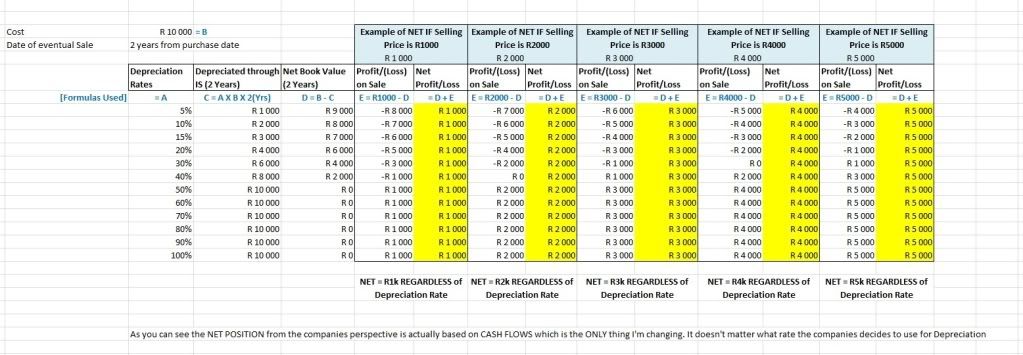
At the end of the day, the depreciation charge is not relevant, the NET answer at the end when the asset is sold will be the same.

See picture for the calcs.

DepreciationExample.jpg
 
"The OP wanted to know what is a "fair" price. Compare the asking price to the "market" price."

Pretty sure this is what he was asking, all you corporate types are looking at it from the companies point of view not poor dear James:) Just look at other laptops with similar specs and offer the company 80 or 90% of the value you find.

But electronics depreciate faster than a lift with it's cables cut...
 
Top
Sign up to the MyBroadband newsletter
X