Is why McLaren looks immune to porpoising?:
https://the-race.com/formula-1/gary-anderson-is-this-why-mclaren-looks-immune-to-porpoising/
"...But McLaren already appears largely to have eliminated the problem thanks to how powerful the vortices running down the side of the underfloor are.
These seal the low-pressure area from the outside world and, by being more energetic than those produced by McLaren’s rivals, make the floor less prone to stalling because they don’t try to seal the floor by running the sides of the floor more or less on ground.
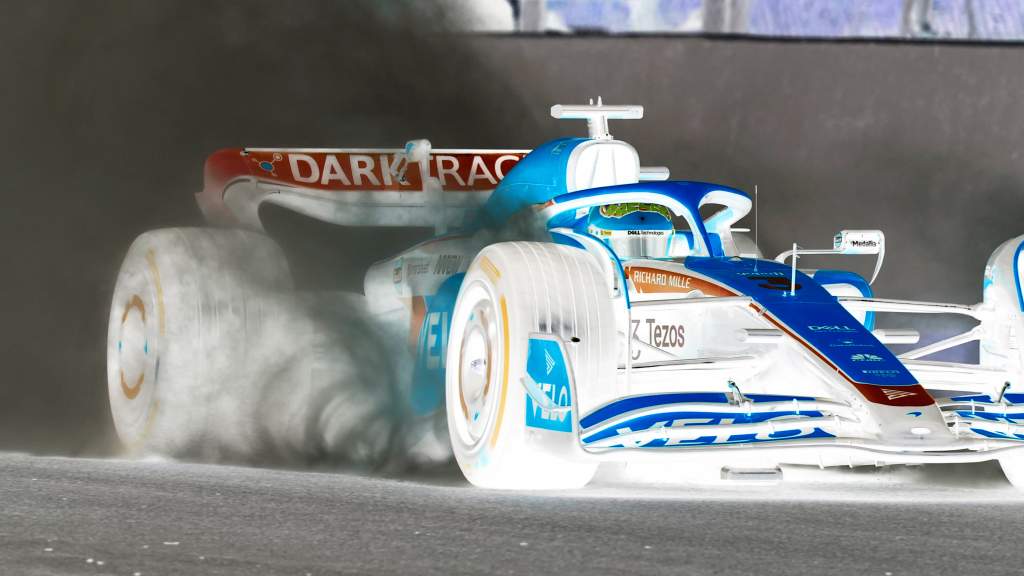
Fortunately, the wet running creates spray and allows us to see exactly what is happening aerodynamically both on and off the car’s surface.
We can take a close look at the McLaren in comparison to the other leading cars from Mercedes, Red Bull and Ferrari to see the effect. Our images have been inverted, a process that flips the light and dark areas, so it is easier to see and understand.
MCLAREN
We can see very clearly how powerful the vortices are as they travel along the sides of the underfloor. Note the clearly-defined clockwise spiralling airflow between the front and rear wheels.
Not only does this improve the sealing of the underfloor, it will also allow McLaren to keep the floor slightly away from the track surface. By doing this you can reduce the risk of porpoising by having that cushion of air between the sides of the floor and the track surface.
You can see this by the darker section that runs horizontally at ground level at the bottom of the spiral. This shows there is more water in the vortex as it pulls airflow out from underneath the car.
It’s also interesting to see how the airflow coming off the outer rear corner of the bargeboard area is now carried upwards and over the top of the floor vortices. This will also be because of the power of the vortices, and it will also help keep them powerful as they travel further rearward.
We often talk about airflow structure along the car and this is a perfect example of what that all means.
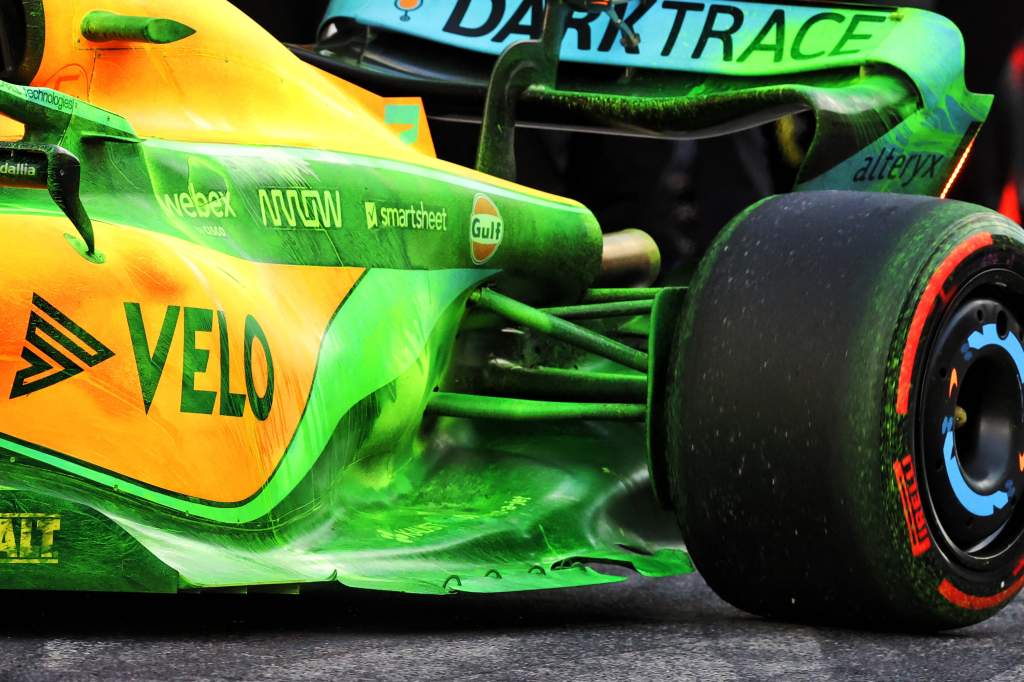
So how is McLaren achieving this? It appears to be through the floor detail, which the team helpfully covered in flow-vis paint, which is very good to show on-surface airflow and how and where the flow lines are generated.
This front section of the McLaren floor is higher than it can be. On this car, we can see the end of the two internal leading edge turning vanes, so this gives it more volume of flow coming out of this section of the floor. This plus the small vertical vane will help set up the powerful vortices we see in the wet running picture.
The small separated wing section halfway along the floor and the intake area near the rear tyre are part of what allows McLaren to have stronger and more consistent vortices travelling down the sides of the car.
This is not too difficult for other teams to copy, but they don’t just work as a standalone unit. They work in conjunction with the rest of the airflow structure, which is not quite as easy to copy.... "




 .
.