Finally, They Admit Renewables Don't Replace Fossil Fuels

Nicodeamus

Honorary Master
Joined
Sep 20, 2006
Messages
14,477
Reaction score
4,530
Bhaskar Sunkara is the founding editor of Jacobin, a socialist magazine, and author of The Socialist Manifesto: The Case for Radical Politics in an Era of Extreme Inequality. He is also an unlikely advocate for nuclear energy.

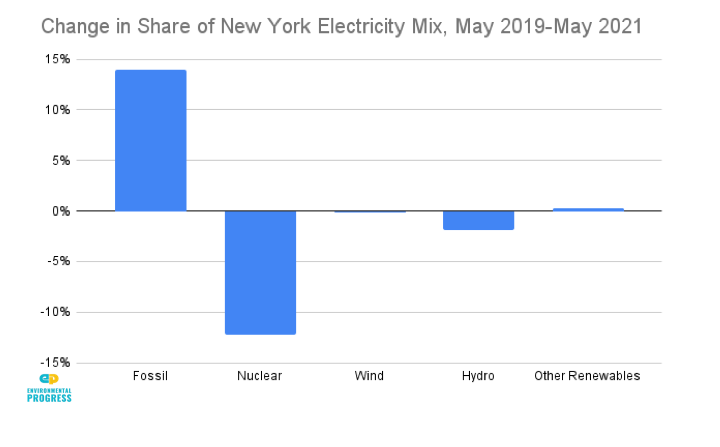
In a new article for The Guardian, Sunkara draws on Environmental Progress research which found that, in its first full month without Indian Point nuclear power plant, New York's carbon emissions from in-state electricity generation rose 35 percent over the state’s pre-covid shutdown levels.


The same analysis found that the carbon intensity of New York’s electricity, the amount of carbon dioxide emissions per unit of electricity, rose 46 percent. And the share of electricity from renewables, including hydroelectric dams, actually declined between 2019 and 2021.

Sunkara’s article comes at a time when a growing number of progressives, socialists, and Democrats are speaking out for nuclear power. A few weeks ago, Emmet Penney, a founding member of Santa Fe’s Democratic Socialists of America (DSA) chapter, noted that “Nuclear plants bring wealth and meaning to their host communities” and, in a turn of phrase that elicited strongly positive responses from readers, Penney added, “They are American industrial cathedrals.”


Part of the reason for growing progressive support for nuclear is because of the research and advocacy of pro-nuclear organizations including Environmental Progress, which has forced renewable energy advocates, and now the industry itself, to admit that solar panels and wind turbines do not substitute for fossil fuels.
 
Dude, what kinda honey boloney sites do you frequent
Nuclear power isn't fossil fuels - what is that headline even.
Nic's a lunatic, there's no point trying to entertain him, he'll post whatever headline suits his narrative, even if they article goes against the point he's trying to make. He works by posting as many links as possible and seeing if one hits and works, then he'll try and take that one and bludgeon you into submission.
 
Nic's a lunatic, there's no point trying to entertain him, he'll post whatever headline suits his narrative, even if they article goes against the point he's trying to make. He works by posting as many links as possible and seeing if one hits and works, then he'll try and take that one and bludgeon you into submission.

Dude needs a hobby.
 
The article speaks about advocacy for nuclear energy. Which is not a fossil fuel.
But then the author suddenly transitions to fossil fuel advocacy. By and large pushing the narrative that, because growing renewable energy deployments have not significantly curtailed the GLOBAL carbon intensity of energy production, renewables are not helping even at the REGIONAL level.
However, this chart clearly shows what's actually going on. In THE WORLD.
1625844227257.png
Electricity generation in all these regions have increased. However if you look, then it is easy to see that there's a marked difference in the trends between the US and EU, ultra large historical emitters. Vs the rest of the world - Especially China. Which, due to building thousands of coal stations since the turn of the century, and having seen dramatic growth in automobile ownership, has dramatically increased it's emissions. Yet the US and EU have both decreased their emissions even while increasing it's electricity generation - i.e. the carbon intensity for both those regions have lowered.

You cannot simply say that renewables are not helping to lower carbon intensity in the US and EU, by looking at the carbon intensity of THE WORLD and one isolated metro in the US (where the situation has hardly even settled I might add). It is even clear that China's carbon emissions growth has been slowing down dramatically since 2010. Likely because it has been deploying renewables at greater scales than the rest of the world combined, even while still building new coal and gas power stations. Simply because it's economy has been growing so quickly. If it's emissions continued to grow at the same rate as it did between 2000 and 2010, then then this graph would need significant head room on the y-axis.

There's a lot of sophistry in the article. Other points of note:
-Electricity from natural gas has played a bigger role in the decline of coal in the US than renewables.
-Market factors: Indian point closed mainly because it could not compete on price. Mainly with natural gas, but for the last few years the cost of both solar and wind, even with utility scale storage linked to it has dramatically decreased. It's operational costs were too high (even though nuclear fuel is relatively cheap - there are many other costs in nuclear power).
-Finally - There has always been huge advocacy from across the entire political spectrum for nuclear. Any advocacy against it has only ever been around public safety and nuclear weapon proliferation. A completely different conversation than the one around carbon intensity. And yes... Also around the cost.

1625846193250.png
(LCOE) is a measure of the average net present cost of electricity generation for a generating plant over its lifetime.

Not so favourable...

And consider this
1625846506566.png
But, but... Why are EVs and utility scale storage prices not decreasing?

Because...
1625846568573.png

The reality is that the question around if intermittent sources can replace base load... Is not really a question of "if". It is a question of "when".
And, the answer: Exactly as soon as battery manufacturing (and that of other potential forms of utility scale storage I might add) meets demand.
And even though business is booming and large (giga, and even soon enough, tera scale) battery factories are in the works, it will be a while.
Batteries are the new plastic. Even battery recycling.

And after all that. I myself have no issue with nuclear power as long as it is safe and economically sustainable.
Plus for all we know, nuclear fusion could become both viable and ultra-cheap in the next few decades. However without it being ultra-cheap... It's prospects will likely be limited to strategic deployment.
 
Last edited:
iu
 
Nic's a lunatic, there's no point trying to entertain him, he'll post whatever headline suits his narrative, even if they article goes against the point he's trying to make. He works by posting as many links as possible and seeing if one hits and works, then he'll try and take that one and bludgeon you into submission.

Johny the evangelist is at it again,

The green narrative and indoctrination has told us for years that heaven is around the corner. The reality is that it just isnt.

The author is a Nuclear advocate, and he oversells a bit. I am just pointing out that the green lobby came to a point where only they predict their own models and forecast. Measured against reality is fell short of the expectations.
 
@The Trutherizer posting gloriously instead of instant rabid condemnation like some other commenters.

I appreciated his comment, but I have disagreements for one LCOE isn't necessarily the best metric.

The point that I am trying to make is that the 100% green greta dream is closer to fantasy than reality.

For one batteries aren't close to where they should be and these systems don't perform as well as they are promised on paper.
 
I appreciated his comment, but I have disagreements for one LCOE isn't necessarily the best metric.

The point that I am trying to make is that the 100% green greta dream is closer to fantasy than reality.

For one batteries aren't close to where they should be and these systems don't perform as well as they are promised on paper.
Superheated Molten Salt ,
 
Nuclear energy today is a far cry from designs from the 1970s and 1980s. Fuel use is more efficient and does not require the same degree of refining

But there is still spent fuel to contend with. The only real solution is to await nuclear fusion, this will no doubt occur in future, but who knows when?
 
The argument for renewable energy vs fossil fuels completely misses the point that for renewable energy to be a viable alternative for fossil fuels it will require a change in lifestyle and the way we use energy.
 
Please fill me in. It’s now cool to slag off renewable energy? Sorry haven’t bumped into anybody IRL condemning the advance and investment in renewables.
 
  • Like
Reactions: ck1
Please fill me in. It’s now cool to slag off renewable energy? Sorry haven’t bumped into anybody IRL condemning the advance and investment in renewables.
Not condemning, but being skeptical. The planet of the humans video is a good start on how bad these projects can he for the environment.
 
Please fill me in. It’s now cool to slag off renewable energy? Sorry haven’t bumped into anybody IRL condemning the advance and investment in renewables.
Every Tom, Dick and Harry out there has been fed a narrative that renewables are a perfect solution to replace the "dirtier" generation methods and seem to regurgitate this ad infinitum. In reality however they are far from perfect replacements, but are a component of a more sustainable power solution.

Pointing this out is not slagging off renewables. It is being realistic about what they are and what they are not.

Unfortunately as this is yet another overly politicized issue where people only seem to want to think in black and white terms.
 
Top
Sign up to the MyBroadband newsletter
X