


I've heard of politicians promising the world, but to promise the moon?
jfk
South Africa’s biggest forum. Discuss, discover, and connect with thousands of members.
I've heard of politicians promising the world, but to promise the moon?
With what money?

Excellent - can Newt be the first to live there.
"It will be American" ?? As far as I know no country can lay claim to any area on the moon.

Just what I am trying to figure out. The US has an economy that is rapidly going to pig-squalor and he wants to shell out who knows how many trillions of borrowed money to do what? :wtf:
They don't. I read recently that 27% of Americans identify as Republicans and 31% as Democrats. Everyone else is completely sick of these clowns.I think you know the answer to that one already
What amazes me is that these people have so much support. Well, it would amaze me if I didn't live in a country run by the ANC.
There's every country that can stop them.The United Nations is nothing without the USA. They are the only remaining superpower in the world. If they want to claim it, there is no other country than can stop them
And they've dramatically scaled back what they do as a consequence.It wouldnt take trillions. Nasa has been doing their thing on about 9-15 billion a year for decades.

Scaled back by increasing it by around a further 2 billion according to wikipedia?And they've dramatically scaled back what they do as a consequence.
Economic impact of NASA funding
A November 1971 study of NASA released by the Midwest Research Institute of Kansas City, Missouri ("Technological Progress and Commercialization of Communications Satellites." In: "Economic Impact of Stimulated Technological Activity") concluded that “the $25 billion in 1958 dollars spent on civilian space R & D during the 1958-1969 period has returned $52 billion through 1971 -- and will continue to produce pay offs through 1987, at which time the total pay off will have been $181 billion. The discounted rate of return for this investment will have been 33 percent.”
A map from NASA's web site illustrating its economic impact on the U.S. states (as of FY2003)
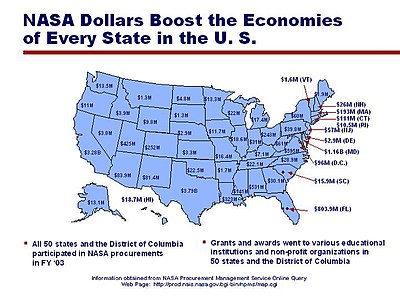
A 1992 article in the British science journal Nature reported:[7]
"The economic benefits of NASA's programs are greater than generally realized. The main beneficiaries (the American public) may not even realize the source of their good fortune. . ."
Other statistics on NASA's economic impact may be found in the 1976 Chase Econometrics Associates, Inc. reports ("The Economic Impact of NASA R&D Spending: Preliminary Executive Summary.", April 1975. Also: "Relative Impact of NASA Expenditure on the Economy.", March 18, 1975) and backed by the 1989 Chapman Research report, which examined 259 non-space applications of NASA technology during an eight year period (1976–1984) and found more than:
— $21.6 billion in sales and benefits;
— 352,000 (mostly skilled) jobs created or saved,and;
— $355 million in federal corporate income taxes
According to the "Nature" article, these 259 applications represent ". . .only 1% of an estimated 25,000 to 30,000 Space program spin-offs."
In 2002, the aerospace industry accounted for $95 billion of economic activity in the United States, including $23.5 billion in employee earnings dispersed among some 576,000 employees (source: Federal Aviation Administration, March 2004).
I'd vote for him if I thought he could pull it off. If as much effort went into space exploration as has gone into war in the last 50 years mankind would be a lot better off as a species. Scientific innovation and invention is the way forward.


To be fair to Gingrich, this is his only cool idea so far.

We should ask VioAdmin, he's a specialist in this area.


