Hydrogen.. the way forward?

I think the future lies in Super Capacitors: http://en.wikipedia.org/wiki/Supercapacitor

It's still being heavily research (primarily because they use materials like Carbon Nanotubes that in itself is still under heavy development), but I read a article that stated some of the current test samples exceed the amount of charge of a battery.

If it is true that will be the car of a future, reason being: Capacitors have near 100% efficiency, they don't degrade nearly as quickly as a battery (you'll probably die before the capacitor is completely degraded, they can be charged and discharged at incredible rates.
 
Hydrogen works, the problem is the distribution networks. You can get electricity just about everywhere, but Hydrogen doesn't exactly grow on trees you know ;)

When automobiles first became available Im sure gasoline didnt grow on trees either and that there wasnt a filling station on every corner either. That didnt stop the internal combustion engine from becoming the most important invention of all time!
 
When automobiles first became available Im sure gasoline didnt grow on trees either and that there wasnt a filling station on every corner either. That didnt stop the internal combustion engine from becoming the most important invention of all time!

Petrol didn't have much to compete against, so they rolled it out as fast as they could.

Currently the cost of Hydrogen is 'about the same' as petrol, and you've already got a tonne of petrol cars on the road. So not only do you have to put up stations with a tiny client base, your client base won't grow fast because there aren't many stations.

Electricity should be significantly easier to roll out, since you already have a pretty good infrastructure in place.
 
What are the different raw materials and quantities needed to build a hydrogen vs EV car (specifically the battery) and would this cause a problem on a larger scale?
 
Electricity should be significantly easier to roll out, since you already have a pretty good infrastructure in place.

But electric cars are like sweeping the dirt under the rug in environmental terms. I too am not an advocate of this technology other than in the absence of better, cleaner alternatives like hydrogen is looking to be.
 
I think the future lies in Super Capacitors: http://en.wikipedia.org/wiki/Supercapacitor

It's still being heavily research (primarily because they use materials like Carbon Nanotubes that in itself is still under heavy development), but I read a article that stated some of the current test samples exceed the amount of charge of a battery.

If it is true that will be the car of a future, reason being: Capacitors have near 100% efficiency, they don't degrade nearly as quickly as a battery (you'll probably die before the capacitor is completely degraded, they can be charged and discharged at incredible rates.

A full recharge on a the Tesla's special 70A/220V charger (15.4kW) charger takes less than 4 hours. Even if you have a supercapacitor, you'll still have to source that power from somewhere. IIRC a small house's mains supply is only 60A/220V. A LiPo battery can charge in less time if you can supply it with more power.

Those supercaps do have a rosy future, but the won't necessarily mean faster charging cars.

The higher energy density would go a long way though, so you'd potentially have 4x the range, or you could drop a lot of weight. Perhaps even swap out packs at home. Leave three on charge, and pop one in the car for your daily commute, or pop all 4 of them in for an extended trip to the coast. If the power distribution is built to embrace this storage, you might run your house of the caps during peak hours, and then they charge during off-peak times.

Charging a cellphone in a few minutes is also pretty handy. And laptops would be proper portable systems ;)
 
But electric cars are like sweeping the dirt under the rug in environmental terms. I too am not an advocate of this technology other than in the absence of better, cleaner alternatives like hydrogen is looking to be.

But where will the Hydrogen come from? It's not exactly clean if you must use 2x as much electricity to generate the H as you would use to charge the batteries.
 
But where will the Hydrogen come from? It's not exactly clean if you must use 2x as much electricity to generate the H as you would use to charge the batteries.

Is that for the same range?
 
But where will the Hydrogen come from? It's not exactly clean if you must use 2x as much electricity to generate the H as you would use to charge the batteries.


Im not sure. Good point and if thats the case then we havent really got a solution yet.
 
Im not sure. Good point and if thats the case then we havent really got a solution yet.

Well, we do in a way. Be it electric or h2, power can in theory be generated from wind or solar, and converted to h2 or stored in a battery. In the short term we can solve the problem with nuclear power. You do end up with radioactive waste, but nuclear power techniques are still advancing and maturing, meaning less waste. In any case, both nuclear or wind/solar have an *almost* zero co2 footprint.
 
Well, we do in a way. Be it electric or h2, power can in theory be generated from wind or solar, and converted to h2 or stored in a battery. In the short term we can solve the problem with nuclear power. You do end up with radioactive waste, but nuclear power techniques are still advancing and maturing, meaning less waste. In any case, both nuclear or wind/solar have an *almost* zero co2 footprint.

Yeah.. the world needs a couple of thousand well designed nuke stations. Turn everything electric. We have the ability to easily make juice.
 
Is that for the same range?

Depending on the weight/size of the system, yes.

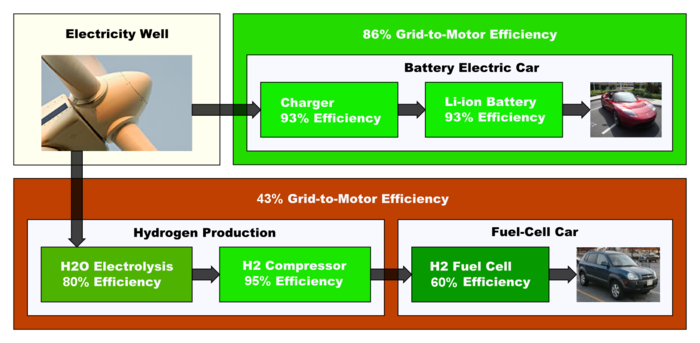
This little diagram was referred to earlier:
700px-Battery_EV_vs._Hydrogen_EV.png


Where you get the energy from doesn't matter, be it coal or cold fusion. If you put 100kWh into the system, you're only going to have 25kWh available in the car with Hydrogen, where Li-Ion can have 86kWh in the car.

Sure some types of batteries might be more difficult to expose of, but according to that little diagram, they're almost 3 1/2 times more efficient in getting from your electricity well to your motor. That's like one car getting 10l/100km and another getting 3l/100km in efficiency terms.

For the paying customer that's the difference between paying R1.00/km and R0.30/km. That's WAY bigger than the difference between petrol and diesel.

Technology changes, but you're going to be hard pressed to get past that H2 Compressor efficiency. Physics doesn't change, and compressing a gas is a fairly low-tech process.

---

What the customer wants is affordability, and ease of use.

The whole 'save the environment' spin is mainly good for publicity and politics, it doesn't really sell the cars.
 
Last edited:
Depending on the weight/size of the system, yes.

This little diagram was referred to earlier:
700px-Battery_EV_vs._Hydrogen_EV.png


Where you get the energy from doesn't matter, be it coal or cold fusion. If you put 100kWh into the system, you're only going to have 25kWh available in the car with Hydrogen, where Li-Ion can have 86kWh in the car.

Sure some types of batteries might be more difficult to expose of, but according to that little diagram, they're almost 3 1/2 times more efficient in getting from your electricity well to your motor. That's like one car getting 10l/100km and another getting 3l/100km in efficiency terms.

For the paying customer that's the difference between paying R1.00/km and R0.30/km. That's WAY bigger than the difference between petrol and diesel.

Technology changes, but you're going to be hard pressed to get past that H2 Compressor efficiency. Physics doesn't change, and compressing a gas is a fairly low-tech process.

---

What the customer wants is affordability, and ease of use.

The whole 'save the environment' spin is mainly good for publicity and politics, it doesn't really sell the cars.

Excellent post.
 
Why bull****?

Cause eventhough it is right, it remains the wrong answer. People like the current way of things and if you can make them fill up with something other than petrol (but they still want to fill up) then it will not be too alien for them and they might just go with it.
 
Cause eventhough it is right, it remains the wrong answer. People like the current way of things and if you can make them fill up with something other than petrol (but they still want to fill up) then it will not be too alien for them and they might just go with it.

So you're saying that it will fail because people will be freaked out by doing a battery swap instead of filling up with fuel in a tank?

I disagree - the cellphone business model didn't fail because people were afraid of buying airtime rather than paying a monthly account. As long as it's easy to keep your car on the road, I reckon the model will be accepted, so as long as there's a good netowrk of charging/swapping stations before EVs go on sale, the EV will be accepted.
 
Cause eventhough it is right, it remains the wrong answer. People like the current way of things and if you can make them fill up with something other than petrol (but they still want to fill up) then it will not be too alien for them and they might just go with it.

Are you serious? You want the next big leap to be an inefficient process just so that it's familiar? People adapt, most people welcome new tech. By your reasoning I should still be sending snail mail as opposed to e-mail.
 
Hydrogen works, the problem is the distribution networks. You can get electricity just about everywhere, but Hydrogen doesn't exactly grow on trees you know ;)

Its even better, it just falls from the sky - all you need is a way to separate the hydrogen atoms.
 
Top
Sign up to the MyBroadband newsletter
X