Intel Core i7-4770K Overclocking, Performance Analysis and Conclusion

Pe-Killer

Expert Member
Joined
Aug 26, 2006
Messages
1,836
Reaction score
20
If you are already the proud owner of a sandy bridge or ivy bridge system then don't bother.

Conclusion

Intel clearly has things other than raw performance on its mind, as you've probably figured by the vast amount of efficiency and power saving-related marketing material preceding today's NDA. An average of a four to 10 per cent increase isn't to be sniffed at, though, but it does mean that the Core i7-4770K, and most likely the Core i5-4670K too, isn't a particularly worthwhile upgrade for those with equivalent Sandy Bridge or Ivy Bridge CPUs.

There are some substantial improvements, particularly in our image editing test over the Core i7-2600K, for example, but the 15 per cent performance lead here is a rare one. For new system builds, however, the choice is clear - there's no point buying an Ivy Bridge system given your upgrade path is about as long as a day in an arctic winter and equivalent Ivy Bridge CPUs cost practically the same and don't offer a lot more by way of overclocking either.

Haswell is a definite and sometimes significant improvement over Sandy Bridge and Ivy Bridge. Somehow the PC enthusiast and overclocker in us hoped for more, though, and it seems we'll once again be hampered by temperature when it comes to overclocking. However, we can't dispute the numbers. If you're after a new system and need a fast hyper-threaded CPU, this is the one to get.

http://www.bit-tech.net/hardware/2013/06/01/intel-core-i7-4770k-cpu-review/8
 
This is a reason that abandoning socket design is not yet as planned... but perhaps still on the cards.
 
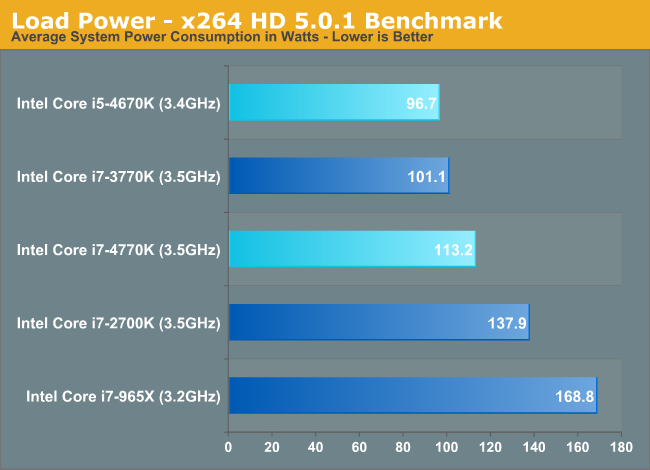
Haswell, pretty much, isn't worth it to overclockers and PC enthusiasts. Its far more convuluted and fraught with nuances and the VRM integration only drives heat up more. At stock, in the best-case scenario, Haswell has a 13% performance lead but uses 12% more power and puts out, on average, 15% more heat. Ivy Bridge is, surprisingly, the better buy.

This is the tipping point. Intel's been scaling up its laptop designs for a while now, but desktop Haswell is not worth the extra heat and it isn't appreciably faster either. Broadwell may improve on this and we'll see improvements to the VRM along with lower power consumption and better heat output, but Haswell isn't that good. The last, great, performance jump was Sandy Bridge. If you're still on a i7-2500K or i7-2600K, don't bother upgrading. Not for the next four years, at least.

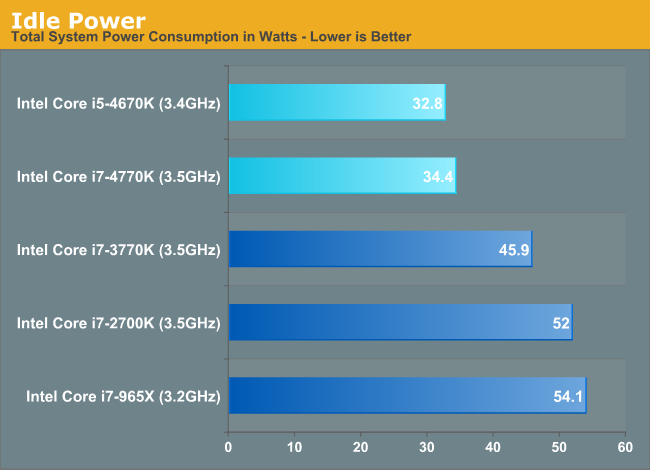
As for the i7 920 and similar owners. Idle and regular power consumption is lower, but you'd only really be upgrading for the better chipset, extra port functionality and better performance in some apps.

Core 2 Duo and Quad guys - this is your upgrade. Not only is Haswell almost twice as fast as your chip, it uses half as much energy.
 
The last, great, performance jump was Sandy Bridge. If you're still on a i7-2500K or i7-2600K, don't bother upgrading. Not for the next four years, at least.

:love: Best buy/priced CPU ever... bought mine at the perfect time... an equivalent performing CPU costs +R1k more now, 2 years later.
 
Haswell, pretty much, isn't worth it to overclockers and PC enthusiasts. Its far more convuluted and fraught with nuances and the VRM integration only drives heat up more. At stock, in the best-case scenario, Haswell has a 13% performance lead but uses 12% more power and puts out, on average, 15% more heat. Ivy Bridge is, surprisingly, the better buy.

This is the tipping point. Intel's been scaling up its laptop designs for a while now, but desktop Haswell is not worth the extra heat and it isn't appreciably faster either. Broadwell may improve on this and we'll see improvements to the VRM along with lower power consumption and better heat output, but Haswell isn't that good. The last, great, performance jump was Sandy Bridge. If you're still on a i7-2500K or i7-2600K, don't bother upgrading. Not for the next four years, at least.

As for the i7 920 and similar owners. Idle and regular power consumption is lower, but you'd only really be upgrading for the better chipset, extra port functionality and better performance in some apps.

Core 2 Duo and Quad guys - this is your upgrade. Not only is Haswell almost twice as fast as your chip, it uses half as much energy.

Yeah sandy bridge is still one of the best. Runs cool and also capable of handling the latest graphics cards with ease.
 
prices not looking good!

4670k R31xx
MSI z87-g43 R17xx

Together about a grand more than their ivy predecessors.

4770k R45xx fuuuuuuuu
 
I had a clannie member ask me about upgrading just yesterday... My answer "What for? Only reason I see at the moment for the 1150 chipset is basically green points for energy saving" I bought my 2600K immediately after they sorted out the motherboard issue. I have mine on a "soft" OC with eis running, so only clocks up when needed. I rarely get near 60C in the hottest summer days. So I'm happy as anything with my setup.....
 
yeah its not worth it if you have a sandy or ivy.

I have an ancient AMD 965 which still is pretty decent but I am more after USB3 etc.
 
Haswell, pretty much, isn't worth it to overclockers and PC enthusiasts. Its far more convuluted and fraught with nuances and the VRM integration only drives heat up more. At stock, in the best-case scenario, Haswell has a 13% performance lead but uses 12% more power and puts out, on average, 15% more heat. Ivy Bridge is, surprisingly, the better buy.

This is the tipping point. Intel's been scaling up its laptop designs for a while now, but desktop Haswell is not worth the extra heat and it isn't appreciably faster either. Broadwell may improve on this and we'll see improvements to the VRM along with lower power consumption and better heat output, but Haswell isn't that good. The last, great, performance jump was Sandy Bridge. If you're still on a i7-2500K or i7-2600K, don't bother upgrading. Not for the next four years, at least.

As for the i7 920 and similar owners. Idle and regular power consumption is lower, but you'd only really be upgrading for the better chipset, extra port functionality and better performance in some apps.

Core 2 Duo and Quad guys - this is your upgrade. Not only is Haswell almost twice as fast as your chip, it uses half as much energy.

You are absolutely right, the performance isn't a great leap from SB or IB, but nevertheless, its still on a new socket and some new technologies.

At first I was doubting myself if I made the right choice building an Ivy Bridge, from Core2Quad since I heard news that Intel will be releasing a new generation of chips but I couldn't wait anymore so I went ahead, and now its pretty clear....the build I have is much cheaper than what Haswell is on offer. Might have to wait another 2 to 3 years before we see a decent leap in performance.
 
... and now I'm happy again that I didn't try to upgrade my i7 920 and 860's yet :D

Yes, I know that the idle power consumption and performance/MHz is a lot better, but it still doesn't justify the cost involved in the upgrade. Also, overclocking the i7 9xx series is way more fun than just fiddling with just the multiplier on SB/IB/HW :)

Perhaps my next upgrade would be back to AMD again I suppose. My previous rig was AMD2600+ (Barton), which was amazing at its time.
 
So glad I bought Sandy Bridge at the time, and didn't wait for Haswell... have had no performance issues at all. Don't see the need to upgrade for a while still, especially now that I am running Linux...
 
Yes, I know that the idle power consumption and performance/MHz is a lot better, but it still doesn't justify the cost involved in the upgrade. Also, overclocking the i7 9xx series is way more fun than just fiddling with just the multiplier on SB/IB/HW :)

That 920 is insanely power hungry at high clocks, though. Maybe Eskom would subsidise you.
 
prices not looking good!

4670k R31xx
MSI z87-g43 R17xx

Together about a grand more than their ivy predecessors.

4770k R45xx fuuuuuuuu

You are not looking in the right place. I'll have a price roundup on MyGaming soon, but the outlay for the same feature cost is only R50-R100 more than Ivy Bridge.

That 920 is insanely power hungry at high clocks, though. Maybe Eskom would subsidise you.

Not quite.

55329.png

55330.png


The i7-920 would draw about 155W on its own, which is in line with the FX-8350. Its the heat that's the issue, not the power draw.
 
Last edited:
as far as i know... Intel haswell is on the tock phase (tick and tock phases)

tock is normally better power efficiency and better chipset. (nothing major)

http://en.wikipedia.org/wiki/Intel_Tick-Tock

and im also running an i7 2600K @ 4.4ghz and i cant justify undergrading to an haswell... im happy getting 60FPS on high in most games. (GTX670 gpu)

if want more speed just get an ssd. if just run SSD you wont need new cpu for an while if on i7 2600K

i saw as well they pushing Broadwell to 2015 now = my next upgrade. and i think most of the people here with an I7 as well.

nice to see the threads are keeping up with latest news article and not like 2-3weeks behind as it is normally :)
 
@HApyM3al... I have almost the same setup as you, just not OC'ing that much. But I do have a Vertex 4 SSD ;) As you said, chuck any game at it and its still buttery smoooooth.
 
Then why we use terms we can easily misunderstand? :)

PS. Any reports on mobile Haswell? It should be more attrective.
 
Last edited:
Top
Sign up to the MyBroadband newsletter
X