Kusile pollution concerns

So renewables getting cheaper??
Solar and wind are great for small scale, not to power countries yet.
 
My man, you've now shifted the goalposts from "We're still waiting for these radiation eating reactors" to the mercurial statement that "None of the current reactors can reuse the fuel to degree that's being touted".

The truth is that there are plenty of reactors on this planet right now perfectly capable of using this fuel. I'm sorry that you didn't know that, but it remains true nonetheless.
There's no point, he's convinced the power of the gods will save us...
 
So renewables getting cheaper??
Solar and wind are great for small scale, not to power countries yet.
Wind sucks, always said it.

Cover every roof in the world with PV.

Connect every EV in the world to the grid.
 
So renewables getting cheaper??
Solar and wind are great for small scale, not to power countries yet.
and they actually **** with the grid, because they reduce the baseline production by other methods ie nuclear reactors which can't spin up for higher demand peak times in such a short window, the shortfall has to be picked up during peak times and bad weather days by dirtier generating methods that can can spin up and down quicker

hence why so many gas/oil help promote solar notion it makes them money

ie the more solar is deployed the bigger that shortfall at peaks ends up being

SA is different we can't generate enough and the the relief solar brings to shedding helps curb the damage to the economy and we have very little nuclear
 
Actually read those... First page is 90% weapons, research and medical waste not power plants.
Also renewables are not cheaper in reality, hence why the consumers actually end up paying more. This might help you understand, but I doubt it, I mean you pasted a search for nuclear waste leaking and none of them were related to power.
Wind operators dropping out of the UK
Germany extends coal
Explain the difference. Radiation doesn't matter, it's all in the storage and the point is it was thought to be safe at one point and no longer is. The only trajectory with nuclear is that the longer we go the more we know we are wrong.

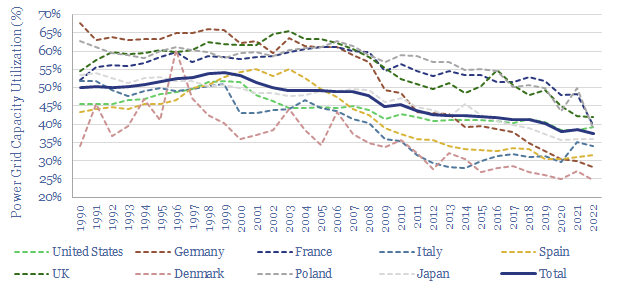
Did you read any of those? People are starting to self provide and eating into the supply of utilities. As grid utilisation decreases but certain fixed costs remain the cost to provide is going up. It DOES NOT mean sticking to older even more expensive forms of energy will make it cheaper. As renewables become cheaper for utilities so do they for consumers and utilities all over the world are finding themselves in the same situation as Eskom where they have to increase costs but in doing so are pricing themselves out of the market. Those that have embraced it with things such as feed-in and time of day tariffs to spread out utilisation are actually faring better than others who want to punish consumers.

The Forbes article is 4 years old. Costs have dramatically fallen and perhaps you missed this part, renewables WITH STORAGE are now the cheapest so some of those factors are no longer valid if they ever were. Perhaps we also need a new way of thinking and a shift from AC transmission to DC. Ironically one of the problems with renewables is also one it uniquely solves.
 
My man, you've now shifted the goalposts from "We're still waiting for these radiation eating reactors" to the mercurial statement that "None of the current reactors can reuse the fuel to degree that's being touted".

The truth is that there are plenty of reactors on this planet right now perfectly capable of using this fuel. I'm sorry that you didn't know that, but it remains true nonetheless.
The argument has always been there's no such commercial reactor so no shifting. Nobody ever said fuel "may" (not always) be not be used again. Reducing radiation from 100,000 years to 10,000 isn't of much use to us and is not what is being touted.
 
The argument has always been there's no such commercial reactor so no shifting.
The fuel works in current day thermal reactors. Sorry mate. Don't know who told you that kak but they're very wrong.

It's being used in reactors today all over the place.

Even the USA, that doesn't have a policy of using these MOX fuels, STILL has reactors fully capable of using the stuff right now.

Nobody ever said fuel "may" (not always) be not be used again. Reducing radiation from 100,000 years to 10,000 isn't of much use to us and is not what is being touted.
Actually you can apparently reduce to a couple hundred years.
 
Last edited:
Explain the difference. Radiation doesn't matter, it's all in the storage and the point is it was thought to be safe at one point and no longer is. The only trajectory with nuclear is that the longer we go the more we know we are wrong.

Did you read any of those? People are starting to self provide and eating into the supply of utilities. As grid utilisation decreases but certain fixed costs remain the cost to provide is going up. It DOES NOT mean sticking to older even more expensive forms of energy will make it cheaper. As renewables become cheaper for utilities so do they for consumers and utilities all over the world are finding themselves in the same situation as Eskom where they have to increase costs but in doing so are pricing themselves out of the market. Those that have embraced it with things such as feed-in and time of day tariffs to spread out utilisation are actually faring better than others who want to punish consumers.

The Forbes article is 4 years old. Costs have dramatically fallen and perhaps you missed this part, renewables WITH STORAGE are now the cheapest so some of those factors are no longer valid if they ever were. Perhaps we also need a new way of thinking and a shift from AC transmission to DC. Ironically one of the problems with renewables is also one it uniquely solves.
Because power stations are storing the radiation differently to other industries. It's heavily regulated while the others are not. Can't so look nuclear power stations bad, cause these other industries have radiation leaks.
They aren't even the same thing
 
The fuel works in current day thermal reactors. Sorry mate. Don't know who told you that kak but they're very wrong.

It's being used in reactors today all over the place.

Even the USA, that doesn't have a policy of using these MOX fuels, STILL has reactors fully capable of using the stuff right now.


Actually you can apparently reduce to a couple hundred years.
Plus the amount of high level waste is actual minimal, currently you can get more radioactive material spewing out of a coal power plant
 
The fuel works in current day thermal reactors. Sorry mate. Don't know who told you that kak but they're very wrong.

It's being used in reactors today all over the place.

Even the USA, that doesn't have a policy of using these MOX fuels, STILL has reactors fully capable of using the stuff right now.
Sorry dude, you completely miss the gist of it. Nobody ever said you can't reuse it so you're arguing the wrong argument. If what you claim is true they wouldn't be trying to develop the new reactors.

Actually you can apparently reduce to a couple hundred years.
Not practically.
 
Radioactive material from fossil fuels? Que?
Yeah amazing:)
Studies show that ash from coal power plants contains significant quantities of arsenic, lead, thallium, mercury, uranium and thorium[1]. To generate the same amount of electricity, a coal power plant gives off at least ten times more radiation than a nuclear power plant.
 
Because power stations are storing the radiation differently to other industries. It's heavily regulated while the others are not. Can't so look nuclear power stations bad, cause these other industries have radiation leaks.
They aren't even the same thing
Pray tell. It's not like anyone can just purchase nuclear fuel on the open market. It looks more like where human error and shortsightedness can enter it will. The point being that these "solutions" were thought to be safe yet they aren't.

Radioactive material from fossil fuels? Que?
There is some radiation, on the level of a banana. Also fossil fuels are sometimes found with uranium deposits strangely but these are then mined separately. Also you're simply completing a cycle where, if the theory is correct, living organisms concentrate it over their lifetime and then release it back into the environment.

What people miss is that it's not the amount of material that matters but its volatility. It takes a football field or bigger to store only a few barrels and then the barrels themselves are already heavily insulated.
 
Pray tell. It's not like anyone can just purchase nuclear fuel on the open market. It looks more like where human error and shortsightedness can enter it will. The point being that these "solutions" were thought to be safe yet they aren't.


There is some radiation, on the level of a banana. Also fossil fuels are sometimes found with uranium deposits strangely but these are then mined separately. Also you're simply completing a cycle where, if the theory is correct, living organisms concentrate it over their lifetime and then release it back into the environment.

What people miss is that it's not the amount of material that matters but its volatility. It takes a football field or bigger to store only a few barrels and then the barrels themselves are already heavily insulated.
Way more than a banana
To generate the same amount of electricity, a coal power plant gives off at least ten times more radiation than a nuclear power plant.

So, in your mind, that means a nuclear power plant gives off a tenth of a banana .
 
Sorry dude, you completely miss the gist of it. Nobody ever said you can't reuse it so you're arguing the wrong argument. If what you claim is true they wouldn't be trying to develop the new reactors.
My man, the Netherlands has 1 nuclear reactor. Next year it will have been using MOX fuel for 10 years. They're considered new to the game.

I'm sorry my dude. I don't know where you got the idea that these reactors don't exist, but you're wrong. Google it for just 5min if you don't believe me.

That's just 1 country. Off the top of my head I know of France and Japan, both of whom use MOX in their reactors. Collectively just between those 3 countries it's something like 40 reactors total with a history of running it.

People may very well be trying to develop new reactors to use this fuel, but in the sense that humanity is always trying to refine designs and make things more efficient. This idea you have that these reactors don't exist is very obviously absolute horseschit. They exist, and are running right now, as I type this.

Not practically.
It's probably expensive to do so comparatively if you have a natural local source of uranium, and abundant places to store the waste, as an alternative like countries like the USA do. Which is probably why the USA doesn't bother. For countries like Japan that have none of those things, I imagine the reality is a little different. It's definitely doable though. As uranium prices climb it's likely to become the cheapest way to do it.
 
Last edited:
Way more than a banana
To generate the same amount of electricity, a coal power plant gives off at least ten times more radiation than a nuclear power plant.

So, in your mind, that means a nuclear power plant gives off a tenth of a banana .
You're conflating things. Firstly there is a difference between instantaneous and cumulative radiation. You're familiar with the banana equivalent dose (BED)? A banana delivers about 0.1 μSv of radiation where the average daily exposure to a person is about 10 μSv or 100 BED. Average daily exposure is also not the same as maximum safe daily exposure.

A nuclear plant is permitted to leak 250 μSv per year, or 2500 BED. I can't see the figures but assuming yours correct, or even multiplied tenfold, a coal plant gives off no more than 250,000 BED. I don't know but I think people eat way more than 250,000 bananas a year in SA alone. A chest CT scan delivers 70,000 BED. It is not the released radiation that's a concern. With coal the released and manufactured radiation is the same. With nuclear it's not.

Secondly with coal the "radiation" was taken out of the environment at some point. You're simply putting it back as would eventually happen naturally.
 
That's just 1 country. Off the top of my head I know of France and Japan, both of whom use MOX in their reactors. Collectively just between those 3 countries it's something like 40 reactors total with a history of running it.

Today MOX is widely used in Europe and in Japan. Currently about 40 reactors in Europe (Belgium, Switzerland, Germany and France) are licensed to use MOX, and over 30 are doing so. In Japan about ten reactors are licensed to use it and several do so. These reactors generally use MOX fuel as about one-third of their core, but some will accept up to 50% MOX assemblies.

 
My man, the Netherlands has 1 nuclear reactor. Next year it will have been using MOX fuel for 10 years. They're considered new to the game.

I'm sorry my dude. I don't know where you got the idea that these reactors don't exist, but you're wrong. Google it for just 5min if you don't believe me.

That's just 1 country. Off the top of my head I know of France and Japan, both of whom use MOX in their reactors. Collectively just between those 3 countries it's something like 40 reactors total with a history of running it.

People may very well be trying to develop new reactors to use this fuel, but in the sense that humanity is always trying to refine designs and make things more efficient. This idea you have that these reactors don't exist is very obviously absolute horseschit. They exist, and are running right now, as I type this.
It seems you're behind on this. Again not referring to refining and reusing fuel to a limited extent. The supposed radiation eating reactors that can function on any fuel till it's depleted (read nothing left but common elements) don't exist. Nobody is using them and nobody is selling them. They're experimental.

It's probably expensive to do so comparatively if you have a natural local source of uranium, and abundant places to store the waste, as an alternative like countries like the USA do. Which is probably why the USA doesn't bother. For countries like Japan that have none of those things, I imagine the reality is a little different. It's definitely doable though. As uranium prices climb it's likely to become the cheapest way to do it.
It's expensive period. It's more expensive than simply mining more fuel and it probably gets more expensive the more you have to refine/enrich it and you're probably going to hit the limit in any case where you can't any more or you have to mix it with new fuel. Yes it's presumably technically possible to use it till it's exhausted but doing so may be prohibitively expensive which would defeat the purpose and make nuclear non-viable.
 
Top
Sign up to the MyBroadband newsletter
X