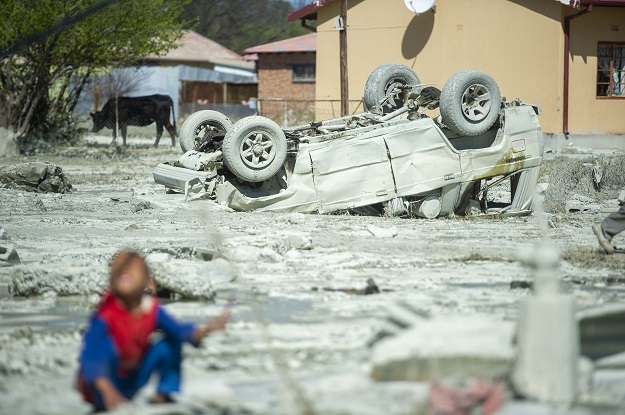
Mine dam collapse - Jagersfontein

@dlk001 It sounds like this is an area that you have expertise in and I was wondering if you have any idea of the validity of the following comment on Daily Maverick (main article here)

View attachment 1383246
Do you know if it is true that the fine residue tailings dams have always been (and are still) regulated by the DWA? Would the course residue tailings dumps still be regulated by the DMRC even though they are the assets of the mine owners that can be bought and sold at will?
I'm looking into dams for a different reason but it appears the answer to your question is yes.

All dams above a certain size needs to be registered with the DWA, the register is even available online. Not sure what level of quality assurance or inspection they do but I would think thats the entire point of this process.

 
@dlk001 It sounds like this is an area that you have expertise in and I was wondering if you have any idea of the validity of the following comment on Daily Maverick (main article here)

View attachment 1383246
Do you know if it is true that the fine residue tailings dams have always been (and are still) regulated by the DWA? Would the course residue tailings dumps still be regulated by the DMRC even though they are the assets of the mine owners that can be bought and sold at will?

The short answer is "Yes", historic dumps pre 01 May 2004 (including tailings) are not regulated by the Mineral and Petroleum Resources Development Act 28 of 2002 (MPRDA) and do not require a "Mining Right" as defined in the MPRDA apart from the dumps that belong to the state. However, the re-mining and processing of any dumps are subjected to various acts including Precious Metals Act, 2005 or the National Environmental Management Act No. 1998.

In drafting the MPRDA in 2002, the committee must have recognised that the National Environmental Management Act (NEMA) had stringent requirements to deal with "tailings" from an environmental protection point of view. However, NEMA does not explicitly address "Mining Safety" as the MPRDA does. The MPRDA is aligned with the Mine Health and Safety Act (MHSA) and the MHSA requires a Code of Practice to mitigate geotechnical risks associated with Mineral Residues.

The proposed amendment of the MPRDA was published in 2013 with an entirely new definition of “historic residue stockpiles” and explicitly mentioned "tailings". While these amendments finally answered the questions related to Mining rights on "Historic Dumps", the Amendment Bill lapsed in 2018 and has unfortunately not been passed into law.

So as it stands, NEMA is one of the most stringent acts regulating pre 01 May 2004 tailings/slimes dams.

With respect to the De Beers case, the court found that "the tailings dumps were movables belonging to De Beers and stored to be retreated. The court found the dumps were distinguishable from the land and they could be removed without damaging the land"

This is a controversial decision that causes divided opinions, and criticism by industry experts including the Minister.

- From a geotechnical point of view, the stability of the dump has direct consequences for the land. Uncontrolled removal of the dump can lead to slope failure and damage to the land.

- From a hydrogeological point of view, water impacts the strength of the material in the dump. Lack of dewatering can lead to dump failure and damage to the land.

A regulatory framework is required to deal with tailings, and waste rock dumps which were created from 1860 up to 2002 with alignment to the Mine Health and Safety Action requirements.
 
Last edited:
The short answer is "Yes", historic dumps pre 01 May 2004 (including tailings) are not regulated by the Mineral and Petroleum Resources Development Act 28 of 2002 (MPRDA) and do not require a "Mining Right" as defined in the MPRDA apart from the dumps that belong to the state. However, the re-mining and processing of any dumps are subjected to various acts including Precious Metals Act, 2005 or the National Environmental Management Act No. 1998.

In drafting the MPRDA in 2002, the committee must have recognised that the National Environmental Management Act (NEMA) had stringent requirements to deal with "tailings" from an environmental protection point of view. However, NEMA does not explicitly address "Mining Safety" as the MPRDA does. The MPRDA is aligned with the Mine Health and Safety Act (MHSA) and the MHSA requires a Code of Practice to mitigate geotechnical risks associated with Mineral Residues.

The proposed amendment of the MPRDA was published in 2013 with an entirely new definition of “historic residue stockpiles” and explicitly mentioned "tailings". While these amendments finally answered the questions related to Mining rights on "Historic Dumps", the Amendment Bill lapsed in 2018 and has unfortunately not been passed into law.

So as it stands, NEMA is one of the most stringent acts regulating pre 01 May 2004 tailings/slimes dams.

With respect to the De Beers case, the court found that "the tailings dumps were movables belonging to De Beers and stored to be retreated. The court found the dumps were distinguishable from the land and they could be removed without damaging the land"

This is a controversial decision that causes divided opinions, and criticism by industry experts including the Minister.

- From a geotechnical point of view, the stability of the dump has direct consequences for the land. Uncontrolled removal of the dump can lead to slope failure and damage to the land.

- From a hydrogeological point of view, water impacts the strength of the material in the dump. Lack of dewatering can lead to dump failure and damage to the land.

A regulatory framework is required to deal with tailings, and waste rock dumps which were created from 1860 up to 2002 with alignment to the Mine Health and Safety Action requirements.
So which regulatory authority is responsible for slimes dams? If it isn't DMR and you quote NEMA then I'm guessing it is the provincial or national environmental authority. They may get technical input from DWS (they do for other waste disposal facilities) as these are "dams" and DWS should have the expertise to promulgate the rules and assess safety (as above they do for all SA large dams with SANCOLD). I deal with both DWS and environmental authorities quite regularly and not sure if they do have much expertise (the do have some Cubans though ha ha).

As to failure I have only played a one string violin about liquefaction but regular and up to date satellite imagery could I agree, be used to assess other likely modes of failure like uncontrolled over topping and internal erosion (piping) to some extent. Instrumentation, drone survey and boots on the ground is more real time, IMHO of course.
 
So which regulatory authority is responsible for slimes dams? If it isn't DMR and you quote NEMA then I'm guessing it is the provincial or national environmental authority. They may get technical input from DWS (they do for other waste disposal facilities) as these are "dams" and DWS should have the expertise to promulgate the rules and assess safety (as above they do for all SA large dams with SANCOLD). I deal with both DWS and environmental authorities quite regularly and not sure if they do have much expertise (the do have some Cubans though ha ha).

As to failure I have only played a one string violin about liquefaction but regular and up to date satellite imagery could I agree, be used to assess other likely modes of failure like uncontrolled over topping and internal erosion (piping) to some extent. Instrumentation, drone survey and boots on the ground is more real time, IMHO of course.

There are three legislative requirements for the construction/operation of a Dam.
  • Dam safety legislation, under the National Water Act (NWA)
  • Water Use legislation, under the National Water Act (NWA)
  • Environmental protection, under the National Environmental Management Act (NEMA)
  • Mineral and Petroleum Resources Development Act (MPRDA)
  • Mine Health and Safety Act (MHSA)
None of these 3 pieces of legislation is aligned with the MHSA which is where enforcement works best.

We need to have clarity and alignment in all 5 pieces of legislation when it comes to licencing, design, design implementation, and monitoring (including oversight).

We need resourcing in terms of ongoing enforcement of the laws. It can happen under DWAF or DMRE, but it requires coordination/clarity in terms of roles and responsibilities.
 
Saw this on FB this morning:

Another mine dam wall has collapsed at the troubled Jagersfontein mine.
Kopanong mayor Xolani Tseletsele says the situation could have been as result of earlier heavy downpours in the area.
The water is running through the neighbourhood of Charlesville and Dennis Louw's farm which is nearby.
The R706 near Charlesville has been closed.
Motorists are advised to use an alternative gravel road to Fauresmith in order to get access to Jagersfontein.
Police are on scene redirecting traffic.
Over two weeks ago, a mine dam wall collapsed, leaving a trail of destruction in the area.
 
Top
Sign up to the MyBroadband newsletter
X