New iMac and MacBook Pro will be Apple's first ARM-powered computers - Report

Hanno Labuschagne

Journalist
Staff member
Joined
Sep 2, 2019
Messages
6,546
Reaction score
4,845
New iMac and MacBook Pro will be Apple's first ARM-powered computers - Report

Apple's first ARM-powered Mac systems will be a 13.3-inch MacBook Pro and new 24-inch iMac, according to a report from 9to5Mac.

The publication cited a research note from analyst Ming-Chi Kuo, who said Apple would officially announce a transition to its own chips at its 2020 Worldwide Developer Conference (WWDC).

The change could mean Apple will be less reliant upon Intel’s CPU hardware for updating its Mac range.
 
I highly doubt the ARM CPUs will outperform the Intel CPUs.

When they moved to PowerPC it made sense because it is a dead platform and CPU performance was the bottleneck.

Here the motivator is cost, I have yet to see benchmarks showing ARM outperforming x86. In fact I know it won't because even companies like Amazon that are pushing hard for ARM have instances that have significantly lower performance than both their Intel and AMD counterparts. Even in benchmarks that try to even the playing field by disabling some x86 features still show 95% of benchmarks lost.

So unless Apple somehow was able to create a processor devision that is outdoing both Intel and AMD in the last year, or the priority is no longer the customer but the dollars
 
I highly doubt the ARM CPUs will outperform the Intel CPUs.

When they moved to PowerPC it made sense because it is a dead platform and CPU performance was the bottleneck.

Here the motivator is cost, I have yet to see benchmarks showing ARM outperforming x86. In fact I know it won't because even companies like Amazon that are pushing hard for ARM have instances that have significantly lower performance than both their Intel and AMD counterparts. Even in benchmarks that try to even the playing field by disabling some x86 features still show 95% of benchmarks lost.

So unless Apple somehow was able to create a processor devision that is outdoing both Intel and AMD in the last year, or the priority is no longer the customer but the dollars
1592831586548.png

This is with the A12X not even the A13 or A14 that'll come out later this year and even paired with a big copper heatsink and a fan.
 

This is with the A12X not even the A13 or A14 that'll come out later this year and even paired with a big copper heatsink and a fan.

Yep plenty of articles show those benchmarks are nowhere near realistic representation.
In Geekbench 5, the ARM CPUs are even outperforming the most powerful x86 CPUs.

Everyone who loves their ARM devices loves bringing up this benchmark.

Let's just say, if those CPUs are truly so powerful, why aren't companies buying those CPUs for servers rather than Xeon CPUs?
You can't realistically be deluded enough to imagine a 400w TDP part is being outperformed by a 8w TDP part.

A significant number of people expect Apple is going to struggle with this migration.
Microsoft tried already and failed, we'll see what happens for Apple but I think once the new Macs come out with a lot slower performance, it'll quickly hurt the sales
 
I highly doubt Apple would have spent so many years planning to migrate to ARM if it was automatically going to be slower than x86. I think that their software is what will make the difference. I don't think the ARM Macs will be massively faster but they will not be slower . Performance isn't measured by TDP or by clock speed like it was back in the P4 days. Real world performance in apps that are designed and optimised for Apple Silicon is what counts.

Either way though, we'll know soon enough.
 
I highly doubt Apple would have spent so many years planning to migrate to ARM if it was automatically going to be slower than x86. I think that their software is what will make the difference. I don't think the ARM Macs will be massively faster but they will not be slower . Performance isn't measured by TDP or by clock speed like it was back in the P4 days. Real world performance in apps that are designed and optimised for Apple Silicon is what counts.

Either way though, we'll know soon enough.

^ This.

Those Mac Minis were shipping to developers immediately. We'll know in days.

Silicon aside, Rosetta 2 looked super impressive.
 
I'll just leave this here:

Supercomputers are made up of a large cluster of processors.
Data centers could be the largest super computers on earth.
As such, it is a measure of money, not of performance of an individual chip.

For example this specific super computer is made up of:
7,299,072 cores and 4,866,048 GB of memory
Using a framework like Hadoop you get the same kind of parallelism without developing anything special and at much lower cost.

Because cost is such a large factor, non-x86 have not been the leading super computers for a while now. x86 isn't cheap and for all practical reasons can't be licensed by any company other than those that are already players.

TL;DR: Super computers have as much in common with typical computers as cars to do trucks. Comparing the two is not useful because a large part is a hardware cost exercise. ARM is cheap to license so it makes perfect sense to develop specialised platforms on them
 
Last edited:
Performance isn't measured by TDP or by clock speed
100% agreed but for production current generation CPUs it is still a good indicator of what is possible. It just isn't going to be possible for a general purpose processor of < 10w TDP to perform in the same range as a 100w TDP part. Just like it isn't possible for an elephant to fly or an fly to break a tree if you see the parallel I'm drawing.

I don't think the ARM Macs will be massively faster but they will not be slower .
Which is what annoys me. The Intel Macs when there were released were immediately significantly faster. There was no doubts that it was the right choice because it performed better in every benchmark (including power usage).

That said if the benchmarks show it is better in every way, just like it was with the Intel switch, I'm onboard.

Real world performance in apps that are designed and optimised for Apple Silicon is what counts.
Well I use a Macbook Pro and I use it in my professional day to day as a software developer. I don't care about the Apple ecosystem. Many people buy Mac* Pro models for professional work. So saying it is optimized for Apple is writing off a large amount of your customer base.

I don't think anyone can be so deluded as to think that Mac* Pro models are in any way comparable to other Apple products. The price tag alone should make that obvious. My work laptop costs R65k for example. Mac Pro workstations significantly more. And in my corporate office we are roughly 200+ developers all using R60k+ laptops. Don't be deluded to think it is because we think Apple ecosystem is great. Enterprise and professional is a whole different ball game from zealots who worship Apple.

The last time Steve Jobs left the company fell into ruin. It isn't beyond their ability to accomplish that again by becoming a company that optimizes for cost over customers.
 
Last edited:
This time, the company’s typical array of charts, benchmarks, and “fastest ever” claims for each new generation of homegrown ARM silicon were completely MIA. Apple wouldn’t chat about it when we asked.

The company’s press release says very specifically that Apple’s new chips will “give the Mac industry-leading performance per watt,” and that’s a very deliberate turn of phrase.

It also seems telling that Apple isn’t publicly planning to get rid of Intel anytime soon. Not only is Apple planning to release several additional Intel-based Macs in the future, but the company “will continue to support and release new versions of macOS for Intel-based Macs for years to come.” For a company that prides itself on the “courage” to often make a clean break with the past, it’s a little unusual.

But it feels very strongly like there’s something Apple isn’t telling us about performance, and we’ll need to wait to see. Improved performance is one of the most compelling reasons to buy a new computer, and an absolute requirement for pros. Performance is time, and time is money, after all.

Source: https://www.theverge.com/2020/6/23/...licon-chips-performance-power-speed-wwdc-2020

TL;DR (as it reads to me): We are going to see if we can pull this off and will go back if we see our market share plummet
 

Some observers were surprised that Apple's big news in transitioning Macs away from Intel processors didn't refer to the move as a migration to "ARM." Instead, Apple's chief executive Tim Cook introduced it as a move to Apple silicon. Here's why.

Apple silicon is a head and shoulders above ARM
The A12Z chip that Apple is currently using in its latest LiDAR iPad Pro and its first generation Apple silicon chip in the Mac mini developer transition kit does incorporate ARM CPU cores. But that ARM Architecture CPU is not the most significant reason Apple is moving away from Intel's chips on Macs.

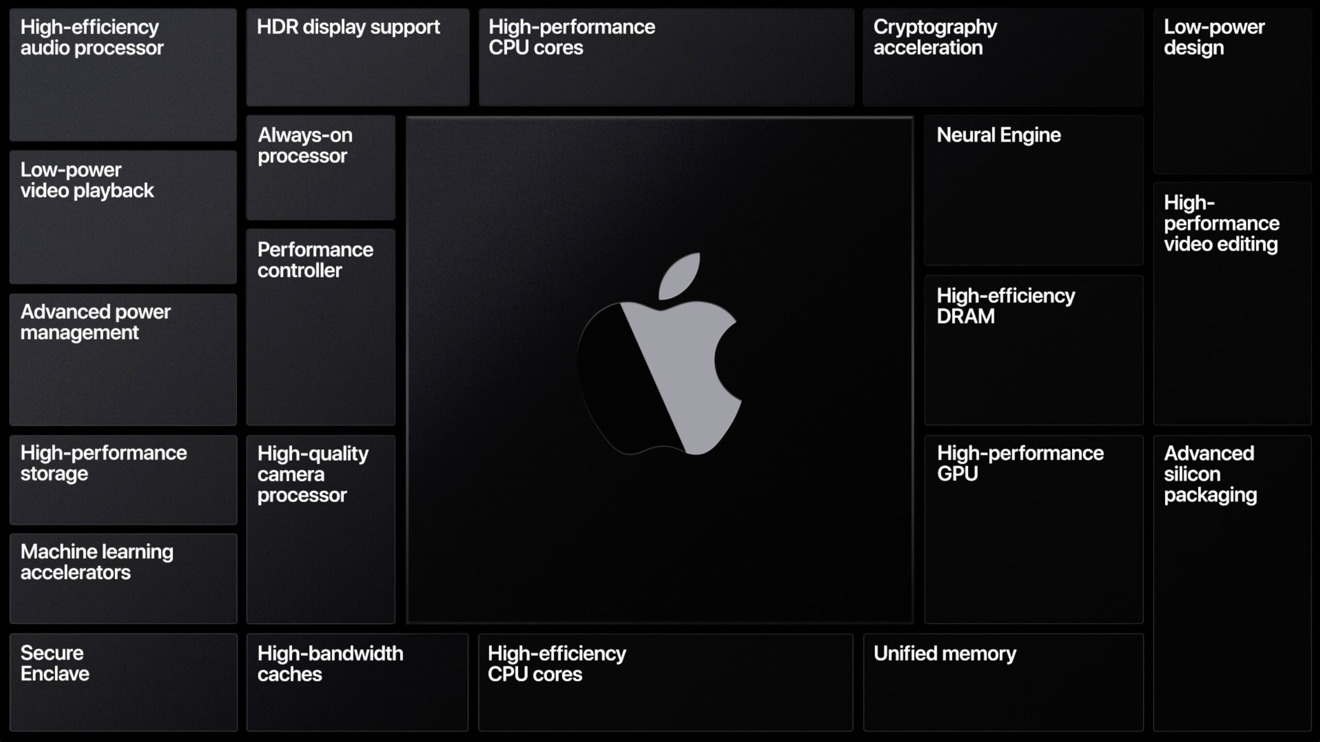
Apple alluded to this in referring to its own custom silicon as being an "SoC," or System on a Chip. Over the past decade, Apple has developed a series of SoCs that incorporate essentially an entire logic board of chips that a typical PC would require into a single chip that can be mass produced and used across multiple devices from its iPhone, to iPad, to Apple TV and even HomePod.

The baseband modems supplied by Qualcomm for handling connectivity to mobile networks also incorporates an ARM processor core, but most of the value of these chips comes from the total package of components and proprietary software, not merely the standards-based CPU core serving at its center.

In some respects, Apple's use of ARM cores in its SoCs is similar to its use of Unix in the OS itself. Both are effectively specifications that standardize the operations of low level technology layers. In the same way that Macs are more than just Unix systems, Apple's SoCs are more than just ARM processors.

As with Qualcomm's modems, the customizations, optimizations, and additional layers of proprietary work that Apple adds to its A-series SoCs results in a package that's significantly more valuable than its base components.

That reality is reflected in Apple's custom silicon being a lot more than just an "ARM chip," and helps to explain why Apple's SoCs have increasingly outperformed other ARM-based SoCs developed by Qualcomm, Nvidia, Samsung, and others.
 
Top
Sign up to the MyBroadband newsletter
X