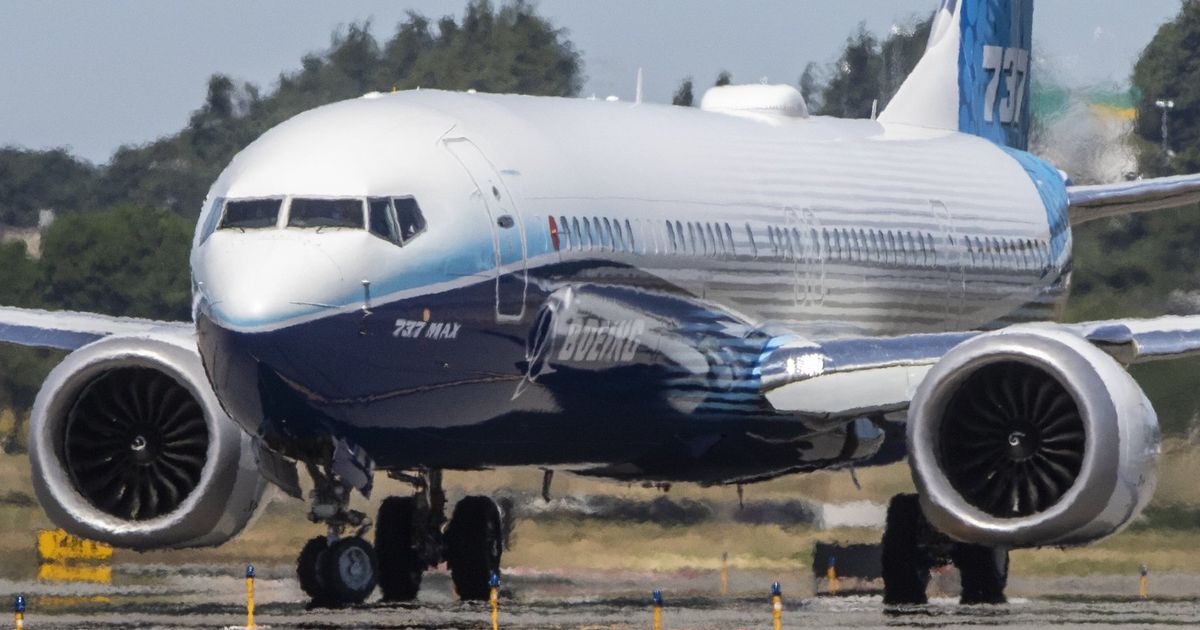
New software issue found in Boeing 737 Max

In the sixties they went to the moon with sliderules and calculators...

Slight exaggeration. Actually the Apollo guidance computer was one of the most sophisticated machines in operation. It had a time-sharing operating system, and could prioritise certain tasks during landing on the moon.

The main difference between a 286 and a modern CPU is the amount of RAM and clock speed. Most of this is used for audio-visual processing, and there is more than enough performance available on a 286.
 
How Boeing’s responsibility in a deadly crash more than a decade ago ‘got buried’ - Chicago Tribune

Here's the link to the (non-paywalled) Chicago Tribune repost of the NYT article regarding the Turkish Airlines 737-800 crash at Amsterdam.

 
So, the general sentiment that "pilot error" is the cause of accidents took hold and then grew after that into a convenient monster. Especially useful if the pilots died in the accident.
Absolutely disgusting.
And then, to come up with a mod and failing to implement it for months on all planes just added to the mess.
What more are we going to find crawling out of the woodwork?
 
The concept of the 'scapegoat' has been around since biblical times, now its called blaming the 'fall guy'. Same mentality...

It has taken decades to get over the default assumption of 'pilot error', and requires hard thinking about actual causes, and fault tree analysis. This is particularly hard to do in a 'macho' culture such as aviation.

The analysis of the human/automated machine interface is one of the ongoing sagas of the current era.
 
Deep down we are sitting with the assumption that computers can't make errors and only humans do. While this notion has actually been disproven on a quantum level ages ago already we are also coming to the realisation that the complexity of even a basic system means it's not possible for it to be error free. Also something we have known for ages.
 
The Dutch crash human factors report has been belatedly released. Quite lengthy, but worth reading the highlights: https://www.onderzoeksraad.nl/nl/media/inline/2020/1/21/human_factors_report_s_dekker.pdf
The only defense against a designed-in single-failure path, in other words, are the pilots who are warned to mistrust their machine and to stare at it harder. Such a reminder, oriented only at the human operator in the system, is hardly credible after three decades of in-depth research into automated airliner flying
and the subtle and pervasive ways in which automation on the flight deck (and particularly its subtle failure) affects human performance (e.g. Wiener & Curry, 1980, Sarter et al., 1997). For flight crews of Boeing 737’s, like the crew of TK1951, there is no sufficient training, no written guidance or documentation, and no likelihood of line experience that would insulate them from the kind of automation surprise that happened near Amsterdam on the 25th of February.

This paragraph is particularly relevant to the MCAS crashes.
 
Even more so now. Reads like a paragraph that could be simply pasted into the final report on the MAX. More shocking is a reference to a report written in 1997!
Just shows the levels of lip service done to investigative reports by Boeing over many years.

There is another sentence in the report that I found very damming against the industry:

TK1951 may have been a surprise for the aircrew involved; it can hardly come as a surprise to the industry.

Apparently, the industry as represented by Boeing and the FAA clearly took no notice of a recommendation and did nothing concrete to eliminate ALL possible single sensor situations.
 
Last edited:
Even more so now. Reads like a paragraph that could be simply pasted into the final report on the MAX. More shocking is a reference to a report written in 1997!
Just shows the levels of lip service done to investigative reports by Boeing over many years.

There is another sentence in the report that I found very damming against the industry:


Apparently, the industry as represented by Boeing and the FAA clearly took no notice of a recommendation and did nothing concrete to eliminate ALL possible single sensor situations.

A lot of these issues boil down to 'cost-benefit' analysis, and Boeing has been very prolific at stretching the regulations.

One reason it was easy to 'bury' this story, was the limited number of casualties (only 9 fatalities and 126 survivors).
 

FAA demands that Boeing flight manuals give more detail on pilot emergency procedures - The Seattle Times​


Boeing, under intensifying regulatory scrutiny after the fatal MAX crashes, has been directed by the Federal Aviation Administration to rework its flight manuals for both the 777X and MAX 10 to include detailed emergency pilot procedures.

The FAA has told Boeing to incorporate into the Airplane Flight Manuals, formal documents that are required for certification of both jets, precise details of the procedures and checklists the crew must follow to handle the kind of emergencies that killed 346 people in the MAX crashes in Indonesia and Ethiopia.

Those procedures had previously been detailed in other documents customized by individual airlines to train pilots. However, those airline documents are not overseen by regulators during the initial airplane certification process and may vary at airlines around the world.

The FAA is tightening control to ensure that for Boeing’s two current airplane development programs — the latest and largest version of the narrowbody MAX, which had its first flight in June; and the giant new derivative of Boeing’s widebody 777, which first flew in January 2020 — this information goes out in a certification document provided to all airlines worldwide.

Boeing doesn’t see this new requirement adding further delay because certification of both jets has already been pushed far out until late 2023.

In May, the FAA cited a serious flight test incident and lack of design maturity for slowing certification of the 777X. And certification of the MAX 10 is similarly delayed as Boeing works to develop further safety updates for flight control and crew alerting systems required by the European air safety regulator.

 
New software issue found in Boeing 737 Max

Boeing has identified a new software flaw in the grounded 737 Max that will require additional work, possibly further delaying the plane’s return to service.

The company alerted the U.S. Federal Aviation Administration and is notifying customers and its suppliers, it said in an emailed statement. [Bloomberg]
outsourcing to India :unsure: :ROFL:
 
:)
Awesome
Thanx for clearing that up
For a moment here I thought a 286 motherboard with 4 megabytes RAM running DOS 6.22 and WIN 3.11 was roaming the sky keeping passengers safe :thumbsup:
When you code properly and only for a specific function you can do a LOT with some very very low speed processors and very little RAM. Especially with Real-Time Operating Systems that are extremely focused on what is needed rather than supporting anything else.
 
Top
Sign up to the MyBroadband newsletter
X