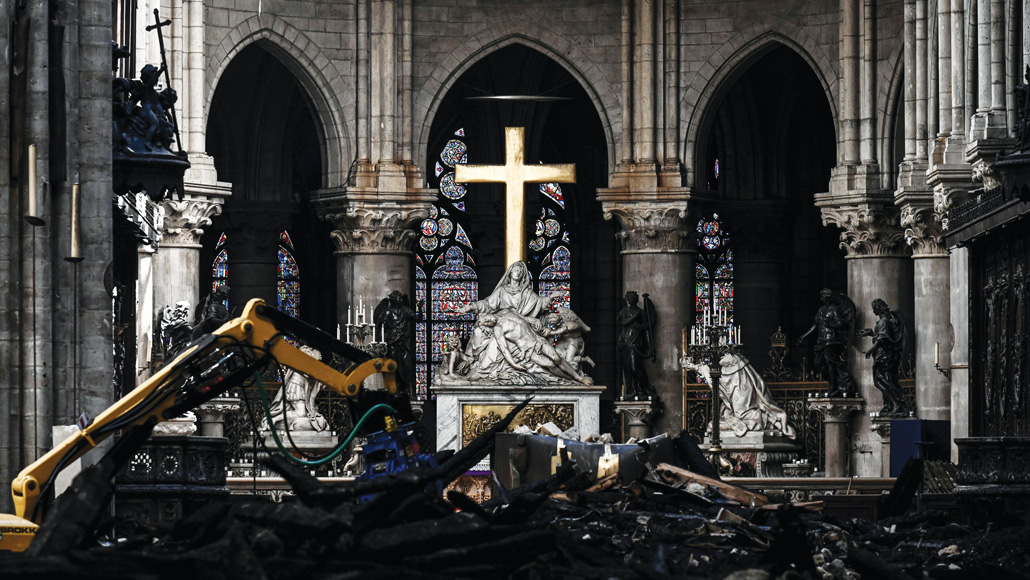
The “forest” of Notre Dame was one of Olivier de Châlus’ favorite places. That dense lattice of timbers under the building’s lead roof epitomized the medieval construction techniques that the engineer has spent years analyzing.
“There was a very special wood smell, very strong, coming from the Middle Age,” de Châlus says. “And it was very, very calm — impressive, compared to the very noisy life inside the cathedral.” As one of the few visitors allowed in the forest, de Châlus had the rare privilege of hearing the creaking noises emitted by the timeworn wood and peering at numbers scrawled on the timbers by long-gone carpenters.
That beloved forest is now gutted, lost in an April 15, 2019 blaze that destroyed the cathedral’s roof and spire and damaged parts of the masonry. De Châlus, who works for the global engineering firm Arcadis, is finishing a Ph.D. on the construction of the cathedral.
There’s little documentation of the building process, which began in 1163 and continued for about 200 years. De Châlus has devoted himself to teasing out the unwritten rules of construction — how builders decided the size of columns or the height of flying buttresses, for example. He notes that builders lifted 100-kilogram stones more than 60 meters off the ground without the benefits of modern technology. Exactly how this was accomplished has been lost to time, he says.