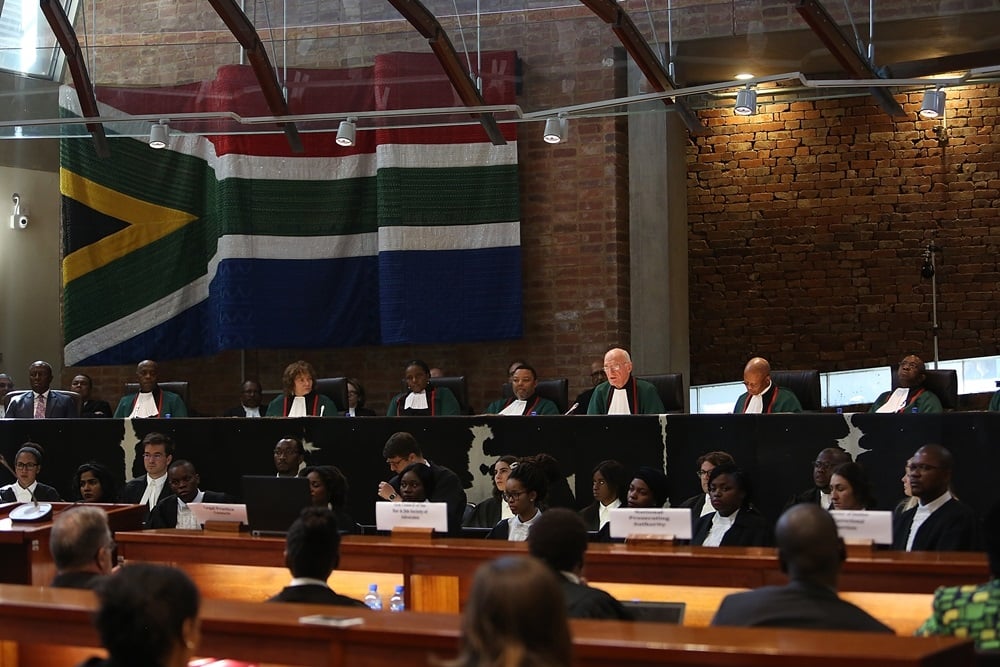
RICA declared inconsistent with the Constitution

That piece of legislation leaves a lot to be desired.

Think about this: You have to prove to me that you live in your house (ie show me the lease, the title deeds or a letter from Mom - who has a lease or a title deed) before I can legally dig a piece of fibre into your house to provide you with a retail internet connection, or another ISP with a wholesale connection.

I know where you live. I'm running fibre to you. Why does the government require you have to prove to me that you live there?

Yet, tomorrow you can take your internet account to a high street shop and use it as proof of residence to obtain credit.
 
A government that does not conduct mass surveillance on its citizens does not exist.

They end up collecting tons of data, that they do not have the means to properly analyze, just wasting the tax payers money.

Targeted surveillance is viable - but mass surveillance not, not in this country at least.
 
Exactly. They don't have a way to properly enforce the law

They like wasting money, making new laws, when they cannot enforce the old ones, so they are not going to be able to enforce the new laws. Welcome to the Wild West, ooops, Wild Africa...
 
yes and in light of parts of RICA being declared unconstitutional I'm arguing there are other things that need to go the same way.

ID / personal information on censorship forms.

The problem is yours if you supply any personal identifying info on census forms.

Censorship forms are a whole different thing...
 
The problem is yours if you supply any personal identifying info on census forms.

Censorship forms are a whole different thing...
ROFLMAO oops LOL ... Um the census requires you to fill in your name ID etc on the form. Or at least the last one did.
 
Interesting article by Sam Sole on why the Rica ruling is important for investigative journalists, and some details that still need to amended: https://www.dailymaverick.co.za/art...amabhunganes-landmark-ruling-on-surveillance/
Finally, Sutherland gloriously vindicated the role proper professional journalism plays in our constitutional scheme – and therefore the safeguards it should be accorded, especially with regard to the protection of confidential sources.

He noted: “Despite much lauding of the role of the media and the express guarantee of freedom of expression and of the media … there has been a reluctance to take the next step needed to recognise journalists as a special class of persons whose intrinsic working methods warrant especial protection, such as lawyers enjoy.”

If journalists’ work had constitutional value, Sutherland asked: “Why be precious about recognising the critical instrumentality of confidential sources in producing that valuable output?”

He observed somewhat tartly: “In a country that is as wracked by corruption in both our public institutions and in our private institutions as ours is, and where the unearthing of wrongdoing is significantly the work of investigative journalists, in an otherwise, seemingly, empty field, it is hypocritical to both laud the press and ignore their special needs to be an effective prop of the democratic process.”

Sutherland has referred this matter to Parliament, but in the interim has ruled that any interception application must draw to the designated judge’s attention if the subject is a journalist or practising lawyer – and that the judge must take this into account when deciding whether to grant the order.
 
So what happens now? Apologies if in the article. I dont click on them.
Here is the article. I clicked on it so you don't have to. ;-)

The South Gauteng High Court has found that parts of the Regulation of Interception of Communications and Provision of Communication-Related Information (RICA) Act are unconstitutional.

In April 2017, media group amaBhungane filed an application in the High Court challenging the constitutionality of the act.

This, after it emerged that journalist Sam Sole’s communications were intercepted while he was reporting on the corruption investigation against former president Jacob Zuma.

In a decision handed down by judge Roland Sutherland on Monday (16 September), the court found that the law was inconsistent with the constitution on a number of points including:

  • The act fails to adequately prescribe the procedure for notifying a person whose information has been intercepted;
  • The act fails to adequately prescribe the proper procedures to be followed when state officials are examining, copying, sharing and sorting through data obtained through interceptions;
  • The act fails to adequately address situations where the subject of surveillance is either a practising lawyer or a journalist.
To remedy these issues, the judgement adds a number of new sections to the RICA Act.

It also suspended the invalidity of the act for two years to allow for parliament to bring the legislation in line with the constitution.

Civil society group Right2Know said the judgement means that bulk surveillance activities are now unlawful and invalid in South Africa.

“We congratulate amaBhungane and the legal team and we are happy that this will bring an end to surveillance abuses,” it said.
 
Top
Sign up to the MyBroadband newsletter
X