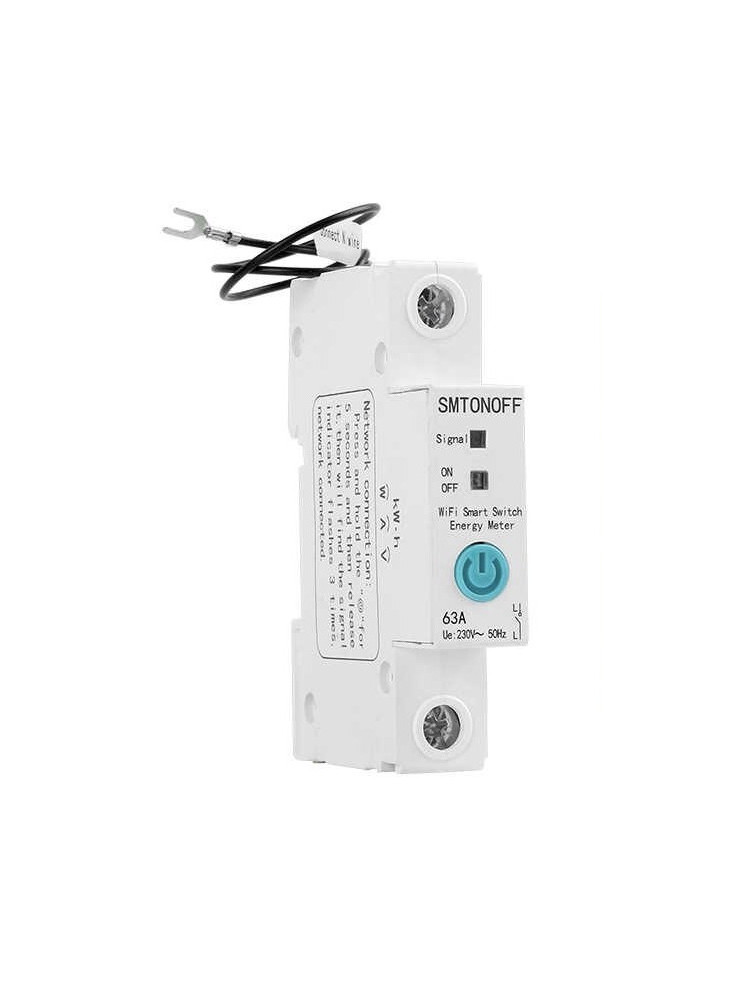
Smart Circuit Breaker WiFi Issues (ESP)

I take it this was to Tasmotize it?

Any benefit, other than not being dependent on Chinese overlords?
Yup. For me, the biggest reason to use your own firmware (apart from lack of reliance on anyone's cloud) is the ability to dynamically adjust your power reporting periods so that you don't miss sudden changes but also don't flood your MQTT/Influx/whatever servers with more data than you need.

I have 70+ Tasmotised power measurement devices sprinkled around my DBs and plug points. When nothing much is changing I don't want every one of those devices reporting in every few seconds - once every 5 minutes is usually fine, but if something suddenly switches on, I want to know about it ASAP. Tasmota's PowerDelta takes care of most of that, but I also use a Tasmota rule to dynamically adjust the TELE period when power crosses a given threshold for each device which is a useful backup even if it isn't changing enough to trigger a PowerDelta update.
 
Yup. For me, the biggest reason to use your own firmware (apart from lack of reliance on anyone's cloud) is the ability to dynamically adjust your power reporting periods so that you don't miss sudden changes but also don't flood your MQTT/Influx/whatever servers with more data than you need.

I have 70+ Tasmotised power measurement devices sprinkled around my DBs and plug points. When nothing much is changing I don't want every one of those devices reporting in every few seconds - once every 5 minutes is usually fine, but if something suddenly switches on, I want to know about it ASAP. Tasmota's PowerDelta takes care of most of that, but I also use a Tasmota rule to dynamically adjust the TELE period when power crosses a given threshold for each device which is a useful backup even if it isn't changing enough to trigger a PowerDelta update.
Which is the easiest modifiable in-DB unit you use ? Shelly ?
 
Which is the easiest modifiable in-DB unit you use ? Shelly ?
I don't have any DB-mounted Shellys. My go-to for a DB-mounted switch/power meter used to be the ZMAi-90 - I have 4 of them from two different hardware generations installed in my own DBs and have flashed several for friends. They used to be really easy to flash, but the most recent ones I've received (late 2021) have had non-ESP-based WiFi modules, so they've required that I swap out the module for an ESP-12, which is relatively easy to do with a hot air station, but it does add some cost and hassle.

Since the ZMAi-90s stopped using ESPs my next generation of high power meters were DDS238-2 switches. Like the ZMAi-90s they're also 2 DIN units wide and have a small LCD on the front which gives you some local feedback on voltage, current, power, energy, etc. Unlike the ZMAi-90s they have the slightly unusual setup of neutral connections at the bottom and live in and out at the top, which a slight negative in my mind, but on the plus side they still (last purchase a few months ago) come with ESP-based WiFi modules so you don't need to buy ESP-12s for brain transplants. With the original ESP-powered ZMAi-90 the original flashing guide you'll find online covered the fact that you'll need to hold the main microcontroller that actually does all the power measurement in reset to prevent it from spamming the serial bus and preventing flashing. The DDS238-2 uses the same main micro, so it has the same issue, but I wasn't able to find a convenient point on the PCB to tie low to reset that micro. The upshot of that was that I found it easiest for the last batch to remove the ESP modules with hot air and flash them separately before reinstalling them, so they're still a bit of a hassle to flash. Another issue that the current generation of DDS238s and ZMAi-90s share is that the main micro doesn't report updated figures to the ESP often enough for me. You can solve that with a Tasmota timer rule that polls the main micro every second, but that comes with the side effect of annoying MQTT spam because I haven't found a way to stop Tasmota from reporting serial success over MQTT.

The single-DIN-width units covered in this post are a LOT easier to flash than either of their double-width cousins above. Once you've bent the rivets holding them closed, they're easy to open and the ESP-based WiFi module is easily flashed in situ - it just requires some soldering of thin fly leads to the board (30AWG wire wrapping wire is great for this). I was initially a little sceptical of anyone claiming to get a beefy enough relay into a single DIN width unit, but the having seen these ones I think they're plenty beefy enough for to be trusted up to at least a third or a half of their claimed 63A rating. They seem to be sold under lots of brands - The SMTONOFF still appears in Banggood ads (about $27), but I've seen them listed as REVOLT or RED POLE on Takealot (both at R699). I've only flashed one REVOLT-branded one for a friend so far and it isn't installed yet so I don't have much real world data, but in my basic testing it performed well, readings were pretty accurate and updates snappy, so I'm likely to start using these more frequently. The space saving of a single DIN width is a great plus too!
 
I don't have any DB-mounted Shellys. My go-to for a DB-mounted switch/power meter used to be the ZMAi-90 - I have 4 of them from two different hardware generations installed in my own DBs and have flashed several for friends. They used to be really easy to flash, but the most recent ones I've received (late 2021) have had non-ESP-based WiFi modules, so they've required that I swap out the module for an ESP-12, which is relatively easy to do with a hot air station, but it does add some cost and hassle.

Since the ZMAi-90s stopped using ESPs my next generation of high power meters were DDS238-2 switches. Like the ZMAi-90s they're also 2 DIN units wide and have a small LCD on the front which gives you some local feedback on voltage, current, power, energy, etc. Unlike the ZMAi-90s they have the slightly unusual setup of neutral connections at the bottom and live in and out at the top, which a slight negative in my mind, but on the plus side they still (last purchase a few months ago) come with ESP-based WiFi modules so you don't need to buy ESP-12s for brain transplants. With the original ESP-powered ZMAi-90 the original flashing guide you'll find online covered the fact that you'll need to hold the main microcontroller that actually does all the power measurement in reset to prevent it from spamming the serial bus and preventing flashing. The DDS238-2 uses the same main micro, so it has the same issue, but I wasn't able to find a convenient point on the PCB to tie low to reset that micro. The upshot of that was that I found it easiest for the last batch to remove the ESP modules with hot air and flash them separately before reinstalling them, so they're still a bit of a hassle to flash. Another issue that the current generation of DDS238s and ZMAi-90s share is that the main micro doesn't report updated figures to the ESP often enough for me. You can solve that with a Tasmota timer rule that polls the main micro every second, but that comes with the side effect of annoying MQTT spam because I haven't found a way to stop Tasmota from reporting serial success over MQTT.

The single-DIN-width units covered in this post are a LOT easier to flash than either of their double-width cousins above. Once you've bent the rivets holding them closed, they're easy to open and the ESP-based WiFi module is easily flashed in situ - it just requires some soldering of thin fly leads to the board (30AWG wire wrapping wire is great for this). I was initially a little sceptical of anyone claiming to get a beefy enough relay into a single DIN width unit, but the having seen these ones I think they're plenty beefy enough for to be trusted up to at least a third or a half of their claimed 63A rating. They seem to be sold under lots of brands - The SMTONOFF still appears in Banggood ads (about $27), but I've seen them listed as REVOLT or RED POLE on Takealot (both at R699). I've only flashed one REVOLT-branded one for a friend so far and it isn't installed yet so I don't have much real world data, but in my basic testing it performed well, readings were pretty accurate and updates snappy, so I'm likely to start using these more frequently. The space saving of a single DIN width is a great plus too!
Wow, thanks for the lengthy explanation and experience shared. Will stick to the SMTONOFF's for now, as they seem to be doing the job pretty well once you feed them enough WiFi signal.

Will look at tasmoizing them if the need arises.
 
I have a real problem with these being called "circuit breakers". They clearly aren't circuit breakers. They have no mechanical overload capability that I can see and don't have the requisite breaking capacity ratings on the front to be considered a circuit breaker. It can't even be considered a disconnector. At best it is a contactor/relay.

The reason I have a problem with this is, no doubt some person is going to install this and think they don't need an actual circuit breaker.
 
I have a real problem with these being called "circuit breakers". They clearly aren't circuit breakers. They have no mechanical overload capability that I can see and don't have the requisite breaking capacity ratings on the front to be considered a circuit breaker. It can't even be considered a disconnector. At best it is a contactor/relay.

The reason I have a problem with this is, no doubt some person is going to install this and think they don't need an actual circuit breaker.
Good point, there is no mechanical disconnector, and certainly no mechanical overload protection.

It is but a smart switch in a form factor similar to a breaker.
 
Good point, there is no mechanical disconnector, and certainly no mechanical overload protection.

It is but a smart switch in a form factor similar to a breaker.
Indeed but just don't remove the circuit breaker and well they should update the description to ensure someone doesn't go and replace a circuit breaker with this thing.

The form factor is DIN rail mounting
There are many, many form factors for circuit breakers, DIN and Escutcheon in home use for example.
Many more when you include industrial and medium/high voltage
Even in DIN standard there are multiple form factors (ie. 1/2, single, double, etc.)
 
Indeed but just don't remove the circuit breaker and well they should update the description to ensure someone doesn't go and replace a circuit breaker with this thing.

The form factor is DIN rail mounting
There are many, many form factors for circuit breakers, DIN and Escutcheon in home use for example.
Many more when you include industrial and medium/high voltage
Even in DIN standard there are multiple form factors (ie. 1/2, single, double, etc.)
Yup, I certainly kept all my existing breakers and just added these in-line as a switch/measuring device. Will shoot a mail to Robofactory as well to ask them to update their description/listing.
 
Yup, I certainly kept all my existing breakers and just added these in-line as a switch/measuring device. Will shoot a mail to Robofactory as well to ask them to update their description/listing.
I'd echo that advice - these should always be installed in series with your existing appropriately rated breakers, and ideally down-stream of the breaker, so that if you somehow ended up with a live-to-neutral short in the wifi switch your breaker would trip for that circuit only. Realistically the risk of a short is quite low with the SMTONOFFs in this thread because the neutral fly lead just goes to the power supply for the SMTONOFF which incorporates a 1A surface-mount fuse, which is more protection than I've seen in lots of other WiFi switches.
 
Top
Sign up to the MyBroadband newsletter
X