Solar Power Thread

Remember a 250Ah battery weighs in at about 100kg, so 15 will be around 1500kg!!

Look, importing stuff directly might save you a couple of bucks, but what about local support if there is a problem?
Who will be installing the system?
Who will issue you with a valid CoC?

Make 200% sure you know what you getting before forking over your hard earned cash!

Who did you use as a supplier locally? Any recommendations?
 
So I was doing a bit of reading and came across this . It's an all in one solution, it acts as a grid tied inverter with backup and a charge controller.

Any other products like this one? By the look of it they seem to offer a 5KW unit also.
 
So I'm probably going to go with the system from The Power Store as mentioned earlier.

I will need an electrician in the Somerset west area.

Just few questions.

Can this simply be hooked up into my DB without changing any of my existing plugs and light circuit breakers?

How will the system switch over when there is a power failure? Is it automatic? Will there be a delay from the time that Eskom goes down to when the back up system kicks in?

Can I set where electricity should be coming from?

Basically in the day the panels should should first supply the current electrical needs, excess capacity should then go to charge the batteries and any surplus after that should back feed into the grid. As it gets darker, electricity supply should then move over to Eskom. The only time battery power should be used is if the panels are not producing sufficient current AND Eskom is down.

My pool and pond pumps are already on a separate circuit breaker so will isolate this so that if Eskom goes out my panels and batteries are not used to run these.

I have a heat pump for my geyser so can run this from the inverter. Cooking with a gas oven and hob already so no need to do anything there. The only other items that draws huge amounts of current would be my washing machine, dishwasher and microwave. Will be replacing my current cfl lights with LED lights as they die. Don't have any down lights fortunately. Outside floodlights have already been replaced with LED floodlights.

Currently I use on average 30kw per day which is mostly at night as only my mother is at home during the day.
 
So I'm probably going to go with the system from The Power Store as mentioned earlier.

I will need an electrician in the Somerset west area.

Just few questions.

Can this simply be hooked up into my DB without changing any of my existing plugs and light circuit breakers?

How will the system switch over when there is a power failure? Is it automatic? Will there be a delay from the time that Eskom goes down to when the back up system kicks in?

Can I set where electricity should be coming from?

Basically in the day the panels should should first supply the current electrical needs, excess capacity should then go to charge the batteries and any surplus after that should back feed into the grid. As it gets darker, electricity supply should then move over to Eskom. The only time battery power should be used is if the panels are not producing sufficient current AND Eskom is down.

My pool and pond pumps are already on a separate circuit breaker so will isolate this so that if Eskom goes out my panels and batteries are not used to run these.

I have a heat pump for my geyser so can run this from the inverter. Cooking with a gas oven and hob already so no need to do anything there. The only other items that draws huge amounts of current would be my washing machine, dishwasher and microwave. Will be replacing my current cfl lights with LED lights as they die. Don't have any down lights fortunately. Outside floodlights have already been replaced with LED floodlights.

Currently I use on average 30kw per day which is mostly at night as only my mother is at home during the day.

So what sort of usage,total watts per day, are you expecting from the system? You mentioned you want 20x65ah lead crystal batteries @ R2 500 each. batteries? By what I could see they are 12V batteries so how do you plan to configure them?

You would need to have 4 in series and then 5 parallel strings. Giving you 65ahx5=325aH. From what I could gather on the interwebz is that people generally do not like having so many parallel strings. They all seem to recommend going with 2V batteries in series.

If you look at the link below having one day of backup power@17kw per day would require 17000 / 48V = 354aH@48V. At 85% storage efficiency that equates to at least 416aH required. And remember the inverter itself will use about (60W*24) = 1440W of power per day. So you effectively get 15560W.

Looking at the Willard : RT 15 2V 445Ah battery you would need 24 of these @R2382x24=R57,168! So you need to spend +-R7000 more :)

NB.These calculations work in the assumption of 100% DOD. They recommend 50% max DOD. So you actually need to double the requirements as in the link example. The Willard RT25 762 A/H@R3000 seems like a better option then, which brings the price of the batteries to R74,000...
Although the led crystal batteries can be discharged 100% , I'm not really sure if they are meant to regularly?

I have not done any sort of ROI calculations but to me it seems that an off-grid solar solution might not be worth it. Since you would need to fork out R50-70k every 6 or so years for batteries.

My calculations might be wrong but to me it seems very expensive, a much better solution would be to feed back into the grid but that has all sort of regulatory issues at the moment.

Have a look at the this.
 
Last edited:
Thanks for the info.

Going to put the batteries on hold for now. Going to rather increase the size of the panels and inverter and buy a generator for when Eskom goes down.

If I double the panels and add another inverter would I need anything else to be able to feed back into the grid?

Can the MPPT inverter feed back in?

What generator would be suitable?
 
Friend of mine is sending me these pics from an install he did.
Am quite envious:

10353711_10152571197792621_7803793745961723347_n.jpg
taken at 8:30am
 
Thanks for the info.

Going to put the batteries on hold for now. Going to rather increase the size of the panels and inverter and buy a generator for when Eskom goes down.
Some of the smarter inverters can auto-start a generator. Might be worth asking your supplier.

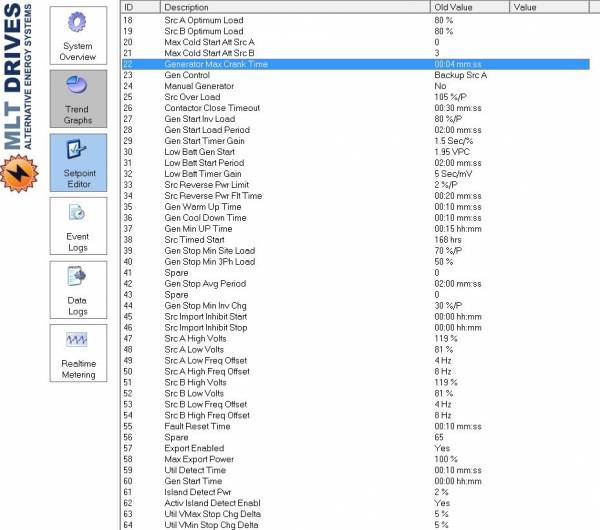
The Power Star from MLT Drives can fully control a generator as a secondary 240VAC source. There are setpoint parameters to set crank time, syncing, loads, etc. As well as power-off after a defined time once the grid is energised.

I'd consider some batteries at least, enough to carry you for even ten minutes. What you want is enough to bridge the gap between the power cut and the auto-start and syncing of the generator power - maybe two or three minutes at a minimum.

Some setpoints in the MLT Drives inverter:
mlt_generator-control.JPG
 
Last edited:
Thanks for the info.

Going to put the batteries on hold for now. Going to rather increase the size of the panels and inverter and buy a generator for when Eskom goes down.

If I double the panels and add another inverter would I need anything else to be able to feed back into the grid?

Can the MPPT inverter feed back in?

What generator would be suitable?

Remember that there is no official feed back policy yet. So you would first need to speak to your local power provider and come to an arrangement before you can feed power back. You would also need to get a special power meter installed for it to work, otherwise you run the risk of doubling your "consumption" if you feed power to your current meter.

So the current state of affairs is difficult, running off grid is very expensive, and you might not even be able to feed back into the grid. Only thing you can do is size your array correctly and maybe try and use the washing machine/dishwasher during the day while you have solar power. You will only be able to save during the day.

I think a general question to the other members are then what sort of savings are they getting during the day too make it worth while?
 
Thanks Arthur.

Now to find a supplier for a roof mounting system.

How good are the "Z" roof mounting on eBay. Local mounting systems are coming in at R400 per panel. Going to cost over on R15k for 36 panels for a tiled roof.
 
I have an old school meter but will be contacting CoCT municipality.

Maybe first find out from them before you go and buy excess panels etc.

Edit: I'm tempted to mail CityPower( Johannesburg ) but what are the odds that they will even have a clue...
 
Last edited:
On another topic. I have single phase power and noticed that Grid Tie Inverters above 5kW are almost all three phase. Is there some way one can cheaply convert/rewire a three phase inverter to single phase. Or maybe a higher power inverter?

I'm not too clued up on the grid tie inverters, if it says 5kW I assume you can only pull max 5kW from it? So I won't be able to turn on the washing machine/ dishwasher and microwave at the same time for instance?
 
I think a general question to the other members are then what sort of savings are they getting during the day too make it worth while?
My load and usage is untypical. I use around 40-50 kWh per 24h period, more or less evenly split between PVable daytime and no-PV dusk-to-dawn.

Before I started exporting in Nov 2012, we tried shifting heavier loads to daytime when PV power is being generated. Realistically this was only the dishwasher and washing machine. The pool in any case runs during the day, and though we cook on gas, we have an electric oven and my wife occasionally uses that from around 6pm or so when PV is dropping fast to zero.

The irrigation system is powered by a 1.09/0.75 kW pump, and it runs for 90 minutes a night.

When we're in we use the heatpump for hot water and that is set to run between 07h00 and 22h30 only. When guests are here (pretty often) we have two other regular geysers, which I switch on for the duration of their stay. I used to have them on timers, but now I just leave 'em on to manage themselves since it no longer matters what time of day we draw power.
 
On another topic. I have single phase power and noticed that Grid Tie Inverters above 5kW are almost all three phase. Is there some way one can cheaply convert/rewire a three phase inverter to single phase. Or maybe a higher power inverter?

I'm not too clued up on the grid tie inverters, if it says 5kW I assume you can only pull max 5kW from it? So I won't be able to turn on the washing machine/ dishwasher and microwave at the same time for instance?


Some of them can be combined to increase the kw. I spoke to the guys at the power store and their 3kw grid tied inverter can be hooked up in 3 to either go to 3 phase or to increase the kw to 9kw.
 
Doesn't that one run backwards if you feed in to the grid? :D


Yes it will. The idea is to export during the day and import at night with imports always being slightly more than exports. Generator for backup when grid goes down as battery backup is too expensive for now.
 
Top
Sign up to the MyBroadband newsletter
X