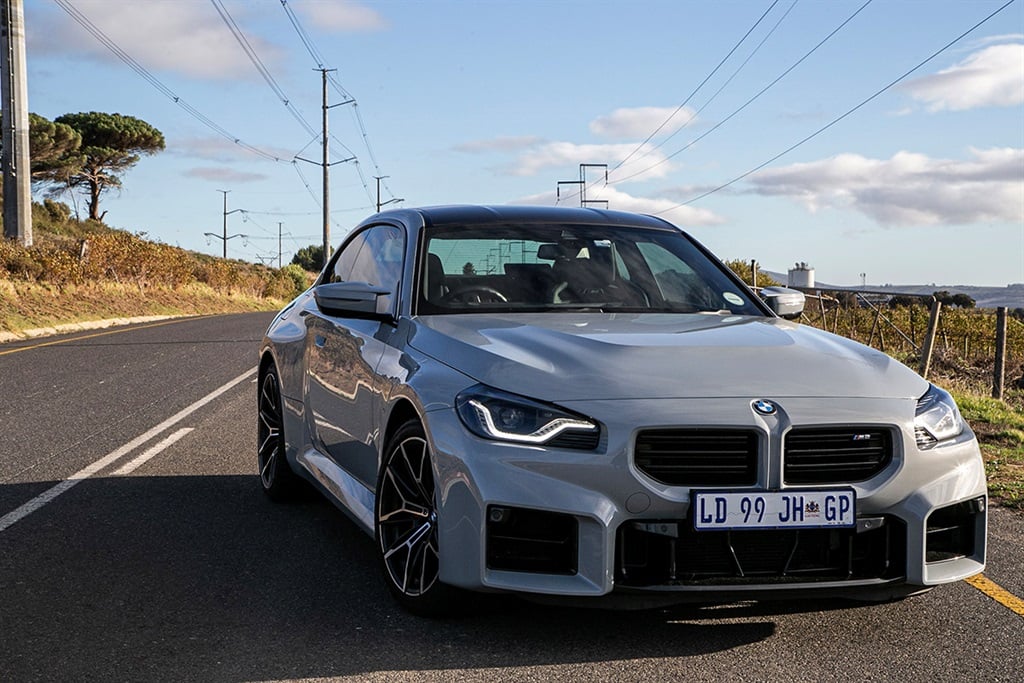
The BMW M2 & M2 Competition Thread

Manhart will give your G87 BMW M2 a cage and over 700bhp

Pretty in pink? Erm, maybe not, but Manhart’s modified M2 will be ballistically quick

Earlier this year Manhart unveiled a modified version of the BMW M2. It was called the MH2 560 and basically involved a bodykit, a new exhaust, lowering springs and an extra 100bhp or so for the 3.0-litre twin-turbo straight six engine. All very exciting, but at the time Manhart did say that the 560 wouldn’t be the end of its G87 tuning.

And lo, we come to the striking new MH2 GTR II. Instead of the standard M2’s 454bhp, this one has 705bhp and 627lb ft of torque thanks to a new ECU, a carbon intake and a free-breathing exhaust.

Manhart says that the GTR II can sprint from 62mph to 124mph (100kph to 200kph) in just 5.76 seconds, and although that’s the only performance figure on offer so far, we reckon the others will be just as impressive.

We’re told it's a ‘limited edition’ creation, with the bodywork clad in an aggressive carbon fibre aero kit and finished in a less aggressive ‘vibrant magenta’ paint. That wing is quite something too.

 
Saw this the other day. That poor car with all that salt water.

 
BMW has given the M2 more power, more speed and more colour

Not-so-baby M car gets a power and torque bump, but did it really need it?

At no point in Top Gear’s custody of a baby blue BMW M2 did we once think, ‘hmm, bit underpowered, this, could use another 20-odd horses and more torque’. BMW has clearly thought about it more than once, because it’s given it exactly that.

So, the not-so-baby BMW M car has been given an inflation-linked power and torque bump, which brings more speed in all the crucial, pub bore measures. Where the 3.0-litre twin-turbo straight-six once delivered 454bhp – loads for a small-ish, rear-drive coupe – it now develops 474bhp.

The M-experts among you will spot that this follows the refreshed M3 and M4 (which use the same engine) being bumped from 503bhp to 523bhp. So, the nostril twins stay just ahead of the ‘baby’ M car. And the marketing department can rest easy at night.

There’s more torque on offer, too – but only if you opt for the eight-speed automatic (which, whisper it, we actually preferred). So the self-shifter gets 443lb ft, while the six-speed manual gearbox, still an option, only comes with 406lb ft. Either figure is sufficient.

 
BMW M2

Setting out its stall as a textbook purveyor of driving pleasure for the purist, the new BMW M2 raises the bar for compact high-performance sports cars in the premium segment. Indeed, it elevates the performance experience in this vehicle class to a whole new level. The new BMW M2 lines up with even more power, greater visual impact than ever and innovative equipment features. Front and centre of this fresh round of updates to the car is the 15 kW/20 hp added to its output: the high-revving six-cylinder in-line petrol engine with M TwinPower Turbo technology now tops out at 353 kW/480 hp. And then there are the new design accents for the exterior, an updated interior and the introduction of BMW Operating System 8.5 to underpin the latest generation of BMW iDrive.

The package of updates for the elite compact sports car makes the first step into the world of high-performance models at BMW M GmbH even more attractive. The new BMW M2 takes its drive concept of a straight-six engine, six-speed manual gearbox (optional) and classical rear-wheel drive - a unique proposition among its rivals - to a new stage of evolution. In combination with its compact dimensions, chassis technology tuned perfectly for both everyday road driving and track use, and a state-of-the-art operating concept allowing individualisation of the car setup, this makes the new M2 ideally equipped to write the next chapter in the BMW M brand's history of success in this segment.

The new BMW M2 will be built alongside the new BMW 2-Series Coupé at BMW Group Plant San Luis Potosí in Mexico. It will be launched worldwide with a production phase-in from August 2024. More than 40 per cent of total sales will be recorded in Europe. The most important single market will be the USA, followed by Germany, China, Great Britain and Japan.

 
Top
Sign up to the MyBroadband newsletter
X