-
- News
-
Categories
- 5G
- ADSL
- AI
- Banking
- Black Friday
- Broadband
- Broadcasting
- Business
- Business Telecoms
- Cellular
- Cloud and Hosting
- Columns
- Cryptocurrency
- Energy
- Enterprise
- Fibre
- Gadgets
- Gaming
- Government
- Hardware
- Industry News
- Internet
- Internet of Things
- Investing
- IT Services
- Motoring
- Reviews
- Science
- Security
- Smartphones
- Software
- Technology
- Telecoms
- Trending
- Wireless
- Press Office
- Forum
- Industry News
- What's Next
- Company hub
- Speed Test
- About us
- Advertise with us
- Contact
- Careers


-
Join the MyBroadband community
South Africa’s biggest forum. Discuss, discover, and connect with thousands of members.
-
Question of the Day: Do you get motion sick?

You are using an out of date browser. It may not display this or other websites correctly.
You should upgrade or use an alternative browser.
You should upgrade or use an alternative browser.
The Brexit Thread
- Thread starter OrbitalDawn
- Start date
- Status
- Not open for further replies.

Gingerbeardman
Executive Member
- Joined
- Nov 6, 2018
- Messages
- 5,472
- Reaction score
- 1,174
In the first one, the shooting is being done with guns. In the second one, the shooting is being done with economic policies.I saw Xarog today.
Eveyone was getting shot, there was blood everywhere. Many people died.
Xarog was doing alot of the shooting.
....
I omitted the fact that you were doing the shooting with a camera.
Accurate or inaccurate description?
What's the problem? If you think that an economic policy is akin to a camera, so be it. But I mean come on, drawing Greece as literally drowning in its own tears is kinda funny. And it simply is the case that the EU's monetary and currency policy serves German economic interests at the costs of the smaller countries even though they have these huge debt burdens that typically nations can deal with through inflation, but which is now denied to the PIIGS because they're chained to the Euro, hence the causing of much economic misery.
Lol.In the first one, the shooting is being done with guns. In the second one, the shooting is being done with economic policies.
What's the problem? If you think that an economic policy is akin to a camera, so be it. But I mean come on, drawing Greece as literally drowning in its own tears is kinda funny. And it simply is the case that the EU's monetary and currency policy serves German economic interests at the costs of the smaller countries even though they have these huge debt burdens that typically nations can deal with through inflation, but which is now denied to the PIIGS because they're chained to the Euro, hence the causing of much economic misery.
No my analogy is to illustrate how omitting a fact, is critical and can lead to a very inaccurate description, interpretation or depiction of an event.
I am talking of the concept where you said an ommission does not mean it is inaccurate.
Gingerbeardman
Executive Member
- Joined
- Nov 6, 2018
- Messages
- 5,472
- Reaction score
- 1,174
Yes, but you're making the omission relevant when you talk about the different kinds of shooting. You haven't established why the omission in this case is in any way relevant to the point being made.Lol.
No my analogy is to illustrate how omitting a fact, is critical and can lead to a very inaccurate description, interpretation or depiction of an event.
I am talking of the concept where you said an ommission does not mean it is inaccurate.
The point is about Germany and how today it is leading all of Europe and they are all enslaved to it, similar to 1940.Yes, but you're making the omission relevant when you talk about the different kinds of shooting. You haven't established why the omission in this case is in any way relevant to the point being made.
Yet it omits Russia's belligerent role in 1940, so the comparison there is faulted, because as you have said, this is about Germany, but Germany was not the only one threatening Europe, Russia was literally killing thousands of Polish officers in the Katyn forrest and annexing parts of Finland ... So relevant and therefore this is an inaccurate characterisation of 1940 Europe.
If they had done the comic based on 1941 after Operation Barbarossa instead, then it would actually have had a point in that respect. The ignorance of the artist at play.
Then the chains and tears of present day. The UK have ably demonstrated that a country can leave. Not really a chain, if you can leave when you want to. The UK has delayed its leaving date, not the EU.
Then the tears ... nice virtue signalling to the Anti-EU populists. Contrasted against a Europe of 1940, the tears is even more ignorant. Countries experiencing peace and relative prosperity versus being Genocided.
Gingerbeardman
Executive Member
- Joined
- Nov 6, 2018
- Messages
- 5,472
- Reaction score
- 1,174
Not relevant to the point of the cartoon. Meaningless complaints.The point is about Germany and how today it is leading all of Europe and they are all enslaved to it, similar to 1940.
Yet it omits Russia's belligerent role in 1940, so the comparison there is faulted, because as you have said, this is about Germany, but Germany was not the only one threatening Europe, Russia was literally killing thousands of Polish officers in the Katyn forrest and annexing parts of Finland ... So relevant and therefore this is an inaccurate characterisation of 1940 Europe.
So because he won't make the point you want him to make, he's wrong.If they had done the comic based on 1941 after Operation Barbarossa instead, then it would actually have had a point in that respect. The ignorance of the artist at play.

Is there a chain around the UK? No. Why do you think that is?Then the chains and tears of present day. The UK have ably demonstrated that a country can leave. Not really a chain, if you can leave when you want to. The UK has delayed its leaving date, not the EU.
Oh okay, so because you don't want to deal with the economic realities that the cartoon is depicting, they're now invalid...Then the tears ... nice virtue signalling to the Anti-EU populists. Contrasted against a Europe of 1940, the tears is even more ignorant. Countries experiencing peace and relative prosperity versus being Genocided.
I am saying if he had used 1941 the cartoons point would have been better made he didn't so it is based on an ignorant view.Not relevant to the point of the cartoon. Meaningless complaints.
So because he won't make the point you want him to make, he's wrong.
Is there a chain around the UK? No. Why do you think that is?
Oh okay, so because you don't want to deal with the economic realities that the cartoon is depicting, they're now invalid...

If he knew more about the history of 1940 he would have seen it was stupid to use that situation for his point.
Yes there is no chain on the UK.
But, the point is the depiction of the chains is stupid as it implies slavery. Could slaves break free on their own volition?
Ignorant characterisations, inaccurate depictions. Stupid.
Gingerbeardman
Executive Member
- Joined
- Nov 6, 2018
- Messages
- 5,472
- Reaction score
- 1,174
These are inconsequential criticisms that in no way detract from the central point of the cartoon. It's a cartoon, not a fscking history lesson.I am saying if he had used 1941 the cartoons point would have been better made he didn't so it is based on an ignorant view.
If he knew more about the history of 1940 he would have seen it was stupid to use that situation for his point.
The banks of which nation owns the majority of PIIGS debts? Does the modern economic order allow nation-states to default on their debts?Yes there is no chain on the UK.
But, the point is the depiction of the chains is stupid as it implies slavery. Could slaves break free on their own volition?
Not really, you're missing the point of the cartoon and then criticising it out of ignorance.Ignorant characterisations, inaccurate depictions. Stupid.

Dave
Honorary Master
Jesus, Xarog, you do know how to stifle a thread with pages of obtuse gobbledygook...

biometrics
Honorary Master
- Joined
- Aug 7, 2003
- Messages
- 71,856
- Reaction score
- 2,240
Are we there yet?Jesus, Xarog, you do know how to stifle a thread with pages of obtuse gobbledygook...

Hamish McPanji
Honorary Master
Ja. Frikkin hell. This thread has become as unreadable as the Trump oneJesus, Xarog, you do know how to stifle a thread with pages of obtuse gobbledygook...
Gingerbeardman
Executive Member
- Joined
- Nov 6, 2018
- Messages
- 5,472
- Reaction score
- 1,174
www.euvisions.eu/germanys-leadership-revisited/
Of course, those who would point to the financial/economic undercurrents within the EU must be crazy to think that Germany exerts a disproportionate amount of influence...
Germany has certainly played a dominant role in managing the Eurozone crisis since May 2010. Although the EU Commission initially warned that the Greek public debt crisis might easily spread to other Eurozone member states, Berlin insisted that this was a ‘national problem’ that needed to be dealt by the Greek government. At this time, removing Greece from the Eurozone was still an option, and ‘Grexit’ became a frequently used word. The fact that Berlin repositioned itself and declared its general willingness to lend bilateral support was in part caused by the lack of a legal method of expelling Greece from the common currency area. What’s more, France and other Southern European members of the Eurozone were sharply critical of this early German positioning, arguing for a much less stringent conditionality between rule compliance and Eurozone membership. Nevertheless, Berlin confronted its Eurozone partners from the beginning with non-negotiable demands as a requirement for German contributions to any rescue scheme.
To enforce tighter controls on indebted Eurozone countries, Germany almost unilaterally ensured the involvement of the International Monetary Fund (IMF) not only in bilateral aid packages for Greece but also in the establishment of the European Financial Stability Facility (EFSF). Moreover, Germany linked the IMF’s involvement in the European rescue fund with member countries’ individual efforts to consolidate their budgets and with a commitment to a ‘culture of stability’ within the Eurozone. Concerning the highly disputed issue of the establishment of Eurobonds, Germany acted as a real veto player. Both German Chancellor Angela Merkel and Finance Minister Wolfgang Schaeuble repeatedly stressed the idea that Germany would not accept the mutualisation of debt because it would violate German and European rules prohibiting financial bail-outs of individual Eurozone member states.
Germany promulgated its rule-based agenda for the Eurozone, which culminated in the so-called ‘Fiscal Compact’. Agreed on in December 2011, this Fiscal Compact included a debt brake (whose incorporation into national law is subject to scrutiny by the European Court of Justice), a balanced budget (the annual structural deficit may not exceed the threshold of 0.5 percent of GDP), and automatic sanctions (which can only be avoided through a reversed qualified majority in the Council of Ministers) for ‘budgetary sinners’. This pact also provided for the strengthening of governance structures within the Eurozone, the enhancement of Brussels’ right to shape national budgetary planning, and the transformation of the temporary EFSF rescue fund into the permanent European Stability Mechanism (ESM). The German government was also the main architect behind the European banking union. Under the new Bank Recovery and Resolution Directive (BRRD) agreed on in 2014, banks are expected to first turn to private sources for additional capital – including a minimum ‘bail-in’ of 8 percent of a bank’s liabilities – before public capital can be used. However, Berlin rejects plans for a European Deposit Insurance Scheme (EDIS). Brussels wants the EU bank deposit guarantee scheme to be a ‘third’ pillar of the banking union along with a new system of bank oversight (the so-called ‘Single Supervisory Mechanism’) run by the European Central Bank (ECB) and the ‘Single Resolution Mechanism’, which ensure the efficient resolution of failing banks with minimal costs for taxpayers.
Although Germany has assumed a pivotal role in the Eurozone crisis, it was neither willing nor in a position to assume benevolent, solidary leadership within the Eurozone in the sense foremost defined by Kindleberger. First, rather than providing peripheral countries in the Eurozone with a market for their distress goods, the Germans have been selling vast amounts of manufactured goods to the periphery. In 2010, Germany recorded a surplus of more the 190 billion EUR; taken together, the smaller and more peripheral Eurozone economies revealed a deficit at the same level. Brussels has repeatedly criticised Germany’s trade surplus, which has exceeded the limit of 6 percent permitted within the EU for several years. In 2017, Germany’s trade surplus reached a new record of 8.7 percent of GDP. Although the trade surplus in relation to the Eurozone was brought down by half to around 2 percent of GDP, Germany’s export-oriented economy hardly presents a long-term sustainable model for the Eurozone.
Second, contrary to what we would expect from a benevolent leadership, the German economy reacted in a more pro- than anti-cyclical manner with regard to the provision of long-term capital, which did nothing to calm speculation on the financial and capital markets. Before the outbreak of the sovereign debt crisis, the German banking sector invested massively and bought government bonds in the southern countries of the Eurozone. In late 2010, German bank exposures in Greece, Ireland, Portugal, and Spain – the PIGS countries – amounted to around 513 billion USD. Germany’s claims were far greater than those of France (409 billion USD) and Italy (76 billion USD). However, with the outbreak of the Eurozone crisis, the German credit industry sharply decreased its financial engagement within the Eurozone. While the German credit market’s claims on the Eurozone decreased by 17 per cent between 2009 and 2012, the decline was even more drastic in the PIGS countries, which amounted to 281 billion USD in 2012.
Of course, those who would point to the financial/economic undercurrents within the EU must be crazy to think that Germany exerts a disproportionate amount of influence...

NarrowBandFtw
Honorary Master
nah man, don't come here with your facts, remember the holocaust, the modern EU is so much better!www.euvisions.eu/germanys-leadership-revisited/
Of course, those who would point to the financial/economic undercurrents within the EU must be crazy to think that Germany exerts a disproportionate amount of influence...
Gingerbeardman
Executive Member
- Joined
- Nov 6, 2018
- Messages
- 5,472
- Reaction score
- 1,174
And now that you have the examples...?Germany's economic success is based on many factors other than EU economic policy being geared towards German interests above everyone else. They would be a successful economy in or out of the EU. I would like examples of how EU economic policy is geared towards German interests above everyone else, as was claimed.
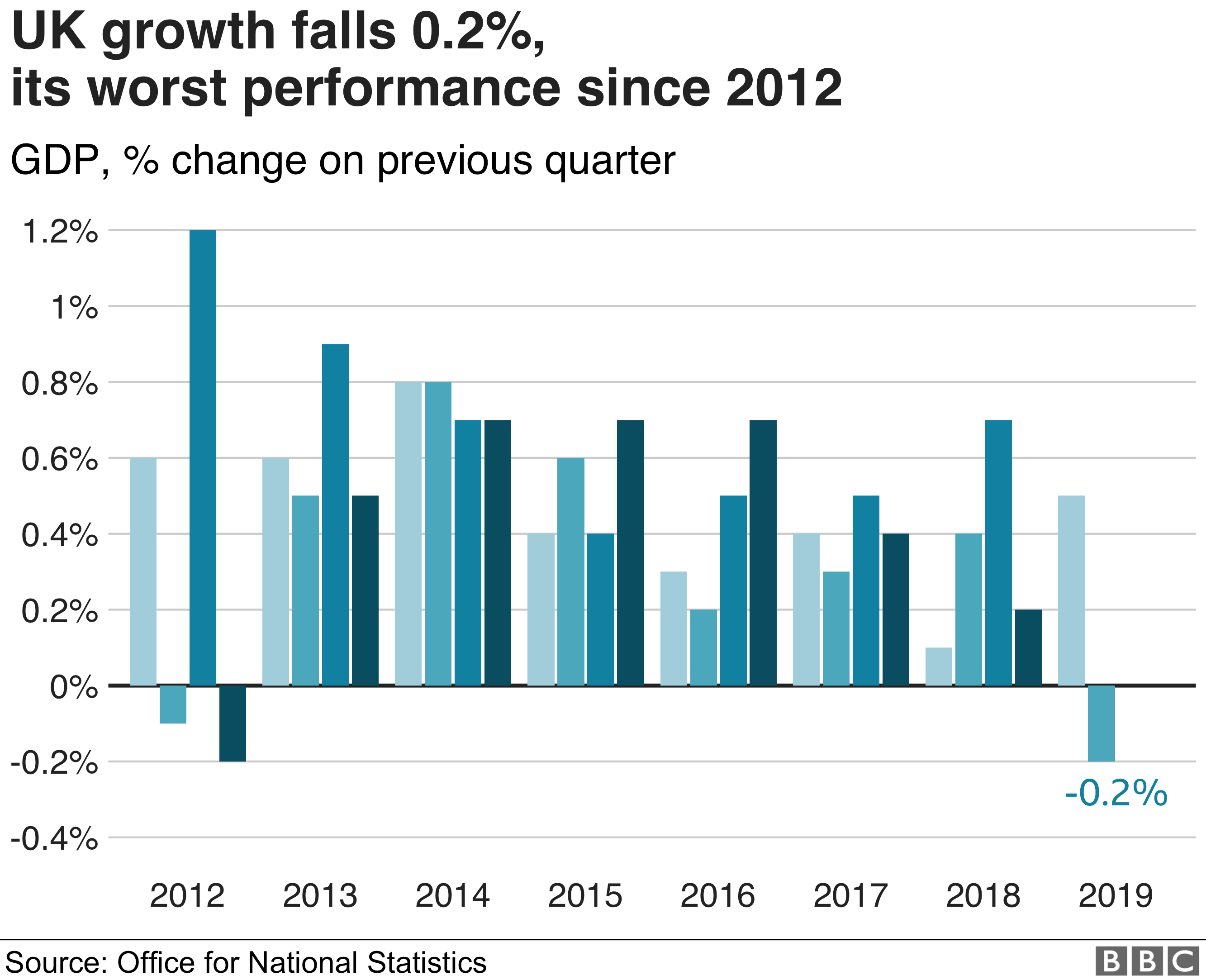
UK economy contracted for first time since 2012.
https://www.bbc.co.uk/news/business-49290926
Not at all a favourable economic position, heading into a no Deal Brexit.
https://www.bbc.co.uk/news/business-49290926
Not at all a favourable economic position, heading into a no Deal Brexit.

theratman
Honorary Master
I wonder how much of a no deal Brexit is factored into the slide.UK economy contracted for first time since 2012.
https://www.bbc.co.uk/news/business-49290926
Not at all a favourable economic position, heading into a no Deal Brexit.
Nice chart in the BBC piece. Getting an error trying to attach it though

Dave
Honorary Master
Nice chart in the BBC piece. Getting an error trying to attach it though
This one?


theratman
Honorary Master
Yeah thanks, can't seem to edit and add an image on the app. Didn't want to post twice.This one?

Dave
Honorary Master
how does that compare to the eurozone?
a few months back the uk was third fastest among the 5 big economies in the eu
Found this with a quick google

https://tradingeconomics.com/euro-area/gdp-growth
- Status
- Not open for further replies.