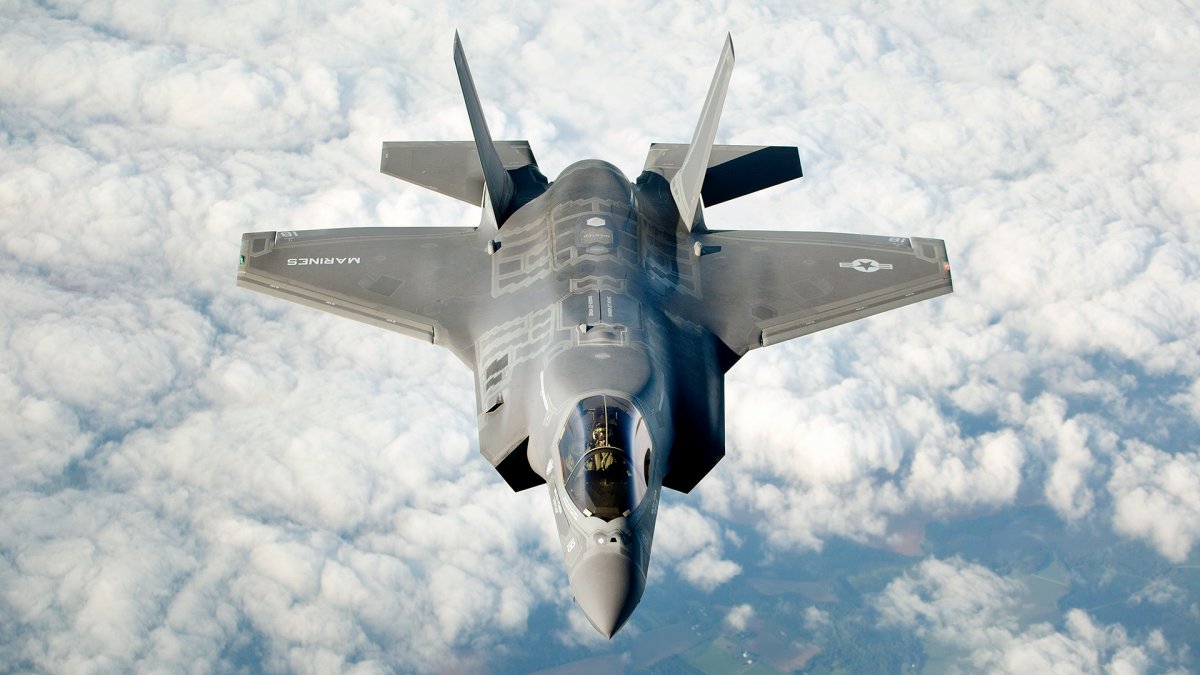
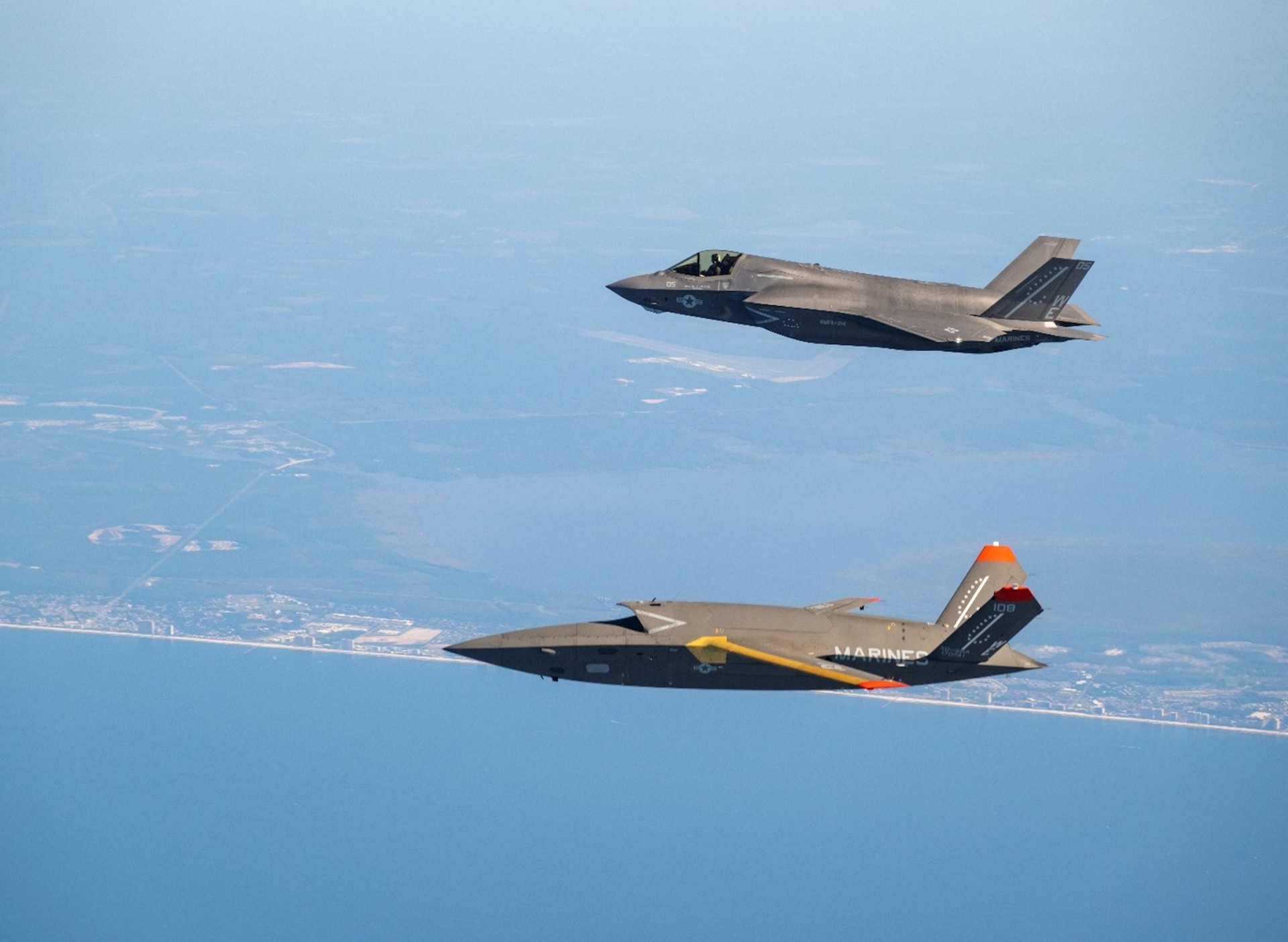
The F-35 thread

Was at the Thunder Over East Texas airshow in Athens TX this past Friday afternoon. They had a single F-35A impressively flown by a woman pilot. Noteworthy awesomeness was the ultra-slow flyby at around 100 knots, and an insane "handbrake turn" tactical maneuver -- throw the tail past the nose on full rudder with nose up, slide nose to point in opposite direction, then accelerate out on full afterburner. The plane doesn't fly the turn - it's vaulted round and then 43 000 pounds of blow move the machine into a vertical climb. First time I've ever seen that in the flesh.

Impressive as mechanical and flying performance is, that's very much secondary to the F-35 stuff you can't demo at an airshow: Sensor fusion. Software-defined fighter.
 
Way back already. It didn't take me long to come to the conclusion that negativity around the F-35 came in three forms. Sour grapes, strategically intentional (Straight from Uncle Sam of course), and misinformed.
I am solidly in the three distinct airframes with shared avionics would’ve been better camp.
 
I am solidly in the three distinct airframes with shared avionics would’ve been better camp.
That's pretty much what the F-35 is. There are airframe differences, as per the different requirements of the Air Force, Marines and Navy. But commonality where it makes sense in order to instantiate a common electronic and systems architecture on which to integrate future combat systems. Round about now-ish, once a sufficient level of experience has been built, the new platforms can begin to differentiate, eg whatever NGAD, AI wingmen, etc turn out to be.

Also, remember that the JSF is only one of several air dominance projects on the go, all at various stages of development. The roadmap, constantly evolving of course, looks at least twenty years ahead.
 
I am solidly in the three distinct airframes with shared avionics would’ve been better camp.
For what purpose exactly though? The US already had hundreds of capable fighter jets across the spectrum. Likely, more than they need until well into the 30s. 6th gen has been in development for yonks.

They didn't need a unique Navy 5.5th gen, and a unique army 5.5th gen and a unique air force 5.5th gen. They needed a versatile 5.5th gen. Singular. To bring new technologies into operation, everywhere. And, as a test platform. Yet, still more capable than almost anything out there, in all those roles. Let alone when they can build them in the thousands. Do you understand what an absolute coup it is? That they could build something like that? The sheer luxury of it.

They're not fools Blu. They know what they need. And they can build fighter jets. Exceedingly well. The days of dogfighting are over until stealth is invalidated. And I wouldn't be surprised if the F-35 remains relevant until the 60s.
 
Last edited:
For what purpose exactly though? The US already had hundreds of capable fighter jets across the spectrum. Likely, more than they need until well into the 30s. 6th gen has been in development for yonks.

They didn't need a unique Navy 5.5th gen, and a unique army 5.5th gen and a unique air force 5.5th gen. They needed a versatile 5.5th gen. Singular. To bring new technologies into operation, everywhere. And, as a test platform. Yet, still more capable than almost anything out there, in all those roles. Let alone when they can build them in the thousands. Do you understand what an absolute coup it is? That they could build something like that? The sheer luxury of it.

They're not fools Blu. They know what they need. And they can build fighter jets. Exceedingly well. The days of dogfighting are over until stealth is invalidated. And I wouldn't be surprised if the F-35 remains relevant until the 60s.
The Navy versus Air Force landing comparison video is a good reason why a separate platform would've better. With the initial idea of the common air frame the USAF aircraft now has structural elements required for the Navy aircraft and that weigh could have been used to improve another aspect of their aircraft. That is my 10c. Its the same reason why two engines on a navy aircraft might be a slightly better idea that one.
 
The Navy versus Air Force landing comparison video is a good reason why a separate platform would've better. With the initial idea of the common air frame the USAF aircraft now has structural elements required for the Navy aircraft and that weigh could have been used to improve another aspect of their aircraft. That is my 10c. Its the same reason why two engines on a navy aircraft might be a slightly better idea that one.
Here's a Navy F-35B landing

Ballpark same top speed. On the other hand that F-18 is overengineered for a grueling traditional deck landing, and a shortish traditional takeoff. It's only slightly faster, because of the twin engines, and the inclusion of the F-35 VTOL fan. Note. Slightly. The F-18 needs the powerful twin engines to take off. It can't maneuver worth a **** at high speed. Can only handle about 7.5Gs positive and 3 negative. While the F-35 can do 9. In all other respects it's severely dated compared to the F-35. All of them. Navy F-18 operational range: ~1000km at a stretch. F-35: >1500km. Navy F-18 stealth: lol Electronics: Toaster
 
Last edited:
Here's a Navy F-35B landing

Ballpark same top speed. On the other hand that F-18 is overengineered for a grueling traditional deck landing, and a shortish traditional takeoff. It's only slightly faster, because of the twin engines, which it needs to take of. Yet it can't maneuver worth a **** at high speed. Can only handle about 7.5Gs positive and 3 negative. While the F-35 can do 9. In all other respects it's severely dated compared to the F-35. All of them. Navy F-18 operational range: ~1000km at a stretch. F-35: >1500km. Navy F-18 stealth: lol Electronics: Toaster
Here is a comparison between a air-force and navy pilot landing an aircraft. The F-35A has structural elements designed for The F-35C while both the F-35A and F-35C have structural elements required by the F-35B. If they started with three separate air-frames they will have ended up with a better aircraft for each role.

 
Last edited:
Here is a comparison between a air-force and navy pilot landing an aircraft. The F-35A has structural elements designed for The F-35C while both the F-35A and F-35C have structural elements required by the F-35B. If they started with three separate air-frames they will have ended up with a better aircraft for each role.

 
And the air force air frame is partially designed to survive this which takes away from other stuff it could've been doing better.
The Navy F-35 doesn't land that way. It doesn't have to. It doesn't have to be engineered to survive ****. It lands and takes off like a freaking hummingbird. You can pack them onto a flight deck like sardines. The NAVY's most assuredly getting roughly a gazzillion times more aerospace power due to this. The air force variant lands just fine on normal runways. And likewise it's not engineered to land any other way. Doesn't have a VTOL fan built in. That space is better used. **** knows how exactly. More than half of it is likely classified. Likely compute in large part. For it's actual role alongside the rest of the air force. Battlefield arbiter. Force multiplier. Long range sniper.

You're so stuck on one single point. That three different jets have to absolutely be the best they can possibly be at traditional, i.e. anachronistic, dog fighter roles - On the modern battlefield. Forget $1.7 trillion. That'd be a bargain then. Altogether you'd be looking at somewhere north of $10 trillion. The F-22 still exists. It's still a monster. The betsest air force jet (6th gen) is in ongoing development, and is likely going to be an even bigger monster.

Get unstuck bra. You're missing the entire strategic discussion around the matter.
 
Last edited:
Was at the Thunder Over East Texas airshow in Athens TX this past Friday afternoon. They had a single F-35A impressively flown by a woman pilot. Noteworthy awesomeness was the ultra-slow flyby at around 100 knots, and an insane "handbrake turn" tactical maneuver -- throw the tail past the nose on full rudder with nose up, slide nose to point in opposite direction, then accelerate out on full afterburner. The plane doesn't fly the turn - it's vaulted round and then 43 000 pounds of blow move the machine into a vertical climb. First time I've ever seen that in the flesh.

Impressive as mechanical and flying performance is, that's very much secondary to the F-35 stuff you can't demo at an airshow: Sensor fusion. Software-defined fighter.

A picture is worth a thousand words,
 
The Navy F-35 doesn't land that way. It doesn't have to. It doesn't have to be engineered to survive ****. It lands and takes off like a freaking hummingbird. You can pack them onto a flight deck like sardines.

It still has to be able to do a normal carrier landings, especially if they have technical issues, and that's why they have arrestor hooks and practice normal landings.

 
The Navy versus Air Force landing comparison video is a good reason why a separate platform would've better. With the initial idea of the common air frame the USAF aircraft now has structural elements required for the Navy aircraft and that weigh could have been used to improve another aspect of their aircraft. That is my 10c. Its the same reason why two engines on a navy aircraft might be a slightly better idea that one.

Stop! I am already sold. A USAF plane with a USN plane structure, just think about how long that sucker will last. :love: #longevitywin
 
Top
Sign up to the MyBroadband newsletter
X