


-
- News
-
Categories
- 5G
- ADSL
- AI
- Banking
- Black Friday
- Broadband
- Broadcasting
- Business
- Business Telecoms
- Cellular
- Cloud and Hosting
- Columns
- Cryptocurrency
- Energy
- Enterprise
- Fibre
- Gadgets
- Gaming
- Government
- Hardware
- Industry News
- Internet
- Internet of Things
- Investing
- IT Services
- Motoring
- Reviews
- Science
- Security
- Smartphones
- Software
- Technology
- Telecoms
- Trending
- Wireless
- Press Office
- Forum
- Industry News
- What's Next
- Company hub
- Speed Test
- About us
- Advertise with us
- Contact
- Careers
-
Join the MyBroadband community
South Africa’s biggest forum. Discuss, discover, and connect with thousands of members.
-
Question of the Day: Best South African stand-up comedians you've seen?
- Forums
- General discussions
- Motoring and Transportation: Cars, Bikes and Plane
- General Motoring News and Reviews
You are using an out of date browser. It may not display this or other websites correctly.
You should upgrade or use an alternative browser.
You should upgrade or use an alternative browser.
The Ford Mustang Thread
- Thread starter FiestaST
- Start date
FiestaST
Honorary Master
FiestaST
Honorary Master
BMW M2 vs Ford Mustang Dark Horse - Petrol Ped
FiestaST
Honorary Master
Ford Mustang FP800S Revealed with 596 kW
Ford has quietly unveiled the 596 kW Mustang FP800S Bronze Magneride package, which adds styling and performance upgrades to the seventh-generation Mustang.
Ford’s Custom Garage has revealed the FP800S Bronze Magneride package for the current-generation Mustang, which includes bronze and carbon-fibre exterior accents, updated suspension and increased power.
The Bronze Magneride package adds a 3.0-litre Whipple supercharger to the standard 5.0-litre V8 Coyote engine; upping the power output to a healthy 596 kW. That’s a 262 kW increase over the 334 kW produced by the (SA-spec) Mustang Dark Horse. Other performance upgrades include an air and oil separator, upgraded half-shaft , lowered suspension and a Ford Performance cat-back exhaust system.
The exterior is distinguished by 19-inch Bronze R1 wheels, shod in Pirelli Trofeo RS tyres, FP800S bronze decals, a carbon-fibre rear spoiler and a unique modular grille with bronze inserts. Other details include a bronze lug nut kit, wheel arch spats and Ford Performance badges on the front grille and gloss black boot trim. Along with the carbon-fibre spoiler, the FP800S also receives a carbon-fibre front splitter, bonnet vent and mirror caps.

 www.carmag.co.za


Ford has quietly unveiled the 596 kW Mustang FP800S Bronze Magneride package, which adds styling and performance upgrades to the seventh-generation Mustang.
Ford’s Custom Garage has revealed the FP800S Bronze Magneride package for the current-generation Mustang, which includes bronze and carbon-fibre exterior accents, updated suspension and increased power.
The Bronze Magneride package adds a 3.0-litre Whipple supercharger to the standard 5.0-litre V8 Coyote engine; upping the power output to a healthy 596 kW. That’s a 262 kW increase over the 334 kW produced by the (SA-spec) Mustang Dark Horse. Other performance upgrades include an air and oil separator, upgraded half-shaft , lowered suspension and a Ford Performance cat-back exhaust system.
The exterior is distinguished by 19-inch Bronze R1 wheels, shod in Pirelli Trofeo RS tyres, FP800S bronze decals, a carbon-fibre rear spoiler and a unique modular grille with bronze inserts. Other details include a bronze lug nut kit, wheel arch spats and Ford Performance badges on the front grille and gloss black boot trim. Along with the carbon-fibre spoiler, the FP800S also receives a carbon-fibre front splitter, bonnet vent and mirror caps.
Ford Mustang FP800S Revealed with 596 kW
Sporting uprated power and styling upgrades, Ford has unveiled the Mustang FP800S Bronze Magneride Package...
www.carmag.co.za
FiestaST
Honorary Master
Corvette ZR1 vs Ford Mustang GTD: Against The Clock | Top Gear
Last edited:
FiestaST
Honorary Master
FiestaST
Honorary Master
Corvette ZR1 vs Mustang GTD vs 911 GT3 RS: Record-Breaking Lap Battle —Cammisa’s Ultimate Lap Battle - Hagerty
FiestaST
Honorary Master
Ford Mustang GTD: Faster Than A GT3 RS? | Stig Laps - Top Gear
FiestaST
Honorary Master
FiestaST
Honorary Master
5 Least Fuel-Efficient Vehicles CAR Magazine Tested in 2025
We have rounded up the five least fuel-efficient vehicles CAR magazine tested in 2025. See the list below.
We’ve previously rounded up the five most fuel-efficient vehicles CAR magazine tested in 2025. Now we take a look at the cars that proved the least economical on our standardised 100 km mixed-use (urban and motorway) fuel route.
5. Aston Martin Vantage Coupé: 13.9 L/100 km (12.1 L/100 km claimed)
4. Jeep Wrangler Limited 2.0T Rubicon: 14.0 L/100 km (11.9 L/100 km claimed)
3. Ford Mustang GT Fastback: 14.62 L/100 km (12.8 L/100 km claimed)
2. Ford Mustang Dark Horse: 14.87 L/100 km (12.8 L/100 km claimed)
1. Land Rover Defender Octa Edition One: 15.70 L/100 km (13.5 L/100 km claimed)
 www.carmag.co.za
We have rounded up the five least fuel-efficient vehicles CAR magazine tested in 2025. See the list below.
We’ve previously rounded up the five most fuel-efficient vehicles CAR magazine tested in 2025. Now we take a look at the cars that proved the least economical on our standardised 100 km mixed-use (urban and motorway) fuel route.
5. Aston Martin Vantage Coupé: 13.9 L/100 km (12.1 L/100 km claimed)
4. Jeep Wrangler Limited 2.0T Rubicon: 14.0 L/100 km (11.9 L/100 km claimed)
3. Ford Mustang GT Fastback: 14.62 L/100 km (12.8 L/100 km claimed)
2. Ford Mustang Dark Horse: 14.87 L/100 km (12.8 L/100 km claimed)
1. Land Rover Defender Octa Edition One: 15.70 L/100 km (13.5 L/100 km claimed)
5 Least Fuel-Efficient Vehicles CAR Magazine Tested in 2025
We have rounded up the five least fuel-efficient vehicles CAR magazine tested in 2025. See the list below...
www.carmag.co.za
FiestaST
Honorary Master
Autocar review of the Mustang GTD
FiestaST
Honorary Master
FiestaST
Honorary Master
Dodge Charger Six Pack Scat Pack vs Ford Mustang Dark Horse vs Dodge Challenger SRT Hellcat Redeye Widebody: Drag Race - Car Throttle
FiestaST
Honorary Master
Dream desert drive: Flat out in the savage 815bhp Ford Mustang GTD
The GTD is the most extreme Mustang ever to wear numberplates - we take unleash its wild side
I wonder if Ford would have liked to build this car 10 years ago. Back then it was planning to return to Le Mans, given it was approaching 50 years since the GT40 had won there, and senior Ford bods wanted to do that with a Mustang.
It was the swankiest car they made and they thought it would be good to see it racing: win on (Saturday and) Sunday, sell on Monday. But the more Ford's engineers looked into it, the more they thought they couldn't make it competitive.
The Mustang would be a big car for endurance racing's GTE category, and while various 'Balance of Performance' allowances would be made for that, giving it more power than some rivals, there would be a limit to how fast they could make a car with such a large frontal area.
So on the sly the engineers started developing the GT, with its narrow cockpit and standing just 1.8 inches higher than the 40in-tall GT40. The bosses were convinced, and it was so naturally fast that race cars routinely had their power capped so they didn't run away with it in competition. But it was a race car that became a road car, rather than the other way around.
The Mustang itch seemingly remained unscratched, because a decade and a generation of Mustang later, Ford still really wanted to race one at Le Mans, so it made a GT3-class variant. With a gearbox mounted at the rear, suspension by Multimatic (the Canadian company that co-developed, builds and helps race the car) and more trickery besides, it has a Le Mans class podium to its name.
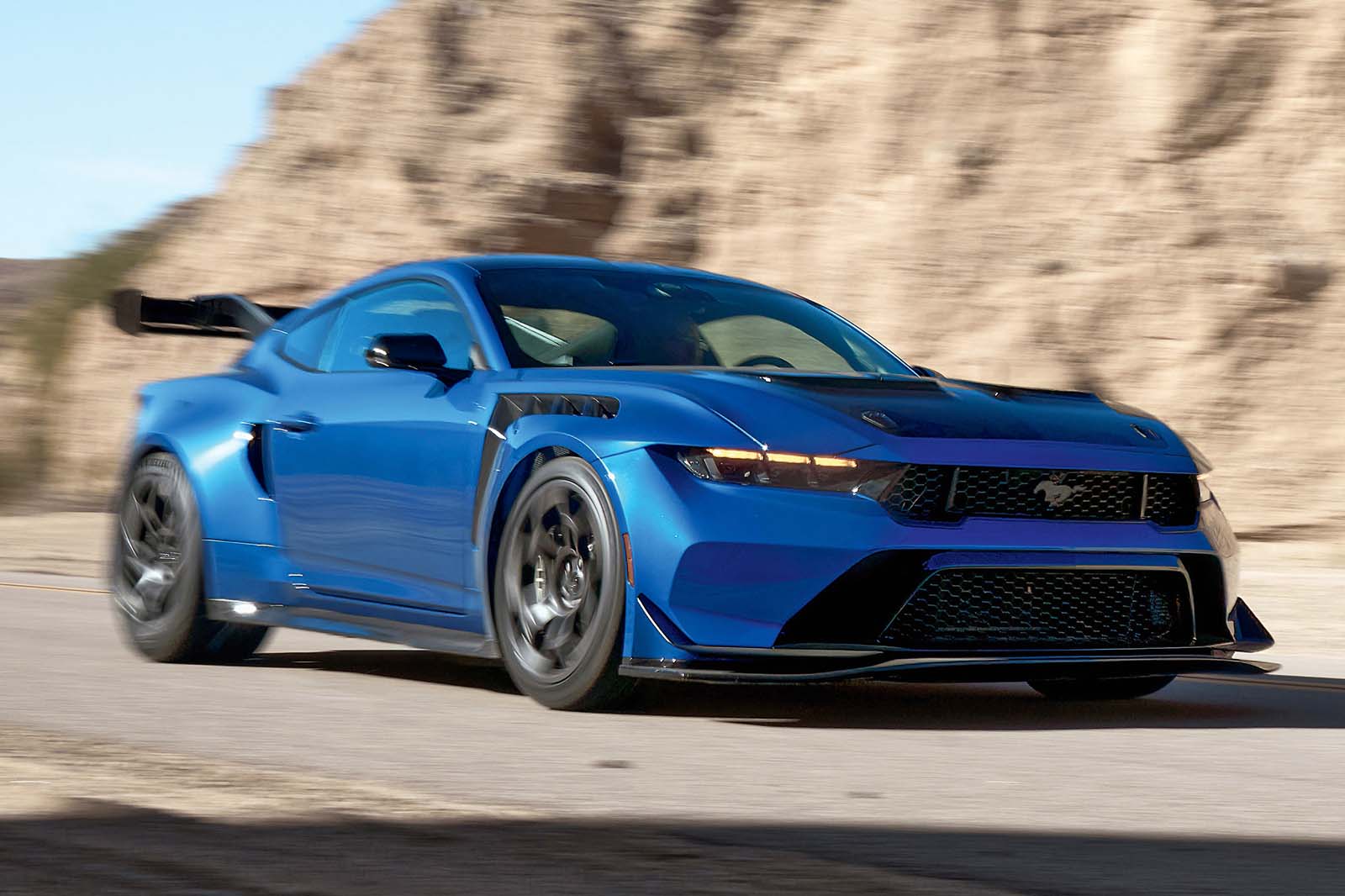
 www.autocar.co.uk


The GTD is the most extreme Mustang ever to wear numberplates - we take unleash its wild side
I wonder if Ford would have liked to build this car 10 years ago. Back then it was planning to return to Le Mans, given it was approaching 50 years since the GT40 had won there, and senior Ford bods wanted to do that with a Mustang.
It was the swankiest car they made and they thought it would be good to see it racing: win on (Saturday and) Sunday, sell on Monday. But the more Ford's engineers looked into it, the more they thought they couldn't make it competitive.
The Mustang would be a big car for endurance racing's GTE category, and while various 'Balance of Performance' allowances would be made for that, giving it more power than some rivals, there would be a limit to how fast they could make a car with such a large frontal area.
So on the sly the engineers started developing the GT, with its narrow cockpit and standing just 1.8 inches higher than the 40in-tall GT40. The bosses were convinced, and it was so naturally fast that race cars routinely had their power capped so they didn't run away with it in competition. But it was a race car that became a road car, rather than the other way around.
The Mustang itch seemingly remained unscratched, because a decade and a generation of Mustang later, Ford still really wanted to race one at Le Mans, so it made a GT3-class variant. With a gearbox mounted at the rear, suspension by Multimatic (the Canadian company that co-developed, builds and helps race the car) and more trickery besides, it has a Le Mans class podium to its name.
815bhp and fighter-jet parts: Driving the Le Mans-inspired £315,000 road legal Mustang GTD | Autocar
The GTD is the most extreme Mustang ever to wear numberplates - we take unleash its wild side
www.autocar.co.uk
FiestaST
Honorary Master
FiestaST
Honorary Master
FiestaST
Honorary Master

HAL 9000
Honorary Master
- Joined
- May 27, 2008
- Messages
- 22,541
- Reaction score
- 26,289
Classic Look Modern BEAST Revology Boss 429 Mustang | Jay Leno's Garage
Jay Leno gets behind the wheel of a modern masterpiece: the Revology 1969 Mustang Boss 429. While it looks like a pristine survivor from 1969, this is a ground-up "re-engineering" featuring an all-new steel body and state-of-the-art Ford performance technology.
Tom Scarpello, CEO of Revology, explains how his team specialized in the Mustang platform to fix the original car's biggest flaw—a front-heavy "iron lump" engine that made it plow through corners. Instead, this version uses a supercharged Gen 4 "Coyote" V8 (the Dark Horse engine) producing over 710 horsepower.
In this episode, Jay and Tom discuss:
The Powerplant: Why the supercharged Coyote engine outperforms the original 429 in both efficiency and drivability.
Engineering Perfection: The use of CAD design, automated spot welding, and structural adhesives to create a chassis significantly stiffer than anything built in the 60s.
The Interior: A $400,000 build quality featuring genuine walnut veneers, bespoke metal controls, and premium leather sourced from Rolls-Royce.
Modern Reliability: How a hybrid CAN bus electrical system reduced wiring by 75% while adding features like power mirrors and Harman Kardon audio.
Watch Jay take the first completed production vehicle out for a spin and see why he calls it "as good as any car that comes out of a factory".
FiestaST
Honorary Master
Alanis King first look at the Mustang Dark Horse SC