The SA Vehicle Industry Thread

2021 and 2022: Growth projections for the SA car market

After a disastrous 2020 that saw South African vehicle sales plummet by 29 percent to just 380 206 units as the Covid-19 pandemic ravaged the economy, the industry is poised for growth in 2021 and 2022.

In its latest quarterly review of the South African motor industry, Naamsa has predicted that the overall new vehicle market will grow by 15 percent to 438 000 units in 2021, and then by another 5,7 percent to total 463 000 units in 2022. Although this is encouraging, it will however take years for the market to recover to pre-Covid levels when vehicle sales averaged around 540 000 units a year.

Bakkies and other light commercial vehicles will be leading the comeback charge, with LCV sales projected to grow by 16,3 percent in 2021 and 6,2 percent in 2021. Passenger car sales, on the other hand, are expected to grow by 15,5 percent this year and 5,2 percent next year.

According to Naamsa, motor company bosses generally agree that the automotive industry is poised for much improved business conditions over the next six months.

 
Government, motor industry edging towards strategy on electric cars

Trade, industry & competition minister Ebrahim Patel is expected to make an announcement on policy soon


Electric cars to be cheaper than petrol models before 2030 – report

Global demand for electric cars is poised to explode in the coming decade, yet formidable challenges remain. Range anxiety is a major concern for many potential buyers, while charging infrastructure is still lacking in many countries. But perhaps the biggest hurdle to mass EV acceptance is how much an electric vehicle costs.

The lithium ion batteries that electric vehicles need to ensure a reasonable driving range between charges are incredibly expensive at the moment, but the good news is that as production scale increases, these prices are coming down.

But how long will it take before an electric vehicle is cheaper to produce than the equivalent petrol-engined variant? As first reported by The Guardian, BloombergNEF is forecasting that larger electric vehicles will reach cost parity with their combustion engined counterparts by 2026, while smaller and more affordable vehicles should reach that level by 2027.

Interestingly, the report also predicts that by the year 2030 an average medium-sized electric vehicle on sale in Europe will actually be 18 percent less expensive than the equivalent petrol or diesel model, and that’s before taking any taxation differences into account. In fact, at this cost level subsidies and incentives simply won’t be needed.

Other predictions are even bolder, with UBS recently stating that EVs and ICE cars will reach cost parity by 2024, according to The Guardian.

 
SA must step up production of EVs for export or be left behind, says Patel

Patel added that efforts must be made to build full electric vehicles to export to key markets, the EU and the UK, as they have set targets to reduce the number of fossil-fuel-relying vehicles. Patel noted that there also needs to be more charging infrastructure domestically. The existing 200 charging points must be expanded, he said.
Patel said that on Tuesday he issued a draft sector green paper on the road to electric vehicles. The public can comment on the document for the next three weeks. The strategy is to be finalised within 90 days.

Some other measures to stimulate consumer demand for electric vehicles domestically requires further discussion - one option is to reduce the ad valorem tax on vehicles. "A reduction on ad valorem tax on electric vehicles can even out the selling price of these two technologies - internal combustion and electric vehicles."

 
Government takes first step toward mapping out electric vehicle strategy for SA

Accepts that global technological shifts could leave SA with stranded vehicle assembly assets.

The government has taken the first step towards mapping out a roadmap for the production of full electric vehicles (EVs) in the country with the publication of an Auto Green Paper on the advancement of new energy vehicles in South Africa.

 
SA Planning Local Electric Vehicle Production

The Department of Trade, Industry and Competition has released an Auto Green Paper on the Advancement of New Energy Vehicles in South Africa, laying the foundation for South Africa to gear up for local Electric Vehicle (EV) production.

The adoption of Electric Vehicles (EVs) is gaining momentum rapidly with global New Energy Vehicle (NEV) sales rising by 43% in 2020, at a time when the world was struck to its knees as a result of the Covid-19 pandemic, which drove demand for new cars into the ground.

The prediction is that NEV sales will surpass ICE sales by 2038. Europe has now become a key region of growth, ahead of China, and the rapid and continuous growth in this sector is putting local government under pressure to act swiftly to establish the necessary policy framework to enable a long-term strategy that will put South Africa in a position to partake and excel in the local manufacturing of electric vehicles for global export and manufacturing of the necessary vehicle components.

The Auto Green Paper on the Advancement of New Energy Vehicles in South Africa, is the first step in the process of developing the roadmap towards local EV production and is the result of input from no less than 7 of the major Original Equipment Manufacturers (OEMs) operating in South Africa as well as National Association of Automotive Component and Allied Manufacturers (Naacam). Note that the Green Paper is not official government policy but rather a government policy discussion paper. A Green Paper is typically followed by a White Paper which articulates a policy position of government that has been approved by Cabinet.

The Green Paper has been released to invite comments from all stakeholders including members of the public and the draft policy for comment will be gazetted by the end of May 2021. Thereafter, policy proposals will be submitted to Cabinet for consideration no later than October 2021.

 
SA govt working on plan to pave way for electric cars

The South African government has been criticised for lacking a concrete strategy to incentivise the move towards electric vehicles.

Notwithstanding the Eskom power-generation maladies, the taxation structure has not been amended to favour EV adoption as it has in many other countries. In fact, electric vehicles currently command a higher import tax than their combustion engined equivalents.

However, that could be set to change following the release of a Green Paper on the advancement of new energy vehicles in South Africa, by the Department of Trade, Industry and Competition (DTIC).

The Green Paper aims to “position South Africa at the forefront of advanced vehicle and component manufacturing”. It proposes a wide range of solutions, including the reskilling of factory workers and the adoption of more sustainable manufacturing processes, however it has not mentioned any concrete plan to incentivise EVs through lower taxes.

That said, the Green Paper does imply that tax reforms are under serious consideration after the manufacturers set out a “compelling business case” to the National Treasury to stimulate demand for New Energy Vehicles in South Africa.

 
SA’s best selling double cab bakkies (so far) in 2021

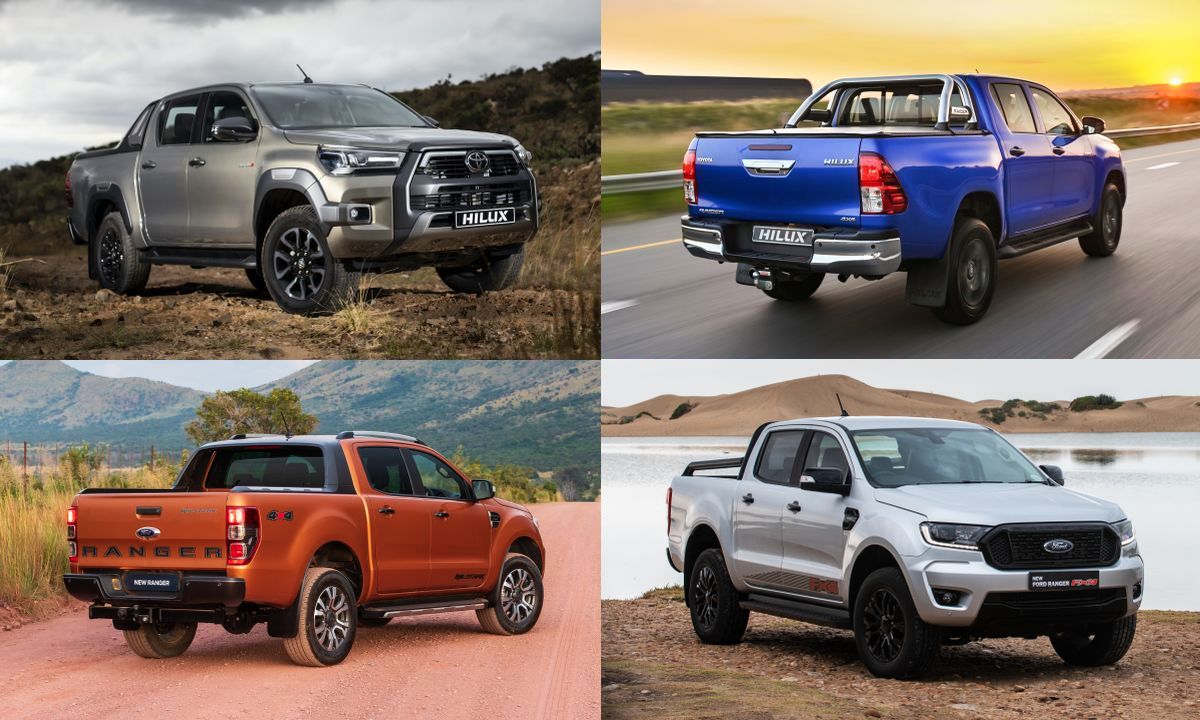
Although the Toyota Hilux is known to consistently outsell its closest rival, the Ford Ranger, by a fairly considerable margin, the race is actually a lot closer if we narrow it down to the double cab body style.

According to our studious friends over at Lightstone Auto, the Toyota Hilux remained the most popular double cab bakkie choice in South Africa during the first four months of 2021, recording 6 039 sales between January and April. However, the Ford Ranger double cab (which is also our 2021 Best Buys winner) came a close second, with 5 939 sales.

This represents a monthly average of 1509,7 units for the Toyota Hilux and 1 484,7 for the Ford Ranger.

The Isuzu D-Max double cab followed in a distant third place with 2 613 sales between January and April, equating to a monthly average of 653 units, while the Mahindra Scorpio recorded 1 138 year-to-date sales, or 284,5 per month.

The Toyota Hilux also won the double cab sales race in 2020, with 15 539 units registered throughout the year, while the Ford Ranger followed fairly closely with 14 494 sales.

 
Crypto cars: this Johannesburg Ferrari specialist dealership will take Bitcoin instead of old-fashioned money

Ferris Cars, based in Fourways, claims to be the first car dealership in South Africa that has sold a car in exchange for Bitcoin instead of cash. And what’s more, it wasn’t just any car, but an immaculately-presented pre-owned Ferrari California.

The occasion was celebrated at a cocktail function attended by customers and media at Ferris Cars’ recently-revised showroom in the Broadacres Shopping Centre. The highlight of the evening was in fact the actual purchase of the Ferrari California by one of the guests, live on screen, demonstrating an actual Bitcoin transaction to the audience.

WHY ACCEPT BITCOIN?

“The idea of selling Ferraris using Bitcoin as a currency was in fact mooted a few months ago,” says Ferris Cars co-owner and director, Tommy Roes. “We announced on March 5, 2021, through our newsletter, that we would now be accepting Bitcoin as a method of payment.”

“Not only were we the first South African dealership to take this step, but to put things into a global context, less than three weeks after our announcement, Elon Musk announced on Twitter that Teslas were now for sale using Bitcoin. So we beat Tesla to the draw by nearly three weeks,” he exclaims.

 
Hyundai set to axe half of its combustion engines to focus on EVs?

A new report suggests that Hyundai is getting ready to discontinue half of its internal combustion engines as a means to free up resources and invest in electric vehicles. It’s understood that this strategy was approved by the South Korean brand’s top management in March.

Sourcing information from two insiders, Reuters reports that Hyundai has not laid out a timeline for this direction, but it will happen. “It is an important business move, which first and foremost allows the release of R&D resources to focus on the rest: electric motors, batteries, fuel cells,” the insider said.

When asked for a response, Hyundai did not address the discontinuation of certain combustion engines but it did confirm that it would be accelerating the adoption of eco-friendly vehicles such as EVs and hydrogen fuel cell driven cars in its line-up.

Hyundai added that it aims to slowly expand its EV offerings in key markets such as the USA, Europe and China until it reaches full electrification by 2040. During this time, the group, which includes Kia and Genesis, aims to sell roughly one million EVs per year by 2025 and claim a 10 per cent share of the global EV market. This is a strategy similar to most manufactures as tightening CO2 emission targets are being implemented in Europe and China.

 
These are the SA car industry’s top export destinations

Ever since the Motor Industry Development Plan (MIDP) was formulated in the 1990s, the South African vehicle manufacturing industry has shifted from its apartheid-era protectionist model that saw it produce many different variants at low volumes, to a producer of fewer model variants at higher volumes with an emphasis on exports.

South Africa exported a total of 270 730 cars and bakkies to destinations around the world in 2020, keeping in mind that the industry was severely curtailed by the economic impact of Covid-19 restrictions. A better indication of SA’s potential as an exporter can be seen in 2019’s record figure of 386 265 units.

But where are South Africa’s vehicles being exported to? According to figures sourced from Naamsa and Lightstone Auto, the country that has imported the most South African cars in recent years is the UK, accounting for 67 798 units in 2020 and 101 401 units in 2019.

The UK is followed by Germany, with 25 736 units imported from SA in 2020, Japan (23 645), France (13 956), Australia (13 041), Italy (10 456), Belgium (10 048), USA (8 584), Netherlands (8 321) and Austria (6 376). Other smaller markets, however, collectively accounted for an additional 82 679 units last year according to the data.

In total, exports made up just over 60 percent of the 447 218 vehicles that were manufactured in South Africa last year.

 
Paywall:

Petrol, diesel, hybrid or electric? Here’s what SA motorists are buying

 
Top
Sign up to the MyBroadband newsletter
X