-
- News
-
Categories
- 5G
- ADSL
- AI
- Banking
- Black Friday
- Broadband
- Broadcasting
- Business
- Business Telecoms
- Cellular
- Cloud and Hosting
- Columns
- Cryptocurrency
- Energy
- Enterprise
- Fibre
- Gadgets
- Gaming
- Government
- Hardware
- Industry News
- Internet
- Internet of Things
- Investing
- IT Services
- Motoring
- Reviews
- Science
- Security
- Smartphones
- Software
- Technology
- Telecoms
- Trending
- Wireless
- Press Office
- Forum
- Industry News
- What's Next
- Company hub
- Speed Test
- About us
- Advertise with us
- Contact
- Careers


-
Join the MyBroadband community
South Africa’s biggest forum. Discuss, discover, and connect with thousands of members.
-
Question of the Day: Do you get motion sick?

You are using an out of date browser. It may not display this or other websites correctly.
You should upgrade or use an alternative browser.
You should upgrade or use an alternative browser.
The SpaceX Thread
- Thread starter Binary_Bark
- Start date

That’s a really bad idea. Mars is an opportunity to set up a world without the present political arseholes or ideologies. And you’re thinking of sending the most corrupt, evil, ignorant piece-of-**** there?can we not send our esteemed president to be on mars? can build nkandla 2.0 with free land....
I watched the video and I suspect Musk might be using a uniquely SA design philosophy. During apartheid I worked at an R&D defense facility involved in sanctions busting. Our main go-to were American proscribed goodies and designs were usually crap. It's quite feasible to improve designs greatly. Sanctions were quite severe so we looked at the equipment we were denied to see what we could do.
Aside: To our surprise it was often badly designed in an effort to get to the market first. Profit was the main thrust. A mediocre design available to everyone else (but denied to SA) that did the job after a fashion, could often be made cheaper and be much better designed by SA for its intended task
My point is that with American designs, they have many more warm, talented bodies (designers) to throw at products (all who communicate with one another by writing). No one knows the whole design. Musk was detailing his duties as Chief Engineer at SpaceX and he emphasised this ‘big picture’ design view as a strength. He has a fairly detailed picture of the whole project and can talk with any SME knowledgeably (a big advantage is he is technically knowledgeable himself). Plus, he can’t be bullshitted.
Yeah, and I do like his 'if design is taking too long, the design is wrong' approachI watched the video and I suspect Musk might be using a uniquely SA design philosophy. During apartheid I worked at an R&D defense facility involved in sanctions busting. Our main go-to were American proscribed goodies and designs were usually crap. It's quite feasible to improve designs greatly. Sanctions were quite severe so we looked at the equipment we were denied to see what we could do.
Aside: To our surprise it was often badly designed in an effort to get to the market first. Profit was the main thrust. A mediocre design available to everyone else (but denied to SA) that did the job after a fashion, could often be made cheaper and be much better designed by SA for its intended task
My point is that with American designs, they have many more warm, talented bodies (designers) to throw at products (all who communicate with one another by writing). No one knows the whole design. Musk was detailing his duties as Chief Engineer at SpaceX and he emphasised this ‘big picture’ design view as a strength. He has a fairly detailed picture of the whole project and can talk with any SME knowledgeably (a big advantage is he is technically knowledgeable himself). Plus, he can’t be bullshitted.

Jet-Fighter7700
Honorary Master
That’s a really bad idea. Mars is an opportunity to set up a world without the present political arseholes or ideologies. And you’re thinking of sending the most corrupt, evil, ignorant piece-of-**** there?
so your saying the best and brightest should be sent to colonize another planet?
what happens when eventually humanities worst impulses manifest themselves off-world?
I actually think we should treat Mars, like Australia was treated back in the day,
a penal colony, where as bad as the crimes you've committed, the hard labor will convince you to be a productive citizen.
look at Australia today, arguably better than the UK from where they came from.

Binary_Bark
Forging
Why NASA's Annoyed About Elon Musk's Giant Rocket
SpaceX has never flown a person into space in its Crew Dragon, its first crew-capable spacecraft. But already the company is showing off its much bigger, much shinier cousin: the Starship, built in Boca Chica, a coastal village at the southeastern tip of Texas, as part of a plan to carry giant crews into deep space. And NASA's administrator is bristling.
That's because, even though the Crew Dragon — which consists of a capsule for carrying cargo and crew into space on top of a Falcon 9 rocket — is still very much in the works, it's well behind schedule. Awarded a NASA contract in 2014, SpaceX initially said it would deliver an operational vehicle that astronauts could fly in by 2017. But that still hasn't happened. As of March, SpaceX has completed one uncrewed mission to the International Space Station using the Crew Dragon. It planned to launch a crewed mission later in 2019. But when a Crew Dragon capsule exploded during engine testing in April, SpaceX and NASA put off the planned first crewed mission.
Binary_Bark
Forging
NASA and SpaceX hope for manned mission to ISS in early 2020
SpaceX could launch US astronauts to the International Space Station as early as next year if tests on the company's long-delayed Crew Dragon capsule prove conclusive, NASA Administrator Jim Bridenstine said Thursday.
Bridenstine made the announcement as he toured the California headquarters of billionaire Elon Musk's SpaceX, a major contractor for NASA.
The visit came as Bridenstine and Musk have been engaged in a public spat over the much-delayed building of the Crew Dragon spacecraft.
The capsule would provide the transportation for astronauts to the space station for the first time since America's space shuttle program ended in 2011.
Musk, who appeared at a news conference alongside Bridenstine and the two astronauts who are set to fly onboard the spacecraft, said he hoped to have the capsule delivered to NASA by the end of the year.
He stressed, however, that safety was paramount and the launch would be delayed without hesitation if any problems arise.
"If everything goes according to plan, it would be in the first quarter of next year," Bridenstine said of the launch. "But remember—and this is the important thing that we have to get right on messaging—there are still things that we can learn or could learn that could be challenging that we have to resolve.
"I'm not saying that's going to happen, I don't know. That's why we test."
Binary_Bark
Forging
SpaceX Files a Request to Launch Another 30,000 Satellites for Starlink, on Top of the 12,000 They’re Already Planning to Launch
SpaceX is really kicking things into high-gear with its Starlink network. The creation of this satellite constellation is central to Elon Musk’s vision of providing high-bandwidth internet access to a global market. Deployment began in earnest back in May with the launch of the first sixty Starlink satellites, with plans to launch an additional 1,584 by 2024 and 2,200 by 2027.
Until now, SpaceX’s long-term goal was to create a constellation of 12,000 satellites at altitudes ranging from 328 km to 580 km (200 to 360 mi) – based on what the FCC has approved so far. But according to recent filings with the International Telecommunication Union (ITU), SpaceX intends to send an additional 30,000 Starlink satellites to Low Earth Orbit (LEO) in the coming years.
Founded by the United Nations in 1865, the ITU is a specialized agency that was created to regulate information and communication technologies and facilitating international connectivity in networks. Essentially, they are responsible for allocating portions of the global radio spectrum and satellite orbits to prevent interference and ensure communication networks are able to interconnect.
Binary_Bark
Forging
SpaceX is Sure They’ll Be Able to Land Starship on the Moon in 2022
Things are looking pretty good for Elon Musk and SpaceX, the company he founded back in 2002 with the intent of reinvigorating space exploration. In the last six months alone, SpaceX has deployed the first batch of its Starlink broadband internet satellites to space, conducted two successful untethered tests with the Starship Hopper, and finished work on the first orbital-class Starship test vehicle (the Mk.1).
And at the 70th International Astronautical Congress, which took place last week in Washington, DC, SpaceX president and Cheif Operations Officer Gwynne Shotwell provided additional details about the Starship‘s mission timeline. As she indicated during a series of interviews, the company hopes to be sending the Starship to orbit next year, landing on the Moon by 2022, and sending crews to the lunar surface by 2024.
As Shotwell was quoted as saying by TechCrunch:
“Aspirationally, we want to get Starship to orbit within a year. We definitely want to land it on the Moon before 2022. We want to […] stage cargo there to make sure that there are resources for the folks that ultimately land on the Moon by 2024, if things go well, so that’s the aspirational time frame.”
The two Starship prototypes (Mk.1 and Mk.2), are being developed at their South Texas Launch Site in Boca Chica, Texas, and Cape Canaveral Space Launch Complex 40 (SLC-40) in Florida, respectively. The Mk.1 was unveiled at a press conference back in September (during the company’s 11th anniversary) where Musk presented the latest updates on the Starship’s design and the company’s proposed timeline.
If this is starting to sound familiar, that’s probably because it’s entirely like Elon Musk himself to be optimistic with timelines. And while SpaceX has not always met the deadlines Musk has set in the past, they have managed to deliver on all of their promises – from the development of reusable first stage rockets and the creation of the Falcon Heavy to the recovery of payload fairings and the deployment of broadband satellites.
Binary_Bark
Forging
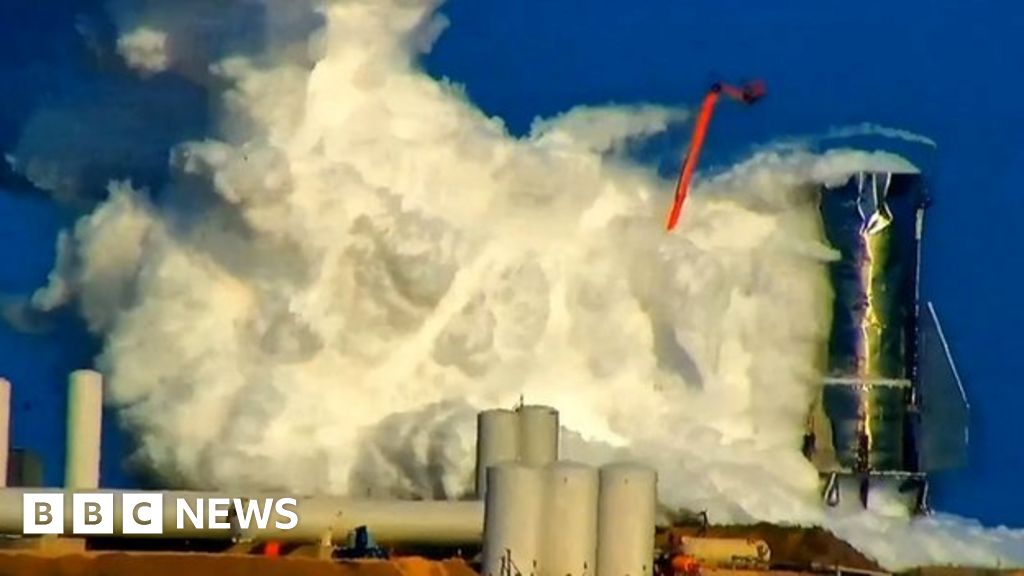
SpaceX Starship prototype blows its top
SpaceX's Starship rocket prototype experienced a major failure during pressurisation testing on Wednesday.
A video from the scene in Texas showed the top part of the vehicle rupture.
Cryogenic propellants that were being loaded at the time dispersed across the Boca Chica facility in a huge cloud.
The US company bills Starship as an all-purpose transportation system of the future. It will be used to ferry people and cargo off Earth, and to destinations around the globe.
The Mk-1 prototype was due to begin practice flights to an altitude of 20km in the coming weeks.
In a tweet, SpaceX CEO Elon Musk said that could no longer happen and the ship would be retired.
Development work is already being directed at another prototype, labelled the Mk-3.
"[Mk-1] had some value as a manufacturing pathfinder, but flight design is quite different," Mr Musk told his legion of fans on social media.
A statement issued by SpaceX read: "The purpose of today's test was to pressurise systems to the max, so the outcome was not completely unexpected."
 www.bbc.com
SpaceX's Starship rocket prototype experienced a major failure during pressurisation testing on Wednesday.
A video from the scene in Texas showed the top part of the vehicle rupture.
Cryogenic propellants that were being loaded at the time dispersed across the Boca Chica facility in a huge cloud.
The US company bills Starship as an all-purpose transportation system of the future. It will be used to ferry people and cargo off Earth, and to destinations around the globe.
The Mk-1 prototype was due to begin practice flights to an altitude of 20km in the coming weeks.
In a tweet, SpaceX CEO Elon Musk said that could no longer happen and the ship would be retired.
Development work is already being directed at another prototype, labelled the Mk-3.
"[Mk-1] had some value as a manufacturing pathfinder, but flight design is quite different," Mr Musk told his legion of fans on social media.
A statement issued by SpaceX read: "The purpose of today's test was to pressurise systems to the max, so the outcome was not completely unexpected."
SpaceX Starship prototype blows its top
The US company's new rocket prototype experiences a major failure during pressurisation testing.
www.bbc.com

Gordon_R
Honorary Master
Was just watching the Scott Manley video and analysis:
Binary_Bark
Forging
SpaceX delivers 'mighty mice,' worms, robot to space station

 phys.org
SpaceX made an early holiday delivery to the International Space Station on Sunday, dropping off super muscular "mighty mice," pest-killing worms and a smart, empathetic robot.
The station commander, Italy's Luca Parmitano, used a large robot arm to grab onto the Dragon three days after its launch from Cape Canaveral. The two spacecraft soared 260 miles (420 kilometers) above the South Pacific at the time of capture.
"Whenever we welcome a new vehicle on board, we take on board also a little bit of the soul of everybody that contributed to the project, so welcome on board," Parmitano told Mission Control.
The capsule holds 3 tons (2,720 kilograms) of supplies, including 40 mice for a muscle and bone experiment. Eight of them are genetically engineered with twice the normal muscle mass—and so are considered "mighty mice."' There also are 120,000 roundworms, or nematodes of a beneficial variety that are part of an agricultural study aimed at controlling pests.
SpaceX delivers 'mighty mice,' worms, robot to space station
SpaceX made an early holiday delivery to the International Space Station on Sunday, dropping off super muscular "mighty mice," pest-killing worms and a smart, empathetic robot.
Binary_Bark
Forging
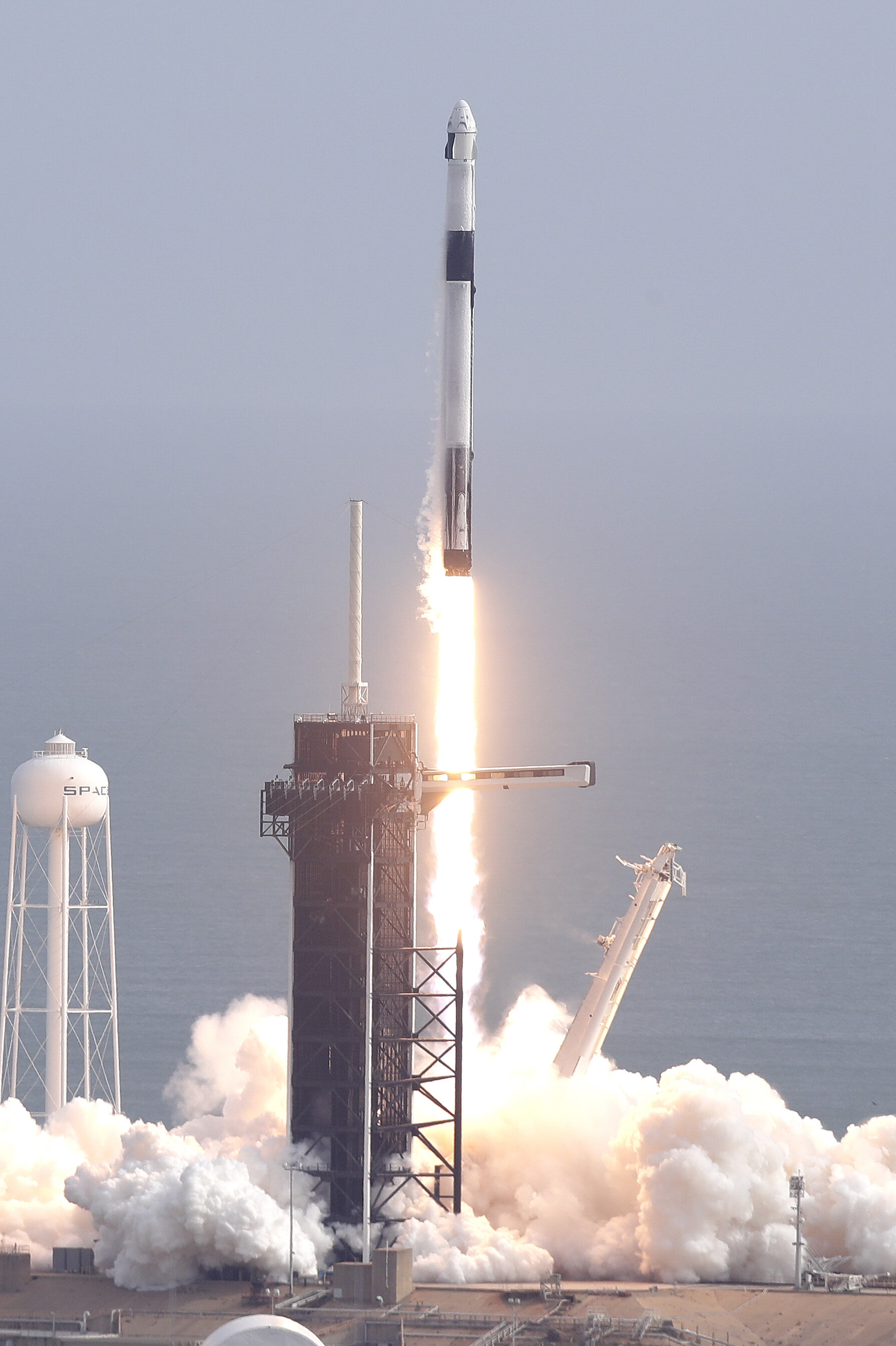
SpaceX launches, destroys rocket in astronaut escape test
 phys.org
SpaceX completed the last big test of its crew capsule before launching astronauts in the next few months, mimicking an emergency escape shortly after liftoff Sunday.
No one was aboard for the wild ride in the skies above Cape Canaveral, just two mannequins.
A Falcon 9 rocket blasted off as normal, but just over a minute into its supersonic flight, the Dragon crew capsule catapulted off the top 12 miles (20 kilometres) above the Atlantic. Powerful thrusters on the capsule propelled it up and out of harm's way, as the rocket engines deliberately shut down and the booster tumbled out of control and exploded in a giant fireball.
The capsule reached an altitude of about 27 miles (44 kilometers) before parachuting into the ocean just offshore to bring the nine-minute test flight to a close and pave the way for two NASA astronauts to climb aboard next time.
SpaceX launches, destroys rocket in astronaut escape test
SpaceX completed the last big test of its crew capsule before launching astronauts in the next few months, mimicking an emergency escape shortly after liftoff Sunday.
Binary_Bark
Forging
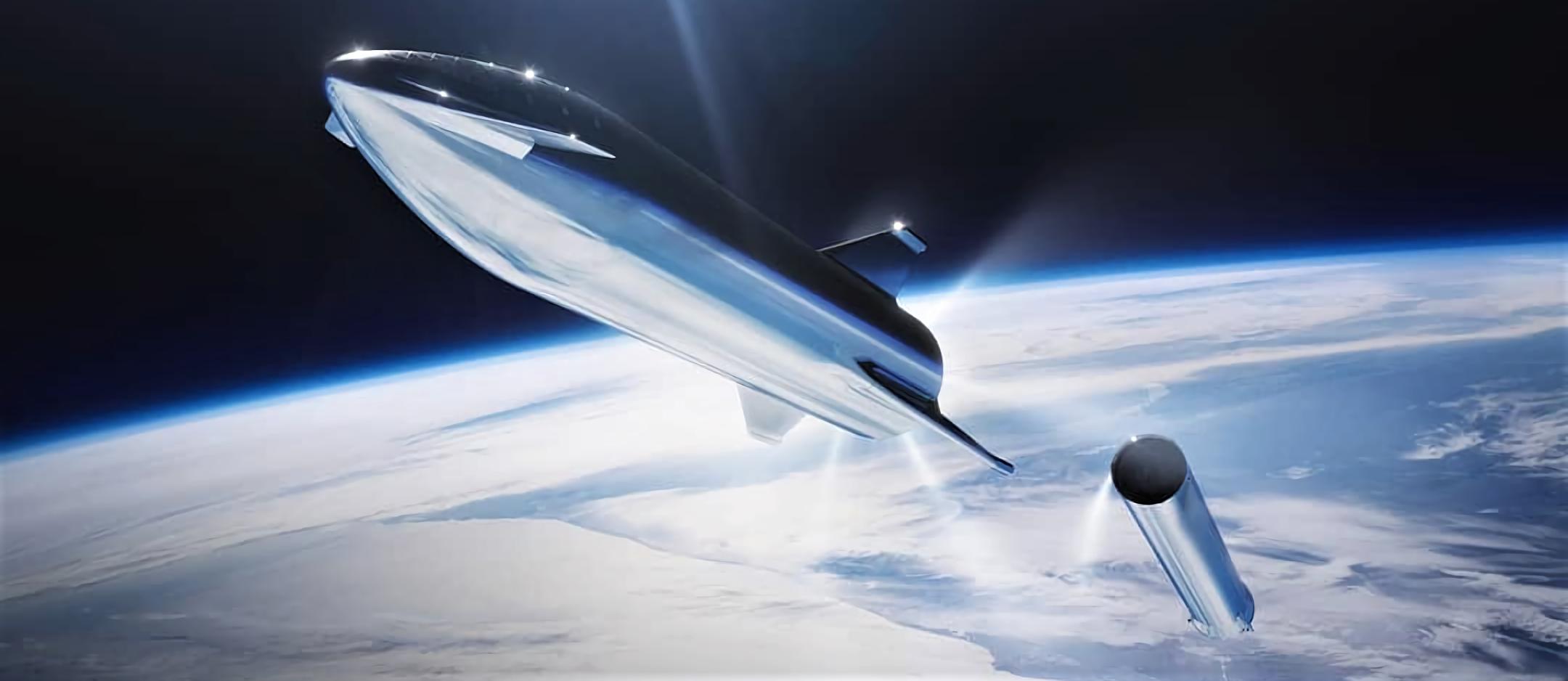
SpaceX Has Requested Permission to Fly Starship as Early as March
 www.universetoday.com
In September of 2019, SpaceX unveiled the first Starship prototype, the first of several test vehicles that would validate the design of the next-generation spacecraft that would fulfill Musk’s promise of making commercial flights to the Moon and Mars. And while there was a bit of a setback in November of 2019 after the Mk. 1 suffered a structural failure, Musk indicated that the company would be moving forward with other prototypes.
As Musk explained at the time, this would consist of the Mk. 3 prototype conducting an orbital test flight to an altitude of 100 km (62 mi) sometime in 2020. According to recent filings made with the FCC, this test could be happening as early as mid-March and will involve the vehicle launching from the company’s test facility in Boca Chica, Texas, and flying to an altitude of 20 km (12.6 mi) before landing.
As per the filings, SpaceX is requesting access to radio frequencies for the sake of a “[e]xperimental launch, landing, and recovery of the Starship suborbital test vehicle” so that ground controllers can communicate with the vehicle during flight and monitor its trajectory. This data will be directly shared with the National Telecommunications and Information Administration (NTIA), the US Air Force, and NASA.
SpaceX Has Requested Permission to Fly Starship as Early as March
According to recent filings with the FCC, SpaceX hopes to conduct their first test flight with the Starship Mk 3 prototype as early as mid-March of 2020.
Binary_Bark
Forging
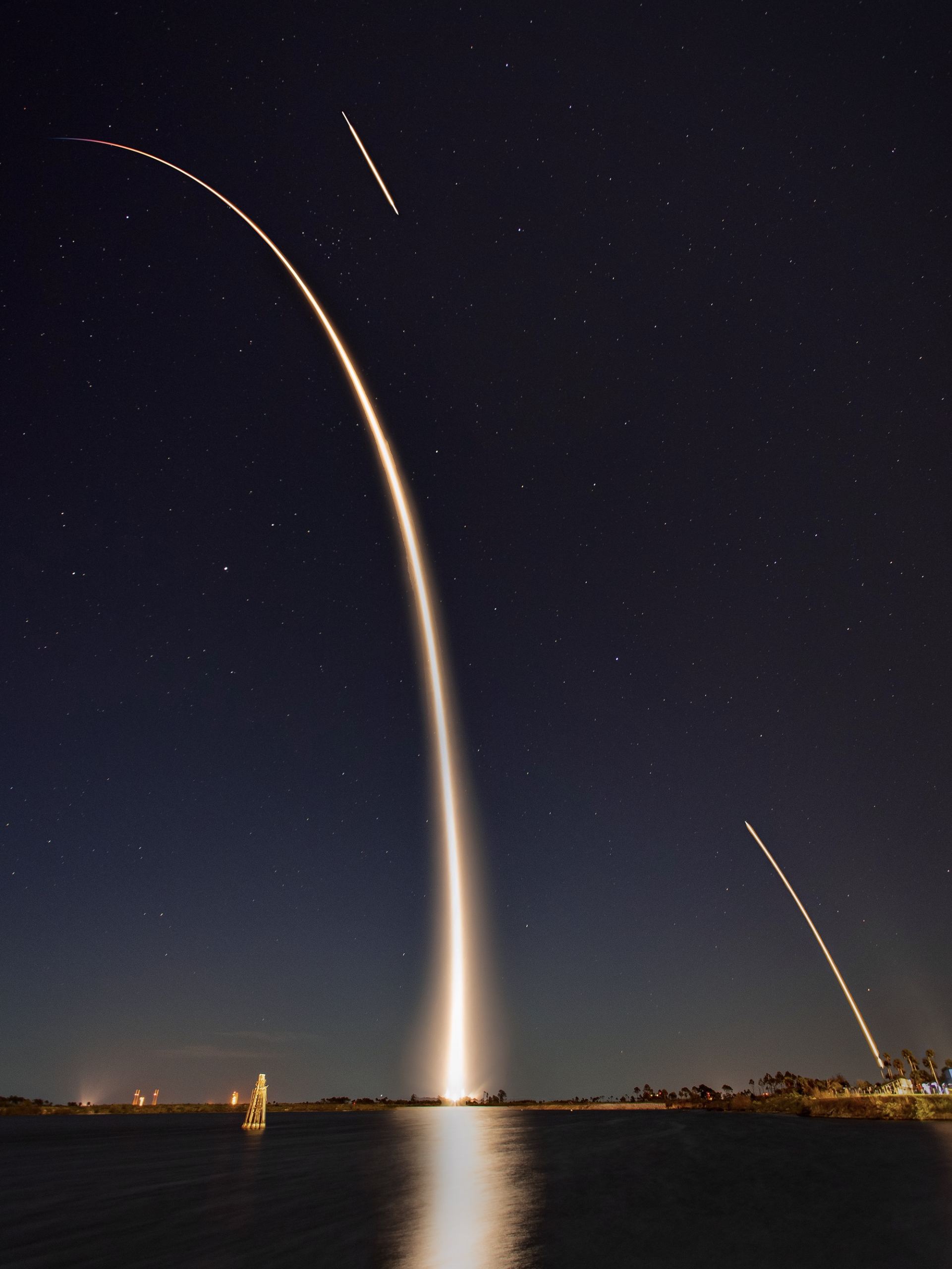
SpaceX Launches its Last Dragon 1 Mission to the ISS
 www.universetoday.com
On Friday, March 6th, as part of the company’s 20th Commercial Resupply Services (CRS-20) mission, SpaceX launched a Dragon 1 capsule destined for the International Space Station (ISS). The mission involved the transport of supplies, as well as materials related to the more than 250 science investigations taking place aboard the ISS. More than that, it represented a milestone for the aerospace manufacturer.
The launch took place at 11:50 p.m. EST (08:50 p.m. PST) from Space Launch Complex 40 at Cape Canaveral Air Force Station. The separation between the first and second stage occurred about nine minutes later. It was then captured by the ISS’s Space Station Remote Manipulator System (aka. Canadarm2) on Monday, March 9th, and berthed with the station.
SpaceX Launches its Last Dragon 1 Mission to the ISS
SpaceX just launched its 20th mission as part of its resupply services to the ISS, which also happened to be the last mission of the Dragon capsule.
Binary_Bark
Forging
SpaceX plans first manned flight to space station in May
 phys.org
Elon Musk's SpaceX will send astronauts to the International Space Station for the first time in May, NASA said, announcing the first crewed launch from the United States to the platform since 2011.
The tech entrepreneur's company will launch a Falcon 9 rocket to transport NASA astronauts Bob Behnken and Doug Hurley in a first for the space agency as it looks to cut costs.
"NASA and SpaceX are currently targeting no earlier than mid-to-late May for launch," the US space agency said in a statement Wednesday.
In March, Musk's Crew Dragon capsule made a round trip to the ISS, which is in orbit more than 250 miles (400 kilometers) above Earth, with a mannequin on board, before returning to the Atlantic after six days in space.
SpaceX plans first manned flight to space station in May
Elon Musk's SpaceX will send astronauts to the International Space Station for the first time in May, NASA said, announcing the first crewed launch from the United States to the platform since 2011.
Binary_Bark
Forging
Elon Musk says that SpaceX Has no Plans to Spin Off Starlink
Last week, the Satellite 2020 Conference & Exhibition wrapped up after four days of presentations and addresses from some of the leading experts in the telecommunications industry. As advertised, SpaceX founder Elon Musk was on hand to deliver a keynote speech in which he announced that (contrary to earlier statements) Starlink will not be spun off and become its own business enterprise.
This comes a little over a month and a half after Gwynne Shotwell, the President and Chief Operations Officer (COO) of SpaceX, stated during a private investor event that the company was considering spinning Starlink off and making it a publicly-traded company. But as Musk stated at the conference in Washington, D.C., SpaceX is too busy “thinking about that zero” to take the company public right now.
This decision is likely inspired by previous telecommunication companies that attempted to deploy large satellite constellations only to go bankrupt – which include Iridium, Globalstar, Orbcomm and Teledesic. All of these companies, save Teledesic, managed to recover in time with the deployment of second-generation constellations.

Today's launch sequence. Liftoff is 4:33 pm ET, or 22:22 pm CAT.
-04:15:00 Crew weather brief
-04:05:00 Crew handoff
-04:00:00 Suit donning and checkouts
-03:22:00 Crew Walk Out from Neil Armstrong Operations and Checkout Building
-03:15:00 Crew Transportation to Launch Complex 39A
-02:55:00 Crew arrives at pad
-02:35:00 Crew ingress
-02:20:00 Communication check
-02:15:00 Verify ready for seat rotation
-02:14:00 Suit leak checks
-01:55:00 Hatch close
-00:45:00 SpaceX Launch Director verifies go for propellant load
-00:42:00 Crew access arm retracts
-00:37:00 Dragon launch escape system is armed
-00:35:00 RP-1 (rocket grade kerosene) loading begins
-00:35:00 1st stage LOX (liquid oxygen) loading begins
-00:16:00 2nd stage LOX loading begins
-00:07:00 Falcon 9 begins engine chill prior to launch
-00:05:00 Dragon transitions to internal power
-00:01:00 Command flight computer to begin final prelaunch checks
-00:01:00 Propellant tank pressurization to flight pressure begins
-00:00:45 SpaceX Launch Director verifies go for launch
-00:00:03 Engine controller commands engine ignition sequence to start
-00:00:00 Falcon 9 liftoff
-04:15:00 Crew weather brief
-04:05:00 Crew handoff
-04:00:00 Suit donning and checkouts
-03:22:00 Crew Walk Out from Neil Armstrong Operations and Checkout Building
-03:15:00 Crew Transportation to Launch Complex 39A
-02:55:00 Crew arrives at pad
-02:35:00 Crew ingress
-02:20:00 Communication check
-02:15:00 Verify ready for seat rotation
-02:14:00 Suit leak checks
-01:55:00 Hatch close
-00:45:00 SpaceX Launch Director verifies go for propellant load
-00:42:00 Crew access arm retracts
-00:37:00 Dragon launch escape system is armed
-00:35:00 RP-1 (rocket grade kerosene) loading begins
-00:35:00 1st stage LOX (liquid oxygen) loading begins
-00:16:00 2nd stage LOX loading begins
-00:07:00 Falcon 9 begins engine chill prior to launch
-00:05:00 Dragon transitions to internal power
-00:01:00 Command flight computer to begin final prelaunch checks
-00:01:00 Propellant tank pressurization to flight pressure begins
-00:00:45 SpaceX Launch Director verifies go for launch
-00:00:03 Engine controller commands engine ignition sequence to start
-00:00:00 Falcon 9 liftoff

powermzii
Expert Member
Oooh thanks for posting this up, something to look forward to when the rugrats are sleeping