Top mirrorless camera brands available in SA

Hanno Labuschagne

Journalist
Staff member
Joined
Sep 2, 2019
Messages
6,514
Reaction score
4,791
Top mirrorless camera brands available in SA

South Africans have five major brands to choose from if they want a mirrorless camera with powerful photo-taking and video-shooting capabilities.

While smartphone cameras have improved radically in the past few years, they have some significant drawbacks that make them unsuitable for many professional and enthusiast scenarios.
 
If the mirror-less cameras have fewer moving parts why are they so much more expensive than SLRs?
 
I've had an A1 for almost 2 years now. 50MP paired with a 600mm lens is a dream for wildlife. Absolutely love it
 
If the mirror-less cameras have fewer moving parts why are they so much more expensive than SLRs?

Because they have A LOT more processing power than a DSLR. Far better video functionality. Far better auto-focusing. Often a lot more features such as EVF's which DSLR's can't have.

Ancient mechanical mirrors and shutters slow things down. There is no need for DSLR's any more. DSLR's were the stop gap between film and full on solid state which mirrorless cameras are now.

DSLRs are like internal combustion engines. They're slowly being replaced by EV's.
 
No rush to switch to mirrorless. I'll stick with my dSLRs.
 
No rush to switch to mirrorless. I'll stick with my dSLRs.
Boomer!
You shoot canon if I recall correctly?
The pro level RF lenses are insanely expensive and they seem to be blocking 3rd party lens manufacturers, not pretty.
 
Do you notice a difference in image quality between photos from the Fujifilm and your phone?
Apples and Oranges.

On a pixel by pixel comparison, probably not.. phones are already pretty high resolution as well.

However, the much faster shutter, low light capabilities, true depth of field (not simulation bs), etc - the type of photos the Fujifilm (not limited to) produce are totally different and cannot be compared to a phone camera.

I think the fact that a camera is designed to take photos and don't have the limitations of a small sensor + small lens, will always produce a different kind of image. :)
 
Do you notice a difference in image quality between photos from the Fujifilm and your phone?
There's a massive difference between smartphone photos vs DSLR / Mirrorless, particularly if you are comparing photos at full resolution. If you're looking at photos shrunk down and compressed for social media or online sharing, then the differences are less obvious.
 
Boomer!
You shoot canon if I recall correctly?
The pro level RF lenses are insanely expensive and they seem to be blocking 3rd party lens manufacturers, not pretty.
Yes, I shoot canon.

It’s not an age thing. Switching to mirrorless now serves purpose for me. It offers little in exchange for a large outlay.

I could use an adapter for my lenses, and probably will when the time comes.
 
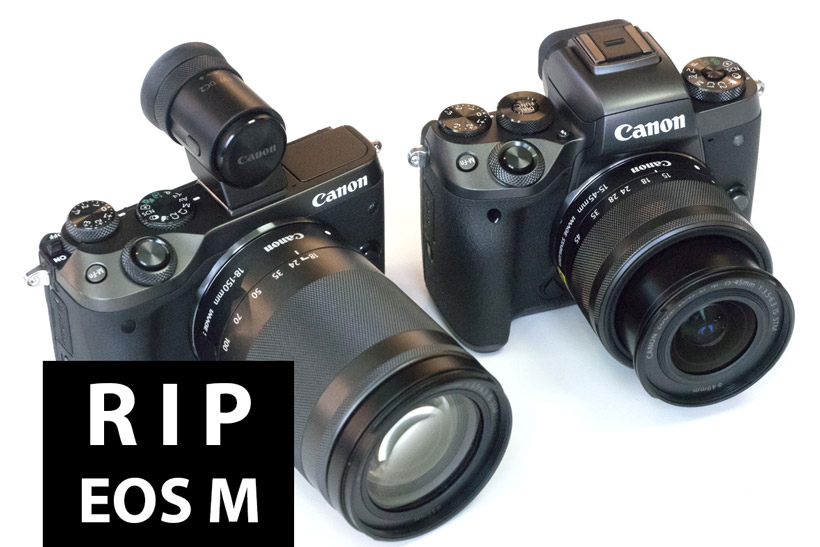
Word is that the EOS M is dead and not worth investing in. It was always an afterthought with no proper lens support and Canon hasn't introduced a new model since 2019 with many models now hard to come by. They're also falling into disrepair with support ending as parts become unavailable. Even their DSLRs are being discontinued. If you invest in the M even as second hand it would be foolish to buy any EF-M lenses as opposed to adapted EF lenses as these are incompatible with all other cameras due to the short flange length.

 
Because they have A LOT more processing power than a DSLR. Far better video functionality. Far better auto-focusing. Often a lot more features such as EVF's which DSLR's can't have.
DSLRs don't need EVFs because they have mirrors.
Processing power is about the processor that's put into the device. If you've bought an entry-level DSLR and are comparing it to a high-end mirrorless, then of course it's going to look poorer. But the high-end DSLRs are much more similar to the mirrorless cameras than you might think, in terms of all of those features.

Ancient mechanical mirrors and shutters slow things down. There is no need for DSLR's any more.
They slow things down, yes, but I think you'll find that there are still use cases. Sometimes you don't need the ultimate speed, but battery life is important. DSLRs can have far longer battery life than mirrorless because they don't need to light up a screen as a viewfinder, they get that passively by just using the mirror.
 
If the mirror-less cameras have fewer moving parts why are they so much more expensive than SLRs?
Where did you get that info? They're only missing the mirror but the new systems have more moving parts and more of them moved to the lenses as opposed to the camera bodies. The viewfinders are also electronic and not optical as there's no way to direct the light. The entry level EOS R100 is about the same price as an EOS M but the native lenses are insanely expenses. Prices will come down as they become mainstream but for now they're cutting edge tech with a lot of development going into them.

There's a massive difference between smartphone photos vs DSLR / Mirrorless, particularly if you are comparing photos at full resolution. If you're looking at photos shrunk down and compressed for social media or online sharing, then the differences are less obvious.
There's a massive difference between smartphone photos vs compact / bridge cameras and there's a massive difference between compact/bridge camera photos vs DSLR / Mirrorless.
 
There's a massive difference between smartphone photos vs compact / bridge cameras and there's a massive difference between compact/bridge camera photos vs DSLR / Mirrorless.
This is almost like comparing a road bike to an electric mountain bike. They're different tools. So the "massive" difference is not just along a single linear axis.

"Proper" cameras - whether DSLR or mirrorless, have bigger lenses and far bigger sensors and thus on paper can produce better images. But the person holding the camera needs to have the skills to get the outcome.

Smartphones on the other hand have small lenses and small sensors (these are improving but still nowhere near DSLR or mirrorless), but they pack a large software punch and can use image processing techniques to achieve good results even for those of us who lack any skill to speak of. In principle, this processing power and software could be put into a mirrorless camera or DSLR but the people who buy these generally want more creative control over what happens to their pictures, so they wouldn't want that.

So average Joe will probably get better photos with an iPhone than an expensive mirrorless or DSLR. A professional will obviously prefer a proper camera though.
 
So average Joe will probably get better photos with an iPhone than an expensive mirrorless or DSLR. A professional will obviously prefer a proper camera though.
That was true for me, but ONLY in low light settings.

Also, when you display the picture on a big screen, you can see which one is a camera.
 
This is almost like comparing a road bike to an electric mountain bike. They're different tools. So the "massive" difference is not just along a single linear axis.

"Proper" cameras - whether DSLR or mirrorless, have bigger lenses and far bigger sensors and thus on paper can produce better images. But the person holding the camera needs to have the skills to get the outcome.

Smartphones on the other hand have small lenses and small sensors (these are improving but still nowhere near DSLR or mirrorless), but they pack a large software punch and can use image processing techniques to achieve good results even for those of us who lack any skill to speak of. In principle, this processing power and software could be put into a mirrorless camera or DSLR but the people who buy these generally want more creative control over what happens to their pictures, so they wouldn't want that.

So average Joe will probably get better photos with an iPhone than an expensive mirrorless or DSLR. A professional will obviously prefer a proper camera though.
That isn't by design. Phone cameras would be everything if they could and likewise would bridge and interchangeable lens. But you can't put the same sensor in a phone as you'd need a proper lens. You can't easily achieve the same zoom with a mirrorless or DSLR as with a bridge as it's partly because of he sensor size. Yes skill is a part of it but you're only as good as what you're using.

Btw the Canon DIGIC processors are pretty advanced. The selfy people usually leave settings on auto while those who "want more creative control" tinker a bit. There's a reason P stands for professional because neither auto not manual are good for taking general photos. In any case was just replying to the question asking about quality.
 
Top
Sign up to the MyBroadband newsletter
X