


MrGray
Honorary Master
Well, our ability to design very complicated things in 2D on paper, did, yes.Thanks. Really good explanation. Makes sense.
Edit: so essentially; with all our advances in technology we actually went backwards?
South Africa’s biggest forum. Discuss, discover, and connect with thousands of members.
Well, our ability to design very complicated things in 2D on paper, did, yes.Thanks. Really good explanation. Makes sense.
Edit: so essentially; with all our advances in technology we actually went backwards?


Can't launch a modern rocket to the moon and you expect me to believe they somehow did it in the 60s? GTFOH!

This was certainly the case. Due to the nature of the projects at the time there were a lot of artisans skilled in what was essentially prototype manufacture. Overall drawings were provided and they would get on with filling in the manufacturing details while making the structures. In some aircraft companies, to speed up this type of work the designers would sometimes produce prototype drawings on long rolls rather than on individual sheets. They would start on one end and and carry on pulling the roll across the drawing board until the part was completed. NASA seemed to be a little more formal in their drawings however, at least the ones that they showed to anyone.Not really. Makes perfect sense to me when you consider they didn't have CAD or CNC. Skilled artisans would handcraft the engines from the blueprint using tooling and techniques that nobody alive still has experience with.
These days you don't have to do any of that as the design and fit are all tested in CAD, etc, in advance. The components are precision cut, and there are advanced welding techniques etc. Don't forget, designed on a blueprint, they were only 2D line drawings, with only manual calculations and geometry to work out if everything fit together.

Which is actually quite perplexing.Well, our ability to design very complicated things in 2D on paper, did, yes.
This statement is at odds with at least one statement in that video: "trial and error testing".This was certainly the case. Due to the nature of the projects at the time there were a lot of artisans skilled in what was essentially prototype manufacture. Overall drawings were provided and they would get on with filling in the manufacturing details while making the structures. In some aircraft companies, to speed up this type of work the designers would sometimes produce prototype drawings on long rolls rather than on individual sheets. They would start on one end and and carry on pulling the roll across the drawing board until the part was completed. NASA seemed to be a little more formal in their drawings however, at least the ones that they showed to anyone.
There are still some prototyping style artisans around, but they are usually older and there are not as many of them.
The trial and error testing on the F-1 engines was largely associated with the degree of combustion instability that is associated with such large engines. This must be addressed or else the whole thing explodes. They went through a bunch of iterations to fix this. More modern designs get away from this by using a larger number of smaller engines.This statement is at odds with at least one statement in that video: "trial and error testing".
One would think these "rocket scientists" would know how to document this so that it could be reproduced or even improved in later designs?
So did they make design changes?The trial and error testing on the F-1 engines was largely associated with the degree of combustion instability that is associated with such large engines. This must be addressed or else the whole thing explodes. They went through a bunch of iterations to fix this. More modern designs get away from this by using a larger number of smaller engines.
Yes they did.So did they make design changes?
If yes...did they document it.
If no...why not?
Or am I looking at it too simplistically?

You need to think much bigger.So did they make design changes?
If yes...did they document it.
If no...why not?
Or am I looking at it too simplistically?
Maybe I'm just a bit small-minded, but 2+2 still adds up to 5 the way they explain it in that video.You need to think much bigger.
Its not just the rockets that needed to be re-built, but the entire value chain needed to be built from scratch.
Design the machine that builds the component that is used to build the rocket.

well....technically she does control Nasa's budget, being head of their National Space Council"Vice President Kamala Harris flew in to be on hand"
That genius' support must have been invaluable.
View attachment 1374065 View attachment 1374067
what...they ran out of Engineers?The main point that was made is that we no longer have the skills. The proposed modern version, if it had been built, would have relied heavily on 3D printing to make up for this deficit.

Imagine if Trump was still president. They'd probably have a Space Force by now.well....technically she does control Nasa's budget, being head of their National Space Council


 www.bbc.com
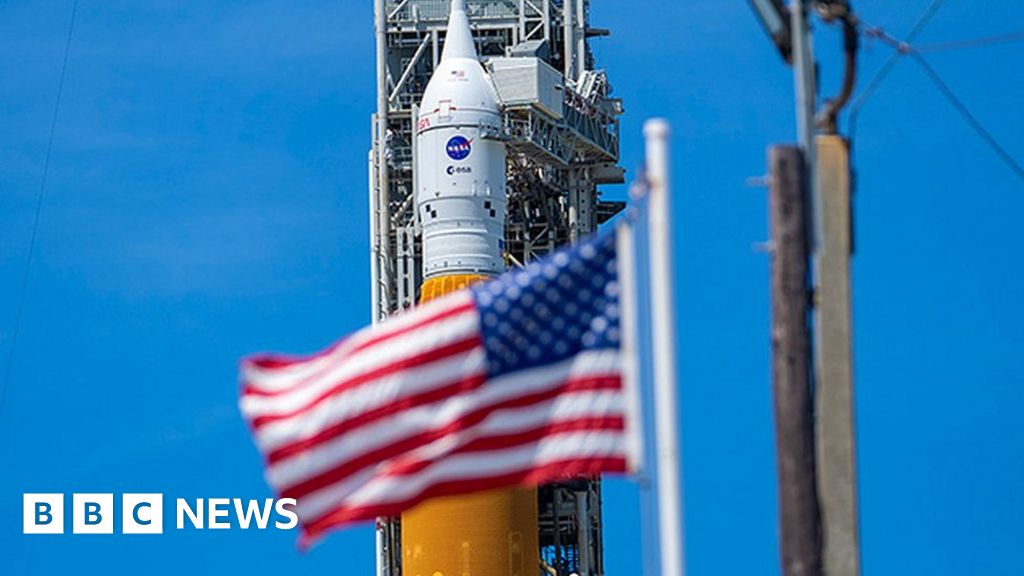
After reviewing data, engineers believe they now understand why the issue occurred.
They think it is likely related to an inaccurate sensor reading and that they can develop a strategy to deal with the problem on launch day.
This involves starting the process of chilling the engines earlier in the countdown.


