Everything you need to know about E-Tolls. The important information...

DJ...

Banned
Joined
Jan 24, 2007
Messages
70,285
Reaction score
3,556
Location
Gauteng
As promised, here is a single thread detailing the important information that you need to know about E-Tolls.

The following video is part 1 of my Sanral video series. Please note that there is an error in the information pack linked in the YouTube video. The R80bn figure was revenue, and not cost. The cost is actually closer to R40bn.

http://youtu.be/8mp4SQzrXJA

[video=youtube_share;8mp4SQzrXJA]http://youtu.be/8mp4SQzrXJA[/video]

And here you will find a definitive FAQ guide to E-Tolls by the Justice Project of South Africa (JPSA), who along with OUTA are leading the consumer fight against E-Tolling in its current form - http://mybroadband.co.za/news/government/94372-etoll-facts.html

The Justice Project South Africa (JPSA) has provided a comprehensive article on eTolls, explaining the system and giving advice on how to address some of the concerns about eTolls.

The article will be updated regularly, and is available here: eToll facts
 
Last edited:
Sanral Video Series Part 2...

This is a follow-up to part 1 where we looked at the financials. In part two, we get down to brass taxes and look at the history of the project, the supposed public consultation, the costs, and the repercussions of paying E-tolls. The production quality is hopefully a little better than part 1 but please bear in mind that I have next to zero skills in the video making and editing department. Please do your part and share this video far and wide...

http://youtu.be/duM11XvTt7w

[video=youtube_share;duM11XvTt7w]http://youtu.be/duM11XvTt7w[/video]
 
Last edited:
What It Should Have Cost...

In this post I dive into the what the Gauteng Freeway Improvement Project should have cost South Africans. It's important to remember that government are now embarking on Phase 2 of GFIP, and they are refusing to consider a fuel levy as the funding mechanism, even though I can conclusively show that it is the most efficient, cheapest, and equitable manner with which to do so...

1 - it was a cash flow issue. Government didn't have the cash on hand to make payments. They'd have had to have a lot of the cash on hand from the beginning.

2 - if we take this into account and split it over 6 years of construction (edit: it's 7 years if we factor in the additional year, which you will see later on), we can spread the payments over that term to figure out an average required increase.

3 - construction prices were inflated. But let's leave them out of the construction costs and leave the figure at R17,9bn.

Using these figures, and using a figure of 25bn litres of petrol and diesel consumed (an average between 2007 and 2013), I calculate that we required a single increase to the fuel levy of 10c per litre, and we'd have paid for the entire project by the time construction had been completed, and the 10c levy could have been removed.

The economy at the time could sustain a 10c increase. Just work it out for yourself. 10c multipled by 25bn multipled by 7.

We could have actually funded this entirely from the fuel levy without going to the bond market at all, had they increased the fuel levy one year before construction began and negotiated a decent remuneration model with the construction companies. All that was required here was good leadership. We'd have saved ourselves R12bn in doing so, and in turn, saved 10c from every litre.

And let's not forget that this excludes the inflated cost that government should have managed. If we assume the prices were inflated by just 20%, the once-off required fuel levy decreases to just 8c per litre, is in place for 7 years, and is then removed.

We can factor in some admin costs there if need be, but it is negligible...

What's the financial impact to South Africans?

The total impact to road users would have been around R1627 over 7 years, per vehicle, had this method been adopted. That is it! R230 per annum. That's R19,37 per month, per vehicle, for 7 years, and then the charge would have been eliminated. It's just 64c per day

If only Gauteng road users were charged, then the cost would have been a total impact of around R4700 over the course of 7 years, which is R672 per annum, or just R56 per month, per vehicle had someone with brains been in charge, or had palms not been greased...

That is it! That is all that this should have cost...

To put this into context somewhat, we should be paying just 4.3% of the maximum E-Tag rate per month. We're in fact paying a 2322% premium for resurfacing of our roads. And that premium is about to get far worse as phase 2 and 3 kick in...
 
Last edited:
Sanral taking on more debt and starting Phase 2...

In this post, I show that Sanral are now embarking on Phase 2 of the project already, as well as highlighting some important information relating to Sanral's debt position and what it means to taxpayers...

Financial position? Dire, IMO.

Sanral is currently embarking on a new capital raising roadshow, to raise a further R9bn, on top of the R41bn they already owe. They plan to borrow around R500m per month for the foreseeable future, in our names as taxpayers. What are they using this debt for? To begin to fund phase 2 of the GFIP (which will cost in excess of R40bn, taking their total debt to close to R100bn) and to service their existing debt. Yes, they are taking on more debt now, to repay debt they took out to finance GFIP phase 1.

In addition, they have requested further treasury assistance to repay another debt that matures in April. They simply don't have the funds to repay this debt.

Why are they doing this? Because some people have caved and are paying their e-tolls, without realising that the consequence is that they'll now have to start forking out far, far more money. People don't realise that this was only phase 1 of a 3 phase project.

Inge Mulder, Sanral's CFO, has stated that they will only raise debt in their HWAY programme, as this is government guaranteed. This is because investors are not interested in touching any debt that is not government guaranteed. Let me explain the difference here - Sanral's HWAY bonds are government guaranteed. Their NRA bonds are not. Their NRA bonds however are the bonds that have matured, and are maturing (meaning they now have to repay them), and these are the bonds that Treasury has bailed them out with. Treasury has paid for these bonds, so effectively Treasury has already bailed them out, and irrespective of them not being government guaranteed, they are paying for them. We are paying for them. Government now needs to find that money, from tax revenue! In addition, Sanral have accepted this cash as a loan, so it only places them further in debt. They refuse to disclose the details of this loan though, as in whether it is actually repayable and what the terms and duration are. In other words, this is a gift - a bailout!

Another interesting fact is that even on their investor roadshows that they're about to embark on, they will not disclose compliance rates! Why not?!

This is because they have been lying to us about how much it is actually costing the average road user, and lying to us by inferring that e-tag sales correlate with compliance. It doesn't whatsoever.

So questions must be asked of ourselves - do you honestly want to see an additional R40bn to R50bn taken out in your name? Do you honestly want phase 2 to go ahead? Is any of this in your best interests? Can you afford to start repaying this new debt they're taking out in your name, as well as the old R41bn debt that's sitting on their books? Do you want to support continued government bailouts of Sanral?

If you'd like to know what this whole project should have cost, see this thread - http://mybroadband.co.za/vb/showthread.php/594711-What-E-Tolling-should-have-cost-South-Africans

It will open your eyes to the shafting that is being handed out to us. And the further shafting that is about to happen now, as Sanral begin to take on more debt to get phase 2 under way...

Discussion - http://mybroadband.co.za/vb/showthr...bailed-out-again-And-they-re-starting-phase-2
 
Last edited:
Sanral's current debt position and why we need to know this...

Here I show you Sanral's dire debt position, and what it means to us...

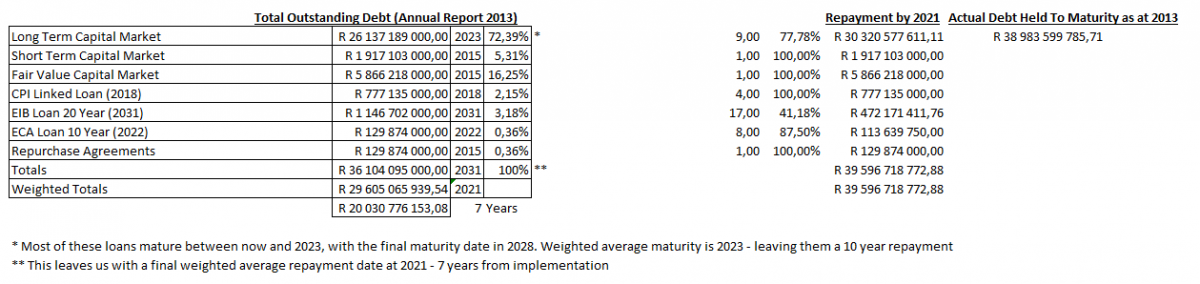
Let me give you a quick breakdown of Sanral's debt position:

Sanral_Debt_Position.png


Now understand that what has been paid off, or is going to be paid off, is simply going to be reinstated as new debt again on their books, in additional to a substantial amount of additional debt to fund phase 2. The new debt being taken out is being used to repay these existing bonds...

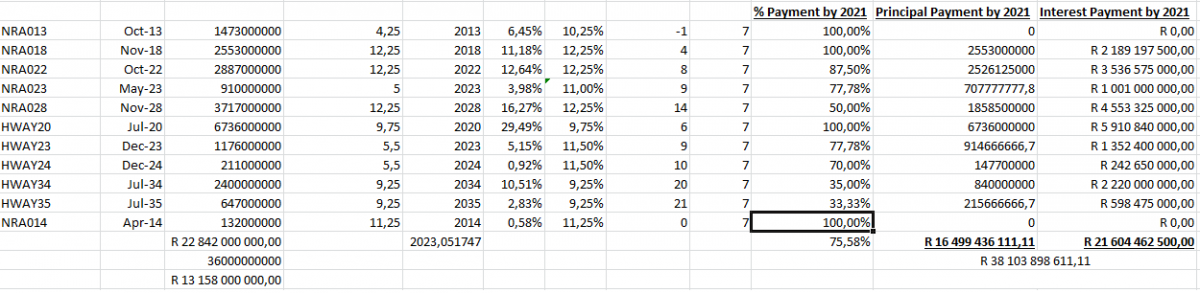
Now let me show you what they need to repay by the year 2021, and why 2021 is such an important date:

Sanral_Repayment_Position_2021.png
 
Last edited:
Here is what it is actually costing you...

Now let's dive into what the costs actually are for road users:

I have previously shown you that the payment split Sanral gave us was a lie. Their stated payment split was:

Light Vehicle 1 82,83% R100
Light Vehicle 2 10,10% R150
Light Vehicle 3 1,82% R250
Trucks (HHV) 5,25% R2180,87

There is simply no way to achieve such a payment split, based on their debt position, without substantial increases.

Now let me show you what the actual payment split needs to look like, based on various degrees of compliance, in order for Sanral to avoid default on their debt or further government bailouts. These payments include annual CPI-related increases as per regulations.

The following scenario is based on a compliance rate of 1 million vehicles. These are the sort of charges that need to be applied:

Sanral_Payment_Split_-_1m.png


The next scenario is based on a compliance rate of 2 million vehicles:

Sanral_Payment_Split_-_2m.png


The final scenario is based on a compliance rate of 3 million vehicles:

Sanral_Payment_Split_-_3m.png


As is evident, Sanral require a substantial compliance rate in order to remain in business. In addition, they require a very different payment split than they've previously claimed would be the case.

So now you should have a better idea of what this is actually costing taxpayers. In the next post, I'll show you what impact this has on income to formal sector employees, a median income employee, and a low-income employee to give these figures some more real-world context...
 
Last edited:
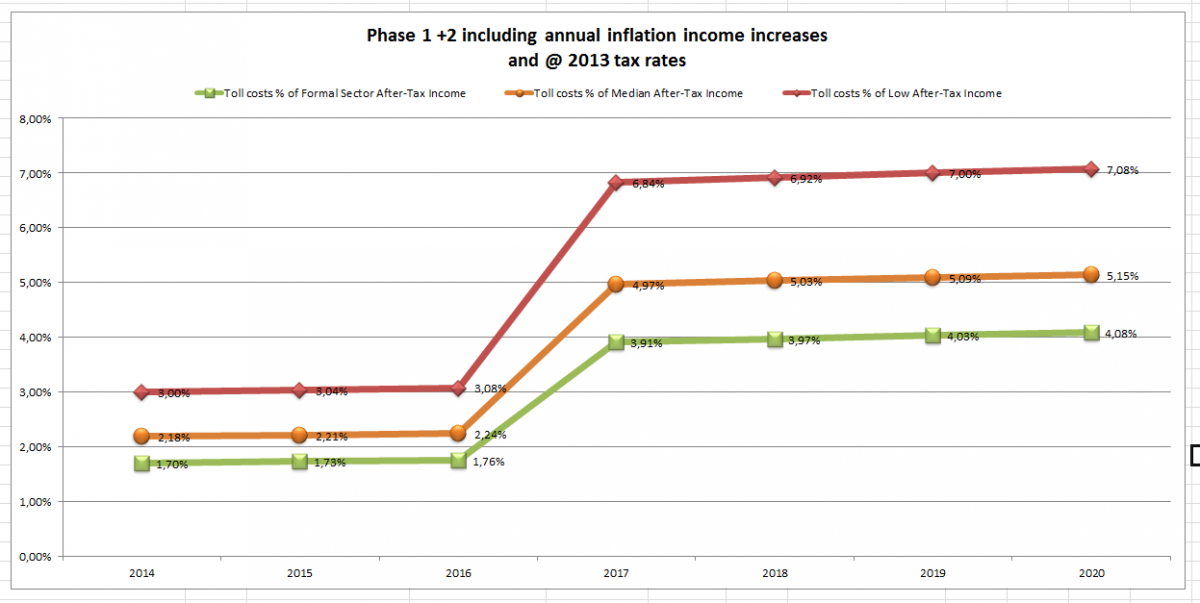
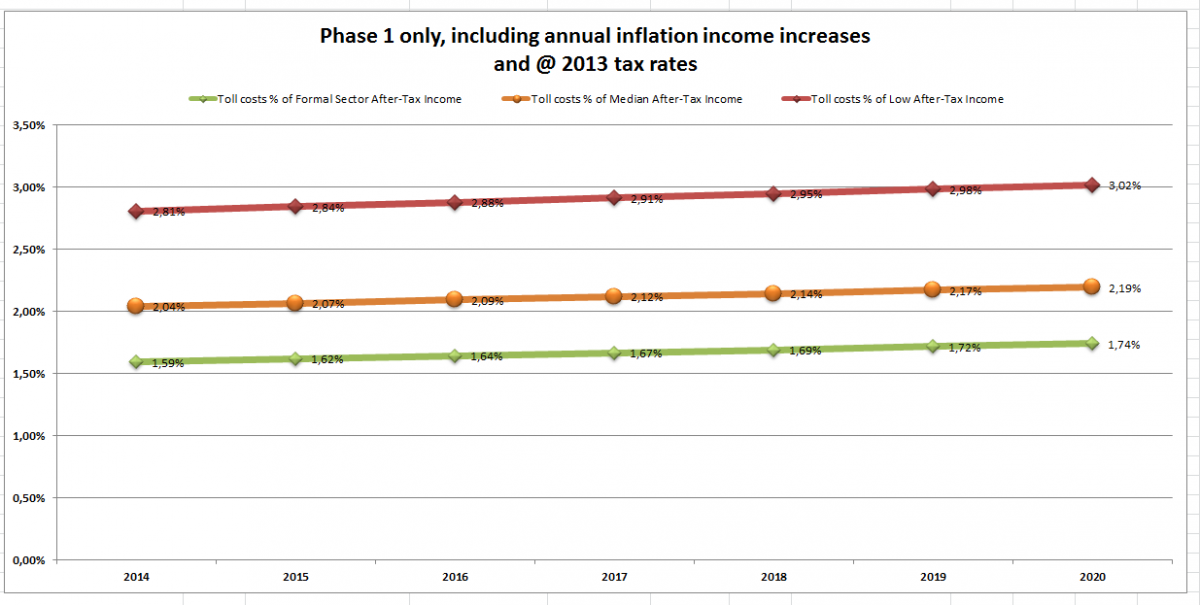
The impact that e-tolls are going to have to your income...

Here I show you what this means to taxpayers in South Africa:

So what does E-Tolling mean to income earners, in light of the above calculations?

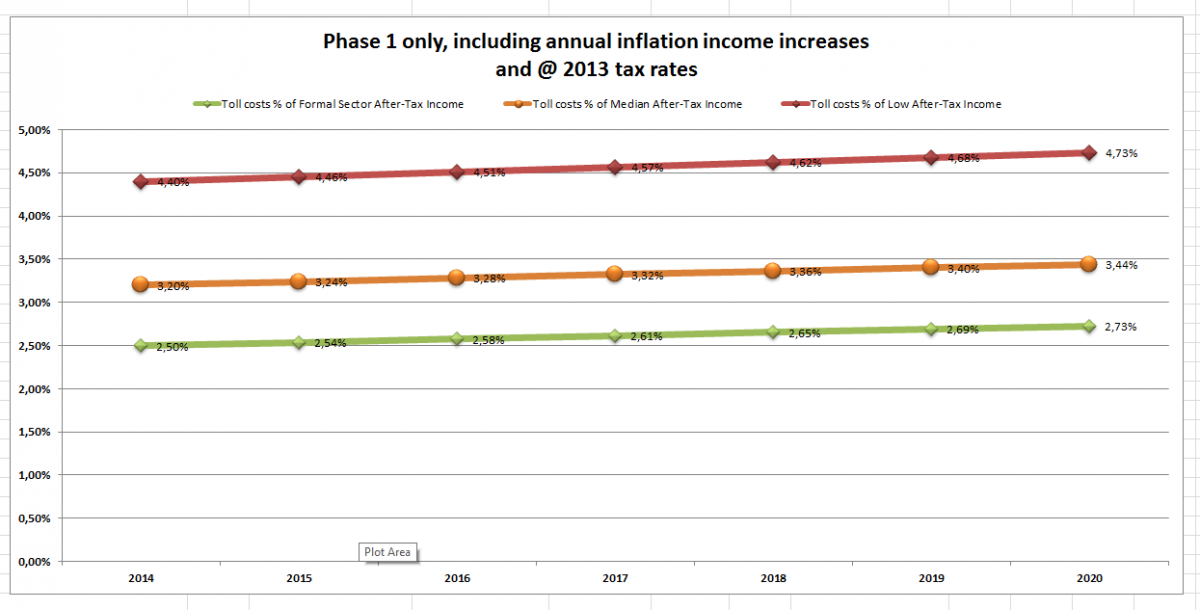
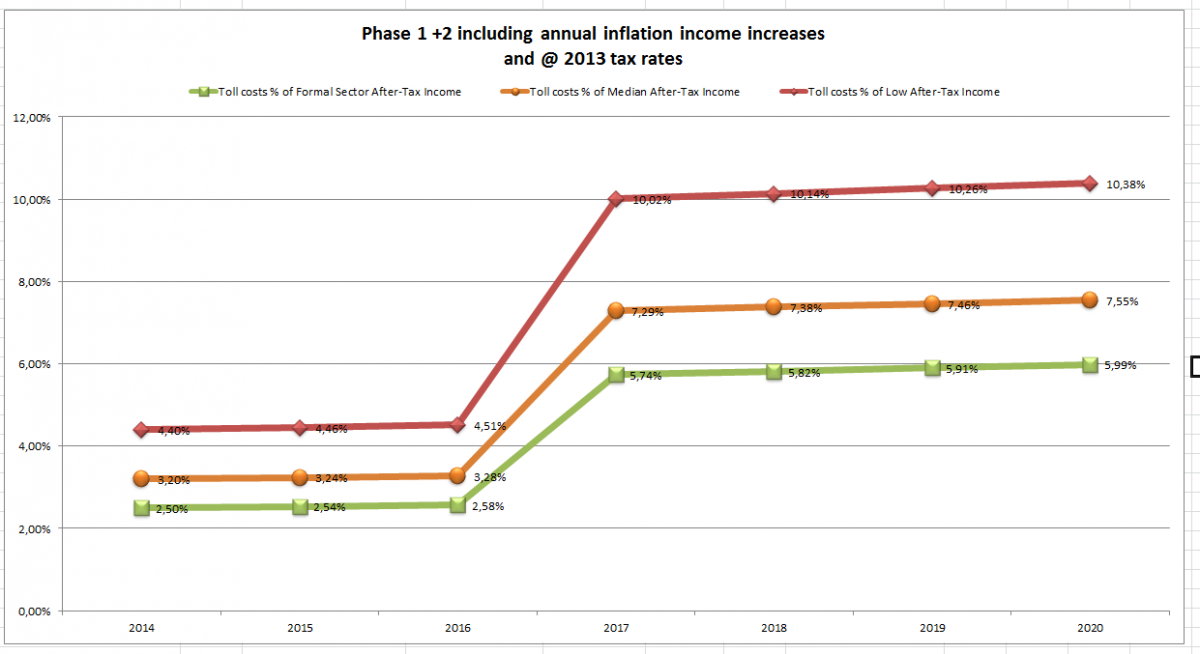
In this scenario, we look at a compliance rate of 1 million:

Phase1:
Income_Impact_1m_compliance.png


Phase 1 + 2:
Income_Impact_1m_compliance_phase_2.png


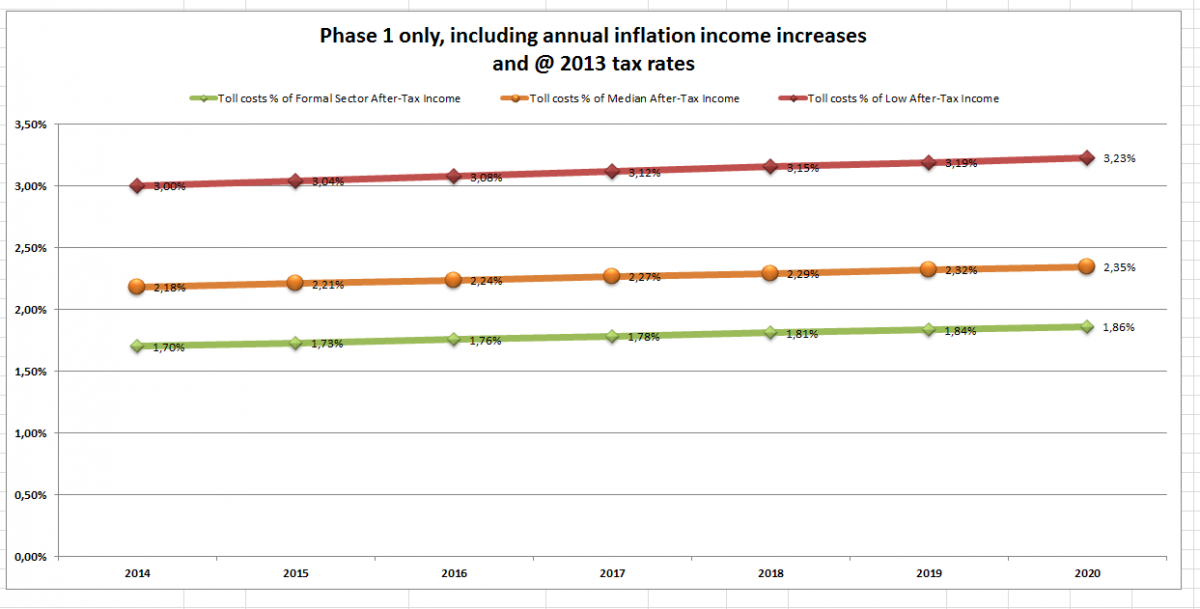
In the following scenario, we look at a compliance rate of 2 million:

Phase 1:
Income_Impact_2m_compliance.png


Phase 1 + 2:
Income_Impact_2m_compliance_phase_2.png


In this final scenario, we look at a compliance rate of 3 million:

Phase 1:
Income_Impact_3m_compliance.png


Phase 1 + 2:
Income_Impact_3m_compliance_phase_2.png


It's a startling reminder of the impacts across the board. These calculations also include annual CPI-related increases to income.

What's clear is that the poor are always hit the hardest, and those trying to break through into the middle class are prevented from doing so by a project like this. When upwards of 10% of a lower-income earner's after-tax money is taken from them, how are they supposed to prosper?

How is anyone supposed to prosper with such ridiculous pricing points?
 
Last edited:
thanks DJ - perhaps if you could try to turn the above into a statement if at all possible?
Something like: "If we funded the GFIP through a 10c/ltr fuel levy, we could have built xxx schools, yyy houses and zzz hospitals"
 
thanks DJ - perhaps if you could try to turn the above into a statement if at all possible?
Something like: "If we funded the GFIP through a 10c/ltr fuel levy, we could have built xxx schools, yyy houses and zzz hospitals"

I don't have the costings for a school or hospital. I've got various costings for Low Cost Housing. Will consider doing this.

I think I might turn the new info into a video to make it more palatable...
 
great!

I would throw all the financial wiz stuff in to get credibility, but think it is very important to drive the issue home to less knowledgeable people, that the wastage is translated into something they can understand
 
great!

I would throw all the financial wiz stuff in to get credibility, but think it is very important to drive the issue home to less knowledgeable people, that the wastage is translated into something they can understand

I just wish I had the skills for these things. They take an age to put together as the only realistic way for me to do it is with Powerpoint and I do a voice-over.

Would be great if I could actually do a proper animated version, or at least something with a bit of production quality...
 
I wonder who did OUTA's - maybe they can help? or if you are on FB, perhaps ask on the OUTA FB page?
 
I wonder who did OUTA's - maybe they can help? or if you are on FB, perhaps ask on the OUTA FB page?

They've been sent a link to this post, and a previous post where I delved into Inge Mulder's statements and Sanral's financial position. Their response was: "this is an exceptionally good and factual piece. Thank you for this."

Hopefully they'll look at this data and come to the same conclusion. I'd happily do the script-writing and voice-overs for them, and also happy to release all of my data and calculations to them...
 
Does anyone know what the current amount of registered e-tag users there are vs the amount of registered gauteng motorists to date? Also at what rate of registered e-tag (also just registered users) does scamral requre to be successful?

Also has anyone heard any news about the first sanral non payment prosecution?
 
AFAIK

1mil SOLD e-tags (they have never quoted REGISTERED)
3mil Gauteng road users
OUTA says about 90% or more need to be registered
There have been no court cases
 
Does anyone know what the current amount of registered e-tag users there are vs the amount of registered gauteng motorists to date? Also at what rate of registered e-tag (also just registered users) does scamral requre to be successful?

Also has anyone heard any news about the first sanral non payment prosecution?

First question: we don't know. Sanral claim about 1/3rd are e-tagged last I can recall.

Second question: that's in my videos and the posts I linked to in this thread. There are a few permutations based on payment splits and whether Sanral lied to us or not, which I maintain they did.

Third question: nothing yet. I don't think the point has been reached where anyone will be handed over for prosection yet, but it's coming...
 
AFAIK

1mil SOLD e-tags (they have never quoted REGISTERED)
3mil Gauteng road users
OUTA says about 90% or more need to be registered
There have been no court cases

First question: we don't know. Sanral claim about 1/3rd are e-tagged last I can recall.

Second question: that's in my videos and the posts I linked to in this thread. There are a few permutations based on payment splits and whether Sanral lied to us or not, which I maintain they did.

Third question: nothing yet. I don't think the point has been reached where anyone will be handed over for prosection yet, but it's coming...

Appreciated!
 
Last edited:
Top
Sign up to the MyBroadband newsletter
X