4Gb RAM issue?

Not technically incorrect.
2^32=4096MB RAM. PAE uses page tables to increase the addressable memory by 4 bits to 36. Thus 2^36 = 64GB. 32bit can only see 4GB max....

Whoa!

Instant throwback to the 8086/286 era...

...and it was called expanded memory, and used EMM386...

man, I hated that...

when DOS extenders came up (such as the DOS-4GW runtime module for DOOM) it made life a lot better...
 
Hmmm, but is the graphics memory addressable by anything in the system, or is it dedicated graphics memory (only addressable by the Graphic card processor)?

Sounds like a stupid question, but applying logic tells you that dedicated graphic memory is invisible to the main system as it is only addressable by the GPU. There is no link between it and the main memory and it cannot be accessed via anything but the GPU... in other words, not counting toward that 4GB addressable memory limit of the main system.

Granted this changes if the graphic memory is shared...

You are half right, yes the memory is not physically the same but thats not the point.
1.The memory address registers can only point up to 4gb in a 32 bit address
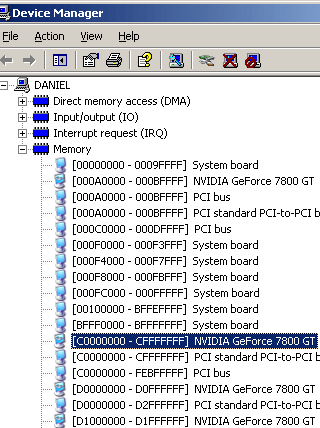
2. The ram of your video card has to be addressed , so it is mapped into this 4gb range so that your cpu can address it.
3. The left over memory is available above 4gb, its there and its free, you just can't address it.
4.Every device that has memory that needs to be addressed by the cpu is going to be mapped into the 4gb range which is why you generally get about 3.4 gig available ram!
 
You are half right, yes the memory is not physically the same but thats not the point.
1.The memory address registers can only point up to 4gb in a 32 bit address
2. The ram of your video card has to be addressed , so it is mapped into this 4gb range so that your cpu can address it.
3. The left over memory is available above 4gb, its there and its free, you just can't address it.
4.Every device that has memory that needs to be addressed by the cpu is going to be mapped into the 4gb range which is why you generally get about 3.4 gig available ram!

Thing is, in response to the bold print in your quote, the CPU does not address your graphic memory. You have a separate processor that addresses and uses graphic memory - it is your GPU. There is no communication between your CPU and your graphic card's memory - the graphic card memory is invisible to the CPU. So how would it count as part of the 4GB addressable range of the CPU?

I think I am right (not just half right)... :p
 
Thing is, in response to the bold print in your quote, the CPU does not address your graphic memory. You have a separate processor that addresses and uses graphic memory - it is your GPU. There is no communication between your CPU and your graphic card's memory - the graphic card memory is invisible to the CPU. So how would it count as part of the 4GB addressable range of the CPU?

I think I am right (not just half right)... :p

No

memmap_320.png


How else would you get your texture into your gfx's card memory, last time i told my gpu to go read the hard disk for info it gave me the middle finger
 
following your logic you'll have an 800Mb graphics card, if you can only see 3.2Gb...? :confused:

Thing is, in response to the bold print in your quote, the CPU does not address your graphic memory. You have a separate processor that addresses and uses graphic memory - it is your GPU. There is no communication between your CPU and your graphic card's memory - the graphic card memory is invisible to the CPU. So how would it count as part of the 4GB addressable range of the CPU?

I think I am right (not just half right)... :p

Although the CPU may not communicate with the GPU, the OS does. If the RAM on the display card, or any other device, PCI bus, audio card is above the 4GB limit then the OS would not be able to address it. This is why the hardware maps, at the OS level, to within the 4GB limit.
 
Quote:
Originally Posted by wishblade View Post
Thing is, in response to the bold print in your quote, the CPU does not address your graphic memory. You have a separate processor that addresses and uses graphic memory - it is your GPU. There is no communication between your CPU and your graphic card's memory - the graphic card memory is invisible to the CPU. So how would it count as part of the 4GB addressable range of the CPU?

I think I am right (not just half right)...
No

http://www.dansdata.com/images/askda...memmap_320.png

How else would you get your texture into your gfx's card memory, last time i told my gpu to go read the hard disk for info it gave me the middle finger

OK, I concede - it was a good fight while it lasted. :D I have been proven wrong, admittedly!! Goes to show how applying simple logic in an incorrect method always comes back to shoot you in the foot...

For interest though - someone care to explain why I have 1GB of graphic memory (256MB dedicated + 700 odd shared) yet as per

http://mybroadband.co.za/vb/picture.php?albumid=343&pictureid=2426

but only 131 000 odd bytes are shown? Just curious, because this could have been an arguing point ;) but decided to concede defeat when I saw the memory range used by the graphic card in System Information was roughly 256MB in size.
 
Last edited:
Lol, the range A000h to BFFFH has been mapped to the gfx card since 8086 vga days, back then it was always assumed that this memory was the gfx cards memory(generally on screen buffer), it has to be reserved for that to provide backwards compatibality to x86 applications, the rest of your memory.. who knows, maybe its considered a "MOTHERBOARD RESOURCE"
 
Aaaahhh, now i see (said the blind man to his deaf daughter, while sitting a the corner of a round table... etc)

OK, so once again, I see the light and yes, graphic memory is counted toward total addressable memory...

but 32 bit hardware can't address more than 4Gb of memory. I still stand by this :p And no I don't want to argue it. I've done more than enough today :D
 
Top
Sign up to the MyBroadband newsletter
X