How about: let's discuss cholesterol

No need to, there are plenty of dietitians who know that natural fats is not the enemy.
Cool, which ones? It is something that I'd like to discuss with a dietitian - get both sides of the story. If you have local details, please PM me.
 
I don’t need to do reading. I go to a dietitian who has done the reading, studying, got a masters degree and helps 1000s of people. And I actually get results from following what she says.

But you keep on the way you are going since you know better.

lol
To be fair there's also people making claims about the harms of ultra processed seed oils who have PhDs & spent the last 15 years researching the topic.
 
Last edited:
A recent studies suggest that statins can significantly reduce glucagon-like peptide-1 (GLP-1) levels, though the exact amount can vary. This reduction in GLP-1 is a potential factor in the increased risk of insulin resistance and new-onset type 2 diabetes observed in some statin users. The mechanism is thought to be a statin-induced change in gut bacteria, which leads to reduced levels of a specific metabolite that is necessary for GLP-1 production.

 
what we need is for RFK Jr to MAHA this nonsense into oblivion, so much of the fat-is-bad-take-your-statins approach is rooted in US dietary guidelines since the 80's that have never been substantially updated, when will that 2025 update finally get published?

it is allegedly delayed due to the US government shutdown, wouldn't be surprised if heated debates & bribery with big pharma is the main reason for the delay though
 
They're mostly discussing LDL cholesterol in relation to oil consumption.
It would have helped if you gave a short summary of the video, but I agree LDL only becomes a problem when the particles are small and dense, which is largely influenced by diet. Larger, buoyant LDL particles are generally considered less harmful, while small, dense LDL is more likely to contribute to plaque build-up in the arteries.
 
It would have helped if you gave a short summary of the video, but I agree LDL only becomes a problem when the particles are small and dense, which is largely influenced by diet. Larger, buoyant LDL particles are generally considered less harmful, while small, dense LDL is more likely to contribute to plaque build-up in the arteries.

That's an outdated hypothesis.

Current understanding is that size doesn't matter. All LDL particles contain one molecule of ApoB and are therefore atherogenic.
It's about the number of particles, not the type. A person can have a high number of large, buoyant LDL particles, resulting in a very high ApoB level and, consequently, a very high risk of a heart attack.
 
That's an outdated hypothesis.

Current understanding is that size doesn't matter. All LDL particles contain one molecule of ApoB and are therefore atherogenic.
It's about the number of particles, not the type. A person can have a high number of large, buoyant LDL particles, resulting in a very high ApoB level and, consequently, a very high risk of a heart attack.
I get your point about ApoB and particle number, that’s true in people eating a modern, inflammatory diet. But that’s the key thing: in a low-inflammation, low-sugar, whole-food diet, LDL behaves very differently.

Traditional humans probably had high LDL too, but almost zero heart disease, because their metabolic environment wasn’t damaged by seed oils, refined carbs and chronic inflammation.

So yes, ApoB matters, in the wrong metabolic context. Fix the diet and the whole picture changes. The real solution isn’t statins for everyone, it’s addressing the underlying inflammation and insulin resistance in the first place.
 
I get your point about ApoB and particle number, that’s true in people eating a modern, inflammatory diet. But that’s the key thing: in a low-inflammation, low-sugar, whole-food diet, LDL behaves very differently.
No, LDL doesn't "change it's behavior". That's not a real thing.

Traditional humans probably had high LDL too, but almost zero heart disease, because their metabolic environment wasn’t damaged by seed oils, refined carbs and chronic inflammation.

So yes, ApoB matters, in the wrong metabolic context. Fix the diet and the whole picture changes. The real solution isn’t statins for everyone, it’s addressing the underlying inflammation and insulin resistance in the first place.
That hypothesis is not based on evidence. The vast majority of the early human population lived around the equator and ate a predominantly plant based diet. The claim that they had "almost zero heart disease" is also false. A study on mummies from around the world show an atherosclerosis incidence of around 34%, regardless of location.

Also, seed oils reduce inflammation, reduce LDL and result in lower incidence of high blood pressure, insulin resistance, heart attacks, all-cause mortality and so on when compared to butter.


1763453611821.webp


Conclusions: In our large community-based study, we observed weak but statistically significant inverse associations between several types of inflammatory biomarkers with RBC n-6 PUFAs. Our findings do not support the hypothesis that omega-6 fatty acids are pro-inflammatory.

we found an inverse relationship between n-3 fatty acids, EPA and DHA, and MUFA with hs-CRP concentration in CAD patients. Our finding suggests that SFA (saturated fatty acid) was directly related to plasma IL-6 and hs-CRP levels.
 
That description of the study is not true, at all. Plaque volume increased massively.

The pre-specified primary outcome, percent change in non-calcified plaque volume (NCPV), was a median increase of 18.9mm³ (~43% from baseline).
This degree of progression, seen in participants with uniformly elevated Apolipoprotein B (ApoB) and Low-Density Lipoprotein Cholesterol (LDL-C) levels, far exceeds rates observed in both low- and high-risk cohorts from prior studies.
Moreover, the study’s null association between ApoB/LDL-C and plaque progression is uninterpretable without the variation in exposure of a comparator group, and the use of this exploratory analysis to inform the title and conclusions is scientifically inappropriate.
Mischaracterization of the study as a “trial” and emphasis on biologically uninformative explanations further undermine the credibility of the findings.
Given the public health implications and potential for misinterpretation, it is vital to clarify that this study in fact provides evidence of accelerated atherosclerosis in a population described as “metabolically healthy.”
 
Last edited:
No, LDL doesn't "change it's behavior". That's not a real thing.


That hypothesis is not based on evidence. The vast majority of the early human population lived around the equator and ate a predominantly plant based diet. The claim that they had "almost zero heart disease" is also false. A study on mummies from around the world show an atherosclerosis incidence of around 34%, regardless of location.

Also, seed oils reduce inflammation, reduce LDL and result in lower incidence of high blood pressure, insulin resistance, heart attacks, all-cause mortality and so on when compared to butter.


View attachment 1864293


Conclusions: In our large community-based study, we observed weak but statistically significant inverse associations between several types of inflammatory biomarkers with RBC n-6 PUFAs. Our findings do not support the hypothesis that omega-6 fatty acids are pro-inflammatory.

we found an inverse relationship between n-3 fatty acids, EPA and DHA, and MUFA with hs-CRP concentration in CAD patients. Our finding suggests that SFA (saturated fatty acid) was directly related to plasma IL-6 and hs-CRP levels.
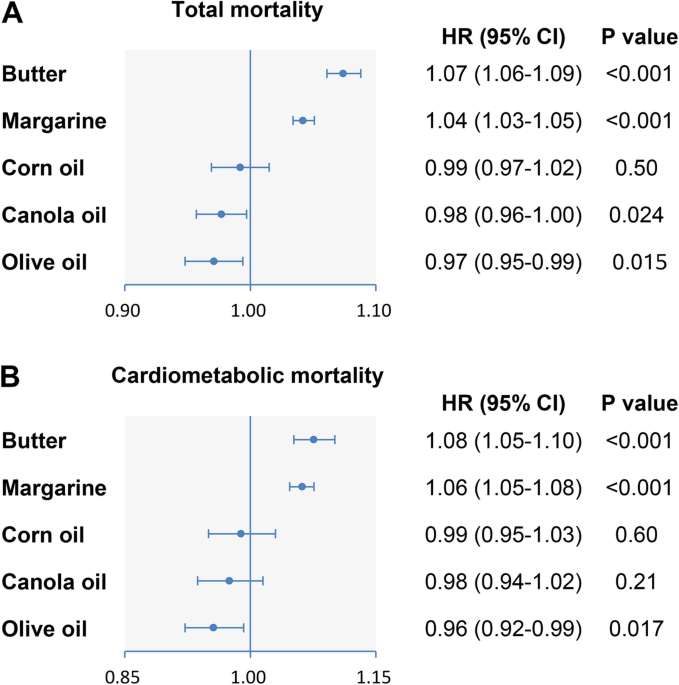
What's wrong with butter that causes this?
"Conclusions
Consumption of butter and margarine was associated with higher total and cardiometabolic mortality. Replacing butter and margarine with canola oil, corn oil, or olive oil was related to lower total and cardiometabolic mortality. Our findings support shifting the intake from solid fats to non-hydrogenated vegetable oils for cardiometabolic health and longevity."
 
1958: Ancel Keys presents his Seven Countries Study claiming saturated fat causes heart disease.

Problem: He had data from 22 countries. He cherry-picked 7 that fit his hypothesis and buried the rest.

France ate butter and cream with low heart disease. Switzerland ate cheese with low heart disease. West Germany ate meat and had declining heart disease despite rising fat consumption.

Keys ignored all of them. They didn't support the conclusion he'd already decided on.

When other scientists pointed this out, Keys didn't engage with the science. He destroyed them personally. He had colleagues blacklisted from journals. He used his position on the American Heart Association to block opposing research from publication. He went after funding for anyone who questioned him.

Dr. John Yudkin suggested sugar might be the problem, not fat. Keys called him a fool in print, destroyed his reputation, got his research funding cut, and effectively ended his career. Yudkin was vindicated decades later but he died in obscurity.

Keys wasn't doing science. He was running a protection racket for his hypothesis. You either supported him or you stopped publishing.

The man who convinced the world that butter would kill them selected 7 countries out of 22 to prove his predetermined conclusion, then spent 30 years destroying anyone who noticed.

And we're still living with dietary guidelines based on his fraud.

 
The main argument against saturated fats is that they raise LDL-cholesterol. But that's a myopic approach, a top nutritionist argues.
"There are several good reasons to question the acceptance of total LDL-C concentration as a valid biomarker for risk when changed by diets"
For instance, the key *gold standard* Mediterranean diet study (PREDIMED) which reduced heart-disease risk did so WITHOUT lowering LDL-C.
Also, LDL particle size matters, and sat fats raise the good kind, not the bad.
Published in a top nutrition journal.
Definitely worth reading

 
First time I have ever been the the green. Maybe from microdosing retatrutide, maybe not. I'll test again next month to see if it was a fluke.
The big drop is when I started psyllium husk and started dropping the saturated fats.
Other than that, fit, healthy, 53 VO2 max which is not bad for someone in their 40's.

1765865539870.png

1765865559471.png
 
Top
Sign up to the MyBroadband newsletter
X