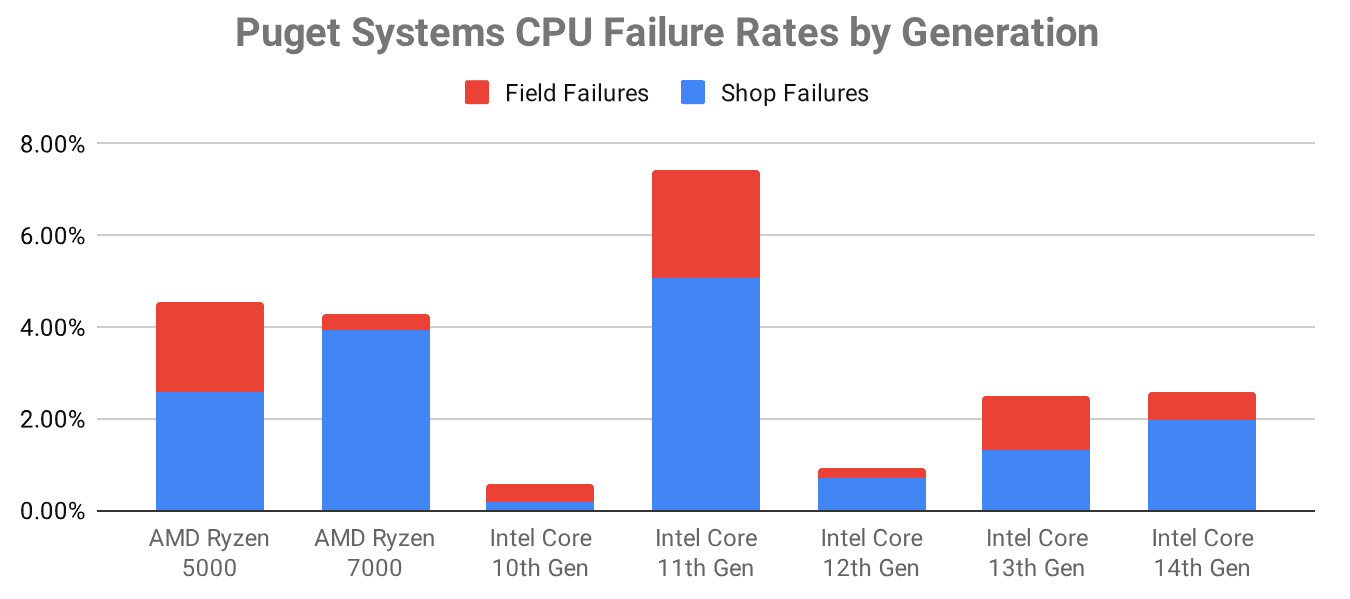
Intel disaster.

I'll throw my thoughts on the matter. Maybe this turns out to be a bigger deal down the line, but based on experience this is the media hype-train in full effect. I've watched these hype-trains in the past and seen the effects they have.

The following will include some anecdotes as well as stats based on figures that are 100x larger than the SA market as a whole.

Asus motherboards melting AM5 CPUs
Asus have two motherboard distributors in the country, neither took action, and neither even knew about the issue. Asus ZA was unaware as well and, to date, hasn't had a return due to a motherboard melting a CPU.

Gigabyte PB-series PSUs exploding
There are two distributors for Gigabyte PSUs in the country. One had two returns within the affected serial number range. Of the two, one was just completely dead (POSSIBLY (and I say this with no evidence) due to load shedding, which was a daily occurrence at the time), and the other was returned because the customer wanted a replacement that didn't fall within the SN range. The other distributor is oblivious to the matter as there weren't returns.

NZXT cases catching fire
This had probably the greatest effect on sales of all the hype-train events of late. I watched disti stock levels stay exactly the same for about a week. No issues were reported.

As with all previous events, this MIGHT end up being a big deal. It might end up being the biggest deal since the Pentium FVID bug from 30 years ago. AS IT STANDS, though, this is just media hyping up a situation to get views. Clickbait gets views, drama gets views, and before you know it something is blown completely out of proportion.

Across the board, whether I look at my own returns, speak to distributors with national figures, speak to vendors' local offices to see if international figures are worth talking about, or even look at international retailer numbers that have been released, 13th and 14th Gen have had a lower failure rate than AM5. Everyone is aware of the situation, but nobody is seeing the same figures the media is portraying.

Side note, strangely, and I don't really see the correlation, more RAM is returned from AM5 systems than Intel DDR5 systems .

Some recent stats:

Intel: This covers 10th, and 12th through 14th Gen - yes, some people still buy 10th Gen

Intel CPUs sold: 118
Intel CPUs returned: 0
Intel CPUs replaced: 0
Intel return rate: 0%
Intel replacement rate: 0%
Breakdown of returns:
  • N/A

AMD: This covers Ryzen 4000-, 5000- and 7000-Series - no recent 3000-Series or older sales

AMD CPUs sold: 97
AMD CPUs returned: 5
AMD CPUs replaced: 4
AMD return rate: 5.2%
AMD replacement rate: 4.1%
Breakdown of returns:
  • 1 x Ryzen 5 4500 - faulty
  • 1 x Ryzen 7 5800X3D - no fault found
  • 1 x Ryzen 5 7600X - faulty
  • 1 x Ryzen 7 7700 - faulty
  • 1 x Ryzen 7 7700X - faulty

All failure rates have been below 5%, which is an industry-acceptable level.

Anecdote. I have a friend that deployed five i9-13900 (non-K) CPUs as servers more than a year ago. Budget is the only thing that prevented the company from doing more at the time, as the five really aren't enough, and seldom drop below 100% load 24/7. All five are still rock-solid.

The only failure since 2020 which was actually a big deal was a Corsair DDR4 dummy RAM kit, which had around an 80% failure rate with most being DOA. I pulled them from sale once returns indicated there was clearly an issue, and Corsair recalled them very shortly thereafter.

I have other reasons to steer people away from 14th Gen, such as lack of upgradability (future LGA1700 CPUs will lack E-cores and AI cores), often poorer value for money, sometimes poorer performance, higher power draw (and therefore poorer thermals), etc.

With the above in mind, I'll be keeping a close eye on the Intel situation and act accordingly :)

May I ask what your returns on AM5 MSI boards looks like?
 
MSI also released their BIOS update. Apparently it is up on their product pages. 790 boards.

Edit, VideoCardz have their press release:


[Taipei, Taiwan] August 2024 – Regarding the instability of the Intel® Core™ 14th /13th Gen desktop processors, MSI will release the latest BIOS of Intel 700 and 600 series motherboards and 14th /13th Generation Desktop PC with 0x129 microcode to mitigate the instability.

The 1st batch of BIOS releasing models are:

- MEG Z790 GODLIKE MAX
- MEG Z790 ACE MAX
- MPG Z790 CARBON MAX WIFI II
- MPG Z790 CARBON WIFI
- MAG Z790 TOMAHAWK MAX WIFI
- Z790 MPOWER

All BIOS of Intel 700 and 600 series motherboards and 14th /13th Generation Desktop PC will be released soon in coming weeks by the end of August. MSI will continue to update our users on the latest news. Please follow MSI’s official channels and check the product pages for the latest BIOS updates.
 
Last edited:
I'll throw my thoughts on the matter. Maybe this turns out to be a bigger deal down the line, but based on experience this is the media hype-train in full effect. I've watched these hype-trains in the past and seen the effects they have.

The following will include some anecdotes as well as stats based on figures that are 100x larger than the SA market as a whole.

Asus motherboards melting AM5 CPUs
Asus have two motherboard distributors in the country, neither took action, and neither even knew about the issue. Asus ZA was unaware as well and, to date, hasn't had a return due to a motherboard melting a CPU.

Gigabyte PB-series PSUs exploding
There are two distributors for Gigabyte PSUs in the country. One had two returns within the affected serial number range. Of the two, one was just completely dead (POSSIBLY (and I say this with no evidence) due to load shedding, which was a daily occurrence at the time), and the other was returned because the customer wanted a replacement that didn't fall within the SN range. The other distributor is oblivious to the matter as there weren't returns.

NZXT cases catching fire
This had probably the greatest effect on sales of all the hype-train events of late. I watched disti stock levels stay exactly the same for about a week. No issues were reported.

As with all previous events, this MIGHT end up being a big deal. It might end up being the biggest deal since the Pentium FVID bug from 30 years ago. AS IT STANDS, though, this is just media hyping up a situation to get views. Clickbait gets views, drama gets views, and before you know it something is blown completely out of proportion.

Across the board, whether I look at my own returns, speak to distributors with national figures, speak to vendors' local offices to see if international figures are worth talking about, or even look at international retailer numbers that have been released, 13th and 14th Gen have had a lower failure rate than AM5. Everyone is aware of the situation, but nobody is seeing the same figures the media is portraying.

Side note, strangely, and I don't really see the correlation, more RAM is returned from AM5 systems than Intel DDR5 systems .

Some recent stats:

Intel: This covers 10th, and 12th through 14th Gen - yes, some people still buy 10th Gen

Intel CPUs sold: 118
Intel CPUs returned: 0
Intel CPUs replaced: 0
Intel return rate: 0%
Intel replacement rate: 0%
Breakdown of returns:
  • N/A

AMD: This covers Ryzen 4000-, 5000- and 7000-Series - no recent 3000-Series or older sales

AMD CPUs sold: 97
AMD CPUs returned: 5
AMD CPUs replaced: 4
AMD return rate: 5.2%
AMD replacement rate: 4.1%
Breakdown of returns:
  • 1 x Ryzen 5 4500 - faulty
  • 1 x Ryzen 7 5800X3D - no fault found
  • 1 x Ryzen 5 7600X - faulty
  • 1 x Ryzen 7 7700 - faulty
  • 1 x Ryzen 7 7700X - faulty

All failure rates have been below 5%, which is an industry-acceptable level.

Anecdote. I have a friend that deployed five i9-13900 (non-K) CPUs as servers more than a year ago. Budget is the only thing that prevented the company from doing more at the time, as the five really aren't enough, and seldom drop below 100% load 24/7. All five are still rock-solid.

The only failure since 2020 which was actually a big deal was a Corsair DDR4 dummy RAM kit, which had around an 80% failure rate with most being DOA. I pulled them from sale once returns indicated there was clearly an issue, and Corsair recalled them very shortly thereafter.

I have other reasons to steer people away from 14th Gen, such as lack of upgradability (future LGA1700 CPUs will lack E-cores and AI cores), often poorer value for money, sometimes poorer performance, higher power draw (and therefore poorer thermals), etc.

With the above in mind, I'll be keeping a close eye on the Intel situation and act accordingly :)
You know, I will say this- I agree with you.
I am known for pushing kit pretty hard, as I like to do stuff like crypto breaking etc, for academic reasons.
I can honestly tell you this, I am not even aware of all these issues, in fact, everything I buy is fire-and-forget.

However, hard disks, and that includes SSDs, there's a pet subject we can talk about.

One Western Digital drive died on me after hardly any use, in fact it was used once, installed OS and then when I wanted to use the machine months later it was dead. Supplier replaced it though.
 
You know, I will say this- I agree with you.
I am known for pushing kit pretty hard, as I like to do stuff like crypto breaking etc, for academic reasons.
I can honestly tell you this, I am not even aware of all these issues, in fact, everything I buy is fire-and-forget.
I say going around saying you have 0% problems in the face of this is probably the single worst thing you can do as an IT business right now.


I say going around saying you have 0% problems in the face of this is probably the single worst thing you can do as an IT business right now.
I am not an IT business, and I don't have 0% problems.
I have had ongoing issues with SSDs dying and not lasting. I am getting tired of having to do regular exchanges and replacements.
 
Lol no.. various different machines and even servers.
Check your RAM speeds, try and limit it, these hyper fast RAM kits drive I/O controllers insane which impacts your drives. At least in my experience I've noticed huge relationship with RAM speed and SSD/NVME operation / stability (On Ryzen at least).
 

Both AM4 and AM5 had teething issues, and some issues still persist to this day. Neither is it limited to memory compatibility and stability.

At least both AM4 and AM5 are more mature now, well AM4 is at its peak.
 
I'll throw my thoughts on the matter. Maybe this turns out to be a bigger deal down the line, but based on experience this is the media hype-train in full effect. I've watched these hype-trains in the past and seen the effects they have.

The following will include some anecdotes as well as stats based on figures that are 100x larger than the SA market as a whole.

Asus motherboards melting AM5 CPUs
Asus have two motherboard distributors in the country, neither took action, and neither even knew about the issue. Asus ZA was unaware as well and, to date, hasn't had a return due to a motherboard melting a CPU.

Gigabyte PB-series PSUs exploding
There are two distributors for Gigabyte PSUs in the country. One had two returns within the affected serial number range. Of the two, one was just completely dead (POSSIBLY (and I say this with no evidence) due to load shedding, which was a daily occurrence at the time), and the other was returned because the customer wanted a replacement that didn't fall within the SN range. The other distributor is oblivious to the matter as there weren't returns.

NZXT cases catching fire
This had probably the greatest effect on sales of all the hype-train events of late. I watched disti stock levels stay exactly the same for about a week. No issues were reported.

As with all previous events, this MIGHT end up being a big deal. It might end up being the biggest deal since the Pentium FVID bug from 30 years ago. AS IT STANDS, though, this is just media hyping up a situation to get views. Clickbait gets views, drama gets views, and before you know it something is blown completely out of proportion.

Across the board, whether I look at my own returns, speak to distributors with national figures, speak to vendors' local offices to see if international figures are worth talking about, or even look at international retailer numbers that have been released, 13th and 14th Gen have had a lower failure rate than AM5. Everyone is aware of the situation, but nobody is seeing the same figures the media is portraying.

Side note, strangely, and I don't really see the correlation, more RAM is returned from AM5 systems than Intel DDR5 systems .

Some recent stats:

Intel: This covers 10th, and 12th through 14th Gen - yes, some people still buy 10th Gen

Intel CPUs sold: 118
Intel CPUs returned: 0
Intel CPUs replaced: 0
Intel return rate: 0%
Intel replacement rate: 0%
Breakdown of returns:
  • N/A

AMD: This covers Ryzen 4000-, 5000- and 7000-Series - no recent 3000-Series or older sales

AMD CPUs sold: 97
AMD CPUs returned: 5
AMD CPUs replaced: 4
AMD return rate: 5.2%
AMD replacement rate: 4.1%
Breakdown of returns:
  • 1 x Ryzen 5 4500 - faulty
  • 1 x Ryzen 7 5800X3D - no fault found
  • 1 x Ryzen 5 7600X - faulty
  • 1 x Ryzen 7 7700 - faulty
  • 1 x Ryzen 7 7700X - faulty

All failure rates have been below 5%, which is an industry-acceptable level.

Anecdote. I have a friend that deployed five i9-13900 (non-K) CPUs as servers more than a year ago. Budget is the only thing that prevented the company from doing more at the time, as the five really aren't enough, and seldom drop below 100% load 24/7. All five are still rock-solid.

The only failure since 2020 which was actually a big deal was a Corsair DDR4 dummy RAM kit, which had around an 80% failure rate with most being DOA. I pulled them from sale once returns indicated there was clearly an issue, and Corsair recalled them very shortly thereafter.

I have other reasons to steer people away from 14th Gen, such as lack of upgradability (future LGA1700 CPUs will lack E-cores and AI cores), often poorer value for money, sometimes poorer performance, higher power draw (and therefore poorer thermals), etc.

With the above in mind, I'll be keeping a close eye on the Intel situation and act accordingly :)

The caveat being that a lot of people who bought the affected 13/14th gen Intel CPUs might be completely oblivious that anything may be wrong with their CPU. They're not failing in a way that is obvious and getting random BSODs might be blamed on the software or Windows or some other component in the system.

Affected CPUs will start exhibiting more issues over time and if these people are unaware they're not going to proactively apply these BIOS updates. It's Intel's duty IMO to make a more concerted effort to inform their customers of the potential issue and that's where they're failing big time.
 
Then you have bad luck. I have SSDs in production which have outlived their advertised thresholds, still in good health. I haven't ever used WD SSD drives though.
Sounds like he likes to overclock, meaning he probably pushes RAM hard, which screws with I/O controllers which will screw up storage like NVME/SSD and give the appearance of failure, (or maybe even cause failure).
 
Do these issues only affect desktop cpus not mobile/laptop processors?
 
Plausible.
Yes man I have noticed pushing RAM hard causes very weird things, especially with regards to I/O (storage). I don't trust XMP/EXPO to deliver stability unless you a have very premium mobo.

So I guess as a small PSA, if you notice your NVME/SSD acting strange, low I/O, disconnecting etc, try switching off XMP/EXPO and let the system run at box RAM speeds and see if you have any problems. Your I/O controls might be noping out because of the XMP/EXPO overclock.

note - this is my experience on MSI/Ryzen combos, I have no idea if this impacts Intel platforms or non-MSI/Ryzen combos.
 
Last edited:
That's kind of a reasonable assumption that companies selling this hardware stay abreast with any news and issues.

You will hear the words "we didn't know" a lot surrounding this because of the legal minefield it potentially creates. As a seller in any capacity I would be super careful now because a lot companies (customers) are going to catch wind of the news eventually, so beyond legal issues, just rolling with ignorance to try and escape accountability will damage relationships (trust) severely anyway.
Right now, there is no recall. If a recall is ever issued, sales will be halted with immediate effect and further action taken. Vendors are taking steps to mitigate an issue which, as it stands, is minor in the broader picture. Claiming ignorance after a recall is issued is common - "I missed that email" or similar. The "we didn't know" is used in place of "we didn't take action after being advised to because we wanted more sales," which is something I'll never do.

Distributors are on standby for further action if required, as if this DOES become an actual issue, it ultimately falls on Intel and they're ready for that. It's the protection the entire channel gets from buying through channel rather than grey imports.

May I ask what your returns on AM5 MSI boards looks like?
Not terrible, BUT their after-sales support isn't exactly world class in any respect. Gigabyte is untouchable when it comes to after-sales support, and is mostly pro-active rather than reactive.

Remember the BIOS vulnerability that affected several hundred SKUs about a year ago? Funnily, not one media outlet mentioned that fact that over 2/3 of affected boards had BIOS updates to address the issue before it even hit the news.

This is the exact type of thing that I'm talking about when referring to the media hype-train. Saying "Gigabyte motherboards have major security issues" gets far clicks and views than saying "Gigabyte fixed these issues before we even knew about them."

The issue was reported by the news on 31 May / 1 June 2023, and Beta BIOSs (now pulled, as final releases were rolled out about a week later) were all dated the days leading up to the end of May.

Edited to remove an embarrassing story - I have enough of those floating around :p
 
I am not an IT business, and I don't have 0% problems.
I have had ongoing issues with SSDs dying and not lasting. I am getting tired of having to do regular exchanges and replacements.
Maybe up your ram, swap files probably hitting your drive constantly.
 
Top
Sign up to the MyBroadband newsletter
X