Nasa returning to the moon

Because an African has already gone into space ;)

To the moon, in a spaceship that was built in Africa?

The guy is trying to inspire people to educate themselves and achieve something for Africa.
Our leaders don't do that often enough.

Might be a bit lost in translation though...
 
To the moon, in a spaceship that was built in Africa?

The guy is trying to inspire people to educate themselves and achieve something for Africa.
Our leaders don't do that often enough.

Might be a bit lost in translation though...
I don't really see how building a spacecraft is going to achieve something for Africa. I'm pretty sure if you asked the average inhabitant of Africa what he/she would prefer: A new school or a spacecraft with some toff in it they'd go for the school every time.
 
I don't really see how building a spacecraft is going to achieve something for Africa. I'm pretty sure if you asked the average inhabitant of Africa what he/she would prefer: A new school or a spacecraft with some toff in it they'd go for the school every time.

That's because you're racist.

(Sorry, just want to try playing the card :))
 
The moon does not cause tides.
It causes only spring and neap tides.
If we had no moon we would still have tides.
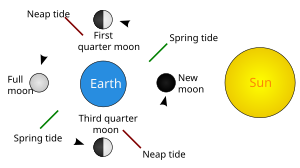
Spring tide is when earth+moon+sun are lined up (at full & new moon)
Neap tide is when the sun and moon's pull cancel each other out.

LOL @ "If you think humans are superior to machines with basic data gathering like this, you're sorely mistaken"

actually, humans are far superior to machines at information gathering.
Machines are limited in their approach by only gathering what we told them to in advance (and nothing else).
If humans went to the moon they could do MUCH more+ gather much more detailed info + adapt to a changing environment and do whatever they choose.

The ONLY reason humans are not going is cost.
As in most things today:
BOTTOM LINE - It's cheaper to send a machine

Additional benefits of sending machines: nobody cries when it crashes + we don't have to feed it, talk to it, make it breath & poop or bring it back.
 
All that needs to happen is for the Americans to find oil on the moon... and it will suddenly become a very popular place.
 
The moon does not cause tides.
It causes only spring and neap tides.
If we had no moon we would still have tides.

Spring tide is when earth+moon+sun are lined up (at full & new moon)
Neap tide is when the sun and moon's pull cancel each other out.
Please provide the source that says this is true. I've never seen this claim made. The alignment of sun and moon are important but they're not just important for neap and spring tides. They're responsible for all tides. As the moon and sun shift relative to the Earth so the water on Earth is moved resulting in tides of all kinds not just neap and spring tides. Neap and Spring tides just correspond to particular alignments of the moon and sun.


LOL @ "If you think humans are superior to machines with basic data gathering like this, you're sorely mistaken"

actually, humans are far superior to machines at information gathering.
Machines are limited in their approach by only gathering what we told them to in advance (and nothing else).
If humans went to the moon they could do MUCH more+ gather much more detailed info + adapt to a changing environment and do whatever they choose.

The ONLY reason humans are not going is cost.
As in most things today:
BOTTOM LINE - It's cheaper to send a machine

Additional benefits of sending machines: nobody cries when it crashes + we don't have to feed it, talk to it, make it breath & poop or bring it back.
Machines are better at collecting data. A human being is never going to be able to measure the gravitational field of the moon as accurately of a machine is.

Seriously have you ever read anything even marginally scientific? Why are you bothering to comment here? Practically everything that you contribute is glaringly anti-science.
 
All that needs to happen is for the Americans to find oil on the moon... and it will suddenly become a very popular place.

Seeing that oil comes from dead/ancient carbon based life, I would say if they do ever find oil on the moon or Mars it will start a space race for a way different reason than you think.

The moon does not cause tides.
It causes only spring and neap tides.
If we had no moon we would still have tides.

Moon = Tides
Moon + Sun = Spring and Neap tide

300px-Tide_schematic.svg.png
 
Last edited:
LOL @ "If you think humans are superior to machines with basic data gathering like this, you're sorely mistaken"

Buddy, I work on SCADA/Data gathering systems for a living. Show me a group of humans that will reliably monitor minor fluctuations in data over the course of a month, 24 hours per day, and I'll show you a gold unicorn. Humans are good at dealing with handling things outside of the norm, but they struggle terrible with things as mundane as this. This is exactly why we have alarms and other notifications on our equipment that notify people should something interesting pop up, instead of having someone sit there, looking at the data. There's no reason to have a human being there in person. Hell, we don't even have human beings on sites 10km away from the client's HQ if it can be helped.
 
I have to agree that bubba is starting to look more and more like rza with every post. What a muppet.
 
NASA Launches Mission to Study Moon From Crust to Core

ScienceDaily (Sep. 10, 2011) — NASA's twin lunar Gravity Recovery and Interior Laboratory (GRAIL) spacecraft lifted off from Cape Canaveral Air Force Station in Florida at 9:08 a.m. EDT (6:08 a.m. PDT) Saturday, Sept. 10, to study the moon in unprecedented detail.

GRAIL-A is scheduled to reach the moon on New Year's Eve 2011, while GRAIL-B will arrive New Year's Day 2012. The two solar-powered spacecraft will fly in tandem orbits around the moon to measure its gravity field. GRAIL will answer longstanding questions about the moon and give scientists a better understanding of how Earth and other rocky planets in the solar system formed.

"If there was ever any doubt that Florida's Space Coast would continue to be open for business, that thought was drowned out by the roar of today's GRAIL launch," said NASA Administrator Charles Bolden. "GRAIL and many other exciting upcoming missions make clear that NASA is taking its next big leap into deep space exploration, and the space industry continues to provide the jobs and workers needed to support this critical effort."

The spacecraft were launched aboard a United Launch Alliance Delta II rocket. GRAIL mission controllers acquired a signal from GRAIL-A at 10:29 a.m. EDT (7:29 a.m. PDT). GRAIL-B's signal was received eight minutes later. The telemetry downlinked from both spacecraft indicates they have deployed their solar panels and are operating as expected.

"Our GRAIL twins have Earth in their rearview mirrors and the moon in their sights," said David Lehman, GRAIL project manager at NASA's Jet Propulsion Laboratory in Pasadena, Calif. "The mission team is ready to test, analyze and fine-tune our spacecraft over the next three-and-a-half months on our journey to lunar orbit."

The straight-line distance from Earth to the moon is approximately 250,000 miles (402,336 kilometers). NASA's Apollo moon crews needed approximately three days to cover that distance. However, each spacecraft will take approximately 3.5 months and cover more than 2.5 million miles (4 million kilometers) to arrive. This low-energy trajectory results in the longer travel time. The size of the launch vehicle allows more time for spacecraft check-out and time to update plans for lunar operations. The science collection phase for GRAIL is expected to last 82 days.

"Since the earliest humans looked skyward, they have been fascinated by the moon," said GRAIL principal investigator Maria Zuber from the Massachusetts Institute of Technology in Cambridge. "GRAIL will take lunar exploration to a new level, providing an unprecedented characterization of the moon's interior that will advance understanding of how the moon formed and evolved."

JPL, a division of the California Institute of Technology in Pasadena, manages the GRAIL mission. It is part of the Discovery Program managed at NASA's Marshall Space Flight Center in Huntsville, Ala. Lockheed Martin Space Systems in Denver built the spacecraft. Launch management for the mission is the responsibility of NASA's Launch Services Program at the Kennedy Space Center in Florida

For more information about GRAIL, visit: http://www.nasa.gov/grail and http://grail.nasa.gov .
 
Thanks Archer.

If the moon is sometimes closer to earth and sometimes further away, would that affect it's gravity or not?

Not affect "it's" gravity, but its variable distance does affect the effect that the moons gravity has on the earth and on our tides.
 
The moon does not cause tides.
It causes only spring and neap tides.
If we had no moon we would still have tides.

Spring tide is when earth+moon+sun are lined up (at full & new moon)
Neap tide is when the sun and moon's pull cancel each other out.

LOL @ "If you think humans are superior to machines with basic data gathering like this, you're sorely mistaken"

actually, humans are far superior to machines at information gathering.
Machines are limited in their approach by only gathering what we told them to in advance (and nothing else).
If humans went to the moon they could do MUCH more+ gather much more detailed info + adapt to a changing environment and do whatever they choose.

The ONLY reason humans are not going is cost.
As in most things today:
BOTTOM LINE - It's cheaper to send a machine

Additional benefits of sending machines: nobody cries when it crashes + we don't have to feed it, talk to it, make it breath & poop or bring it back.

Well, not all humans are superior to machines... Most humans post really stupid things on the Internet....you for example
 
Top
Sign up to the MyBroadband newsletter
X