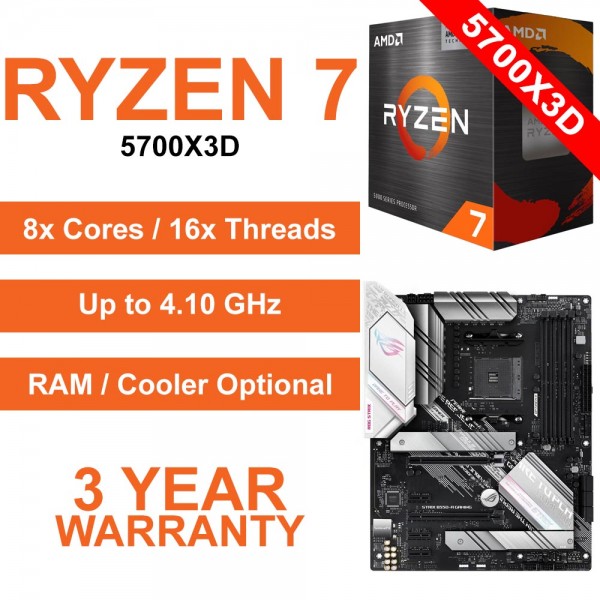
New The PC Build Thread

Oh and another thing, do the more expensive boards tend to have better on-board audio?

Yes. But the difference will only be apparent to an audiophile. The more important thing is sound isolation and insulation from the rest of the components. More expensive boards are better at this.

Asus uses the newer 1220 and MSI the older 1200.
 
Last edited:
I've been very happy with the ASUS TUF Z690 for my 12th gen Intel build.

Same.

I upgraded to 14th gen and went with Asus Tuf as well for that. I also used MSI and Gigabyte for 14th gen and AMD CPU's as well.

I prefer the Asus mainboard (TUF/RoG) to Gigabyte Aorus and MSI Tomahawk. Asus just works better and has lower memory latency and better sound.
 
The Tuf boards seem decent.

I am even considering ditching the more premium features and getting just an Asrock HDV-M.2.
 
You'd think. AM4 accounts for nearly 100% of gaming PCs this year (mostly R5 5500), and 100% of upgrade kits (mostly with a 5700X3D).

That blows my mind in all honesty.

Don't get me wrong, I can save a few K if I went the AM4 platform on the PC I'm plotting on building, but I just struggle with the idea of spending that much money and then being stuck at the end of a platforms lifecycle really.
 
Last edited:
That blows my mind in all honesty.

Don't get me wrong, I can save a few K if I went the AM4 platform on the PC I'm plotting on building, but I just struggle with the idea of spending that much money and then being stuck at the end of a platforms lifecycle really.
I understand it fully when people take a 5500 + RX 6600, but that one that blew my mind was a 5500 + 7900 GRE.

For the upgrade kits, a 5700X3D + Strix B550-A for R 6,999 in November was a no-brainer. A bit more now at R 7,849, but still very hard to beat, especially when you can slap your existing DDR4 into it. With X3D being less sensitive to RAM speed and timings (note I'm not saying not senstivie at all), your DDR4-3200 CL16 kit from when you went Core i5-7400 or Ryzen 1600 + A320M (hence the new board) is adequate.
 
I understand it fully when people take a 5500 + RX 6600, but that one that blew my mind was a 5500 + 7900 GRE.

For the upgrade kits, a 5700X3D + Strix B550-A for R 6,999 in November was a no-brainer. A bit more now at R 7,849, but still very hard to beat, especially when you can slap your existing DDR4 into it. With X3D being less sensitive to RAM speed and timings (note I'm not saying not senstivie at all), your DDR4-3200 CL16 kit from when you went Core i5-7400 or Ryzen 1600 + A320M (hence the new board) is adequate.

Upgrade kits I kind of get I suppose, especially in the economic crunch everyone is under atm.

I suppose if I was desperate for a "new" PC and cash was an issue I'd also be on the AM4 bandwagon really.... I suppose different stages of the process yield different results. I'm happy to wait until I get the cash to build out a new PC and then make sure I at least have some level of upgradability built into the platform I buy.
 
Upgrade kits I kind of get I suppose, especially in the economic crunch everyone is under atm.

I suppose if I was desperate for a "new" PC and cash was an issue I'd also be on the AM4 bandwagon really.... I suppose different stages of the process yield different results. I'm happy to wait until I get the cash to build out a new PC and then make sure I at least have some level of upgradability built into the platform I buy.
That's what I did and I'm okay for now.
 
Food for thought for anyone buying non-X3D CPUs for gaming:

AMD are the victim of their own success.
Depending on your budget as a gamer, you should get the 5700X3D or the 9800X3D, nothing in-between makes any sense in the current market. Everything below is market-dependent, application-dependent & YMMV, but will be applicably correct for 90% of people looking to build a PC.

Price delta between an el-cheapo build nowdays exists only on the Memory/CPU - motherboards seem to be at price parity again due to shortage of B550. (2 Years ago I got an AM4 gigabyte B450 Aorus elite board for R1899, now the same board goes for 3K+)

Lets do a quick comparison based on budget, using lower-end boards that wont melt their VRMs when you actually use the darn CPU, and factoring in DDR5 tax.

Simple 5700X3D Build:

1737389247844.png
Simple 9800X3D build:

1737389269522.png
Simple 9600X Build:

1737389892718.png

If we take a look at comparison graphs done by the good folks at GN, regardless of game, the story remains pretty similar:
  • 1st place : AM5 9800X3D
  • 2nd place : AM4 5700X3D
  • 3rd place : AM5 7600X

Keep in mind when looking at the below, THE 5700X3D AND 9600X ARE THE SAME PRICE (cpu only) - the 5700X3D is on a cheaper platform regardless.

1737393054221.png

Yet, as we can see the 5700X3D platform is approximately 23% faster in game performance while being 11% cheaper than the newer 9600X.

The latest-and-greatest 9800X3D is 58% more expensive as a full platform, but only performs 36% faster
than the 5700X3D

With most games achieving 144+ anyway on the 5700X3D, buying a 9800X3D only makes sense if you're playing at faster-than-144hz refresh rates.


at best, the 9600X achieves parity with the 5700X3D, at worst, see above.

TL;DR
Realistically, a 5700X3D would be future-proofed in performance for a healthy number of years, versus something like a 9600X on AM5, sure, the AM5 socket might be more future-proofed, but unless you get a 9800X3D (or other X3D SKU), you're basically committing to replacing the CPU before you've even made the purchase.

In the same air, buying a 5700X3D means you'll have great performance now, but as soon as you need any more, will need a full platform upgrade.
 
Last edited:
The x3d isn't really great for overall productivity or for games that are cpu frequency inclined
Yeah true dat, as in post I say for 90% of users, there are always exceptions.

Pricing Parity is 'almost' there, due to rising AM4 motherboard costs and lowering DDR5 costing.
X3D is strong, and a healthy upgrade for any AM4 platform, but new builds CAN be done on AM5.

Our market costing is vastly different to the US & Europe, so our own price/performance charts look very different to theirs.
I think I'm gonna look at doing some kind of consolidated build/performance costing for the local market.
 
When looking at these charts, what does the 1% and 0.1% low tell me? Should I buy taking those numbers into account?
 
When looking at these charts, what does the 1% and 0.1% low tell me? Should I buy taking those numbers into account?
It's minimum framerate percentages.

In reference to the chart:

5700X3D:
Average framerate 99% of the time will be : 111.3 FPS
The 1% will see low framerate drops down to 63 FPS
Extreme worst case frame drops down to 45.2 FPS

These charts showcase not just average performance, but what you 'stutter' down to with the odd hitch here and there, as well as the extreme worst, really important to have consistent performance, not just caring about the average framerate.

The X3D chips have larger caches, which results in less cache-misses and more cache-hits in software, which generally results in better overall performance, more stable 1%s
 
The Radeon RX 9000 series is now coming in March,


Radeon 9000 series hardware and software are looking great and we are planning to have a wide assortment of cards available globally. Can’t wait for gamers to get their hands on the cards when they go on sale in March!

Two months to go. I am curious now because it is a lengthy postponement as the January date seemed to have been true though AMD does not want this to look like a product launch that they have postponed due to Nvidia’s pricing strategy. This said, FSR 4 didn’t appear to be ready at CES2025, at least, they did not advertise their new FSR tech as being FSR 4, but maybe that was a marketing stunt to manage expectations. Some tech reviewers have already given it a glance:


The only question I have is, what about the AMD drivers? There was ~2 months between 24.10.1 and 24.12.1, and the latter is an actual November release, and there haven’t been a new driver update since. I would assume that a new driver was being made ready, or otherwise an ‘optimised’ Radeon RX 9070/XT driver. Their current driver does have an issue list. The new driver would have FSR 4, which at this time would be exclusive to Radeon RX 9000. Could it be that they don’t want any library exposed?

Nvidia has released drivers as per schedule, patched their issues.

Just odd. There is still ample time to release an 25.1.1 driver, but the driver release cycle has been odd. I would also assume that there will be an updated driver when the 9900/50/X3D CPUs release. A new AGESA update, 1.2.0.3, is also ready though not, yet, adopted. I think ASUS has a beta BIOS with the new AGESA update. Apparently, it improves memory latencies and clocking, won’t know.

EDIT: AMD is doing the right thing by postponing the launch since they would need to get their pricing right, as well as their own marketed expectations. Thus, they would need to monitor Nvidia's go-to-market RTX 5000 launches. Day 1 is important. I don't like the drivers being sandbagged though, but I guess it is what it is. You bought what was sold to you. The sweetspot that AMD has to nail is the 9070 price. The 9070 XT is likely to call on a premium. AMD still has to make money.
 
Last edited:
Food for thought for anyone buying non-X3D CPUs for gaming:

AMD are the victim of their own success.
Depending on your budget as a gamer, you should get the 5700X3D or the 9800X3D, nothing in-between makes any sense in the current market. Everything below is market-dependent, application-dependent & YMMV, but will be applicably correct for 90% of people looking to build a PC.

Price delta between an el-cheapo build nowdays exists only on the Memory/CPU - motherboards seem to be at price parity again due to shortage of B550. (2 Years ago I got an AM4 gigabyte B450 Aorus elite board for R1899, now the same board goes for 3K+)

Lets do a quick comparison based on budget, using lower-end boards that wont melt their VRMs when you actually use the darn CPU, and factoring in DDR5 tax.

Simple 5700X3D Build:

View attachment 1789587
Simple 9800X3D build:

View attachment 1789586
Simple 9600X Build:

View attachment 1789585

If we take a look at comparison graphs done by the good folks at GN, regardless of game, the story remains pretty similar:
  • 1st place : AM5 9800X3D
  • 2nd place : AM4 5700X3D
  • 3rd place : AM5 7600X

Keep in mind when looking at the below, THE 5700X3D AND 9600X ARE THE SAME PRICE (cpu only) - the 5700X3D is on a cheaper platform regardless.

View attachment 1789589

Yet, as we can see the 5700X3D platform is approximately 23% faster in game performance while being 11% cheaper than the newer 9600X.

The latest-and-greatest 9800X3D is 58% more expensive as a full platform, but only performs 36% faster
than the 5700X3D

With most games achieving 144+ anyway on the 5700X3D, buying a 9800X3D only makes sense if you're playing at faster-than-144hz refresh rates.


at best, the 9600X achieves parity with the 5700X3D, at worst, see above.

TL;DR
Realistically, a 5700X3D would be future-proofed in performance for a healthy number of years, versus something like a 9600X on AM5, sure, the AM5 socket might be more future-proofed, but unless you get a 9800X3D (or other X3D SKU), you're basically committing to replacing the CPU before you've even made the purchase.

In the same air, buying a 5700X3D means you'll have great performance now, but as soon as you need any more, will need a full platform upgrade.
You can even get a better board at a lower price if you don't want an absolute bottom of the barrel board:


It's minimum framerate percentages.

In reference to the chart:

5700X3D:
Average framerate 99% of the time will be : 111.3 FPS
The 1% will see low framerate drops down to 63 FPS
Extreme worst case frame drops down to 45.2 FPS

These charts showcase not just average performance, but what you 'stutter' down to with the odd hitch here and there, as well as the extreme worst, really important to have consistent performance, not just caring about the average framerate.

The X3D chips have larger caches, which results in less cache-misses and more cache-hits in software, which generally results in better overall performance, more stable 1%s
When comparing to my 5600, some games aren't vastly better and some are better with 1% lows and 0.1 but overall framerate isn't super better. I also still only have a 3070ti.
I'll check if I can find my old Division 2 framerate pics
 

Thoughts on this build? I have a good PSU already and a M.2 drive.
 
Top
Sign up to the MyBroadband newsletter
X