SA Politics Thread Part 11: The GNU Normal

Status
Not open for further replies.
Yup, but it's delivered with such confidence and gusto, that you'd think they'd be able to supply the info. I mean they literally tell us it's a fact that 70% is in white hands, yet it's like supply the info, crickets.

They learn from their dear leaders... you never have to prove anything, just state it and it must be true. Fear Fokol is a master at this strategy.
 
Yup, but it's delivered with such confidence and gusto, that you'd think they'd be able to supply the info. I mean they literally tell us it's a fact that 70% is in white hands, yet it's like supply the info, crickets.
Since there is a BEE prerequisite for all state tenders and the way things are calculated it is almost impossible for a low rated BEE firm to get any tenders , how can the majority of tenders be allocated to white firms ?
Love the commentary by those who obv have never been involved in tenders
 
Since there is a BEE prerequisite for all state tenders and the way things are calculated it is almost impossible for a low rated BEE firm to get any tenders , how can the majority of tenders be allocated to white firms ?
Love the commentary by those who obv have never been involved in tenders
Shush now, don't bring in logic to this, white firms have all the tenders, it's been told to us, we must just listen and never question.
The fact that in reality there are no white firms in SA that could really get tenders properly doesn't cross their minds.
 

  • Christopher Logan, who accused Hank’s Olde Irish Pub of racism almost three years ago, says he’s relieved by the Western Cape High Court ruling.
  • The Western Cape High Court on Monday rescinded a R1.25-million default judgment against Logan.
  • The matter dates back to December 2022, when Logan accused pub owner John Papadakis of racism and claimed his friend, Thabiso Danca, was denied entry to the pub because of his race.

A Cape Town man who alleged racism at Hank’s Olde Irish Pub on Bree Street says the past four years have left him emotionally exhausted.
The Western Cape High Court on Monday rescinded a default judgment previously requiring Christopher Logan to pay R1.25 million in damages to the pub’s owners.
Logan initially accused the establishment of racism in December 2022.
Judge Nathan Erasmus granted Logan’s rescission application, filed in December last year, effectively nullifying the judgment handed down in November.

In an interview with News24, Logan, who now lives in the US, expressed relief at the court’s decision.
“This matter has taken a massive toll on my personal life and well-being, as well as affected my loved ones,” he said.

He stressed that the social and emotional costs had been huge and had affected his sense of self.

The case stems from an incident in which Logan alleged that his friend, Thabiso Danca, was denied entry to the pub because of his race.
The allegations went viral on social media, and an assault case was opened against former owner John Papadakis. The National Prosecuting Authority (NPA) declined to prosecute.
Papadakis then approached the court to clear his and his brother Viron’s names and to sue for loss of income, claiming the negative publicity harmed the business.

The court ordered Logan to pay R500 000 to Papadakis’ business as special damages for loss of income, R250 000 as general damages to the business and R250 000 to each of the owners as general damages – all with interest.
However, Logan failed to enter an appearance to defend.
A notice of bar required him to file a plea or exception within five days, failing which he would be barred from doing so. This led to the default judgment.
Logan’s application to rescind the judgment was initially set down for last month but was postponed when Erasmus fell ill.
Logan said the “court recognised this injustice and set aside the default judgment in its entirety”.
“It confirms that the process followed in granting that order was incorrect and that every person is entitled to their constitutional right to a fair hearing before such serious findings are made,” he said.
Logan added:
This is an important step forward, not just for me, but for the principle of fairness in our justice system. I will continue to speak out and to defend the truth of what happened at Hank’s Olde Irish Pub.

In their heads of argument in a separate restraining order application, Papadakis’ lawyers claimed Logan exaggerated the incident for social media attention.
“The applicant elevated a non-incident to [a] ‘racial’ incident, resulting in substantial financial and emotional distress for the respondents.
“The sole motivation behind the act was to gain social recognition and prominence on social media platforms,” they wrote.

They added:
Our nation bears profound scars from its racial history and unfounded accusations of racism, perpetrated for self-serving motives, do nothing to foster healing and reconciliation in South Africa.

Papadakis told News24 on Tuesday, after the court’s decision, that Logan had more than enough opportunities to present his case.
“He [Logan] has had four chances to submit his response court papers, and he did not. He’s clutching at straws and racking up legal costs that he has no intention of paying.
“We’ve made a decision to pursue this till the end.”
I like how the article is framed as if we're supposed to pity Logan. **** em.

Note how he fled to the US too...
 

Good observation by Tony here. Welcome back, PW Botha-style indignance.
In a striking historical irony, the ANC’s defiant rhetoric against Western sanctions eerily mirrors PW Botha’s failed 1986 stance, while the party’s romanticised invocation of Codesa for today’s National Dialogue fundamentally misunderstands how apartheid actually ended – through backroom bilateral negotiations, not public consultation, writes Tony Leon.

“History doesn’t repeat itself, but it often rhymes”, is a phrase attributed in the 1870’s to Mark Twain, the polymath American novelist and essayist.

More earthily and relatively recently, in the 1970s, back when “dead tree media” held the ring here in the form of print newspapers, the Sunday Times, then read by millions, ran a weekly contest called “spot the difference”.


Readers, especially bored preteens, were invited to carefully examine two similar pictures placed in adjoining panels. The trick was to identify subtle, small differences between the two, even though at first blush, they appeared identical.

Today, but with far higher stakes at risk and apparent adults in charge, “spot the difference” is the new-old game of choice for the SA political elite.

Thus, last week, ANC secretary-general Fikile Mbalula was in truculent, finger-waving defiance as he attacked the West, particularly the United States.

Mbalula stated, in a media briefing after his party’s recent NEC meeting, that “the ANC will not be coerced into reversing its ‘progressive transformation laws’.”

He added:

If it means we are going to suffer through sanctions as leaders of the ANC, let it be. We will never back imperialists to subvert our democracy, to subvert our sovereignty.

Mystifyingly, Mbalula added that “it happened during the period of struggle, it will happen even now. We will never forsake our country which we fought for its liberation. Not this ANC…”

Precisely what happened “during the period of struggle” was the time when another occupant of state power here, President PW Botha, used eerily almost the same formula of words to set his face against an interfering West, particularly the United States, seeking to use its vast economic leverage to pressure change in SA.

Here, it requires a deep dive to spot the difference between Mbalula in 2025 and PW Botha in 1986.

Thirty-nine years ago, in August 1986, addressing his National Party congress in Durban, Botha thundered that the NP would “throw off the yoke of negative foreign interference… those who are demanding unacceptable concessions through blackmail and manipulated world opinion should not underestimate us”.

His final note of defiance could have been scripted last week by Mbalula. Botha said back then:

We do not desire sanctions, but if we have to suffer sanctions for the sake of maintaining freedom, justice and order, we will survive them-we will emerge stronger on the other side.

History records - in plain prose and not in rhyme – that within one month of that speech, the US Congress duly obliged with the passage of the Comprehensive Anti-Apartheid Act, ironically willed on by the ANC lobby in the US Capitol. One month later, despite president Ronald Reagan’s veto, the bill was enacted.

Far from either surviving the wide-ranging sanctions embedded in the legislation, SA buckled and was massively weakened.


In less than four years, economic isolation and crippling financial disinvestment forced the hand of Botha’s successor, FW de Klerk, to introduce the precise changes willed by the US and bitterly opposed by Botha. This pressure, far more than any battlefield success by the ANC, was the key which helped unlock the door of change.


One wonders how effective and determinative the current pressure from a very different US Congress today might be on a very different government in South Africa, if the US legislature votes to advance the bill proposing a full-scale review, including sanctions, of US-SA bilateral relations.

Of course, no two historical episodes are identical. They might rhyme but don’t always match each other.

The ANC, when not railing against the West, is expert at panel beating apartheid and the struggle period Mbalula invokes to fit any range of wildly divergent geostrategic arenas, however inapt the pairing: from Palestine/Israel to Morocco/Western Sahara.


No matter the differences in history, geography and populations, in the ANC worldview, one struggle fits all, and apartheid is the stand-in for all manner of villains in its demonology: from Jewish Israel to Muslim Morocco and many places and polities in between.

Call back the past​

Appropriately, perhaps, the new version of “spot the difference” is now played by linking today’s dismal economics and broken politics with the “golden era” of constitutional negotiations in South Africa.

“Call back the past” (also a popular 1970s radio show) is now in vogue in the hope that the sepia-tinged mythology of the 1990s can be wheeled out to rescue the country from the multiple crises confronting it, even when some leading lights draw the wrong conclusions on how change occurred and how it was affected.


At least though there is a rare moment of agreement about the depth of the crisis. Last week, the ANC declared the economy to be in “a state of emergency”. On Monday, DA leader John Steenhuisen placed the economy “in ICU” (intensive care). He suggested a raft of measures to resuscitate it and slammed the ANC’s suggested National Dialogue as worse than a placebo, but a mere “talk shop, a national monologue”.

The explicit referencing of the stumbling and very expensive “national dialogue” to the past constitutional negotiations and the instruments that advanced it, has been very striking. And it is also strikingly misleading.

This column has noted before how inapt a fit the Codesa analogy is for today’s circumstances. In 1991, there was no democratic parliament, the majority sat outside state power, and the government itself possessed massive power and scant legitimacy. The Codesa process was a rickety, at times abandoned, bridge intended to stopgap the vast chasm between two contending forces: the system and the struggle against it.

While there were full-scale plenaries, working groups and two years of on-and-off wranglings, most of the final passage of the interim constitution happened in back rooms and via backstairs negotiations involving a handful of people.

The open sessions were useful for letting off steam and public posturing. Much of the result was owed to bilateral discussions between two parties, the NP and ANC. Even the language of Codesa, which theoretically reached its decisions based on sufficient consensus, was defined by ANC negotiator Cyril Ramaphosa as meaning “when the NP and ANC agree, everyone else can get stuffed”. Crude but true.


Institutional memory​

Repurposing Roelf Meyer as an “eminent person” for today’s National Dialogue, (he has long stepped outside party politics and the NP sits in the elephant’s graveyard of history) offers little clue, beyond a dash of nostalgia, on prospects for success of the current “talk shop” as Steenhuisen dubs it.

Meyer, though, brings to the table the institutional memory of a history he witnessed.

Another “eminent person” involved in the dialogue is former politician Lindiwe Mazibuko, though she was still at school when both Codesa and its successor, the Constitutional Assembly (1994 to 1996), were convened, and which finalised the draft of the current Constitution.

Reading Mazibuko’s lyrical invocation of the “public dialogue” embarked on by the Constitutional Assembly in 1994 as a template for the operations of the current national dialogue struck me as a sincere but misplaced example of wishful thinking.

She wrote in the Sunday Times: “All things considered, the two-year consultation process was an unparalleled success in national engagement, generating nearly 2 million submissions.”
 
Part 2:
Other than her quantitative analysis, there is little from that process which offers any useful guide for present or future purpose.

The real negotiations which birthed the current Constitution, in the end owed final passage to another series of backroom engagements, often conducted between precisely two people in a so called “(back) channel” – Meyer and Ramaphosa.

On occasions, other party leaders and leading figures were brought in especially when deadlocks arose around key clauses. On one occasion we were airlifted, out of public and media view to a SANDF missile site at Arniston on the Cape coast. The two million public submissions might have weighed with some background influence, but were barely referenced when the hard negotiations were in play.

I wrote a contemporaneous account of these negotiations as a direct participant in them. I recalled these observations in my 2008 book On the Contrary:

“The Constitutional Assembly mounted a publicity drive to ‘take the Constitution to the people’. This was done at a cost of over R35m [Note the ZAR/US $ then exchange was R3.55/ I US$ versus R17.62/I US$ today]. Whether a single clause or section was altered as a consequence of public pressure is doubtful. For example, the majority of representations and petitions by ordinary citizens and groups signalled the public’s overwhelming support for capital punishment; but this made no difference whatsoever to the final outcome.”

Indeed, reprise this exercise today, thirty plus crime ravaged years later and true public opinion will reveal the same sentiment, but with doses of anti-foreign migrant sentiment fury laced in.

So, if there is to be an honest and open public dialogue, then be honest and open on acting on majoritarian views, or else confine the decision-making to elite opinion formers who can screen out sentiments that go against the grain of political correctness. You simply cannot have both.

And these popular/populist hit numbers (death sentence restoration and expelling foreigners) will pale by comparison if the national dialogue does a proper pulse-taking of public sentiment on ANC holy cows, ranging from BEE to deploying corrupt cadres. No doubts on the outcomes here, a brace of public opinion polls has given us the answer. Except the same ANC has also advised these are non-negotiable.


“A national engagement of unparalleled success” suggested by Mazibuko, is a doubtful historic precedent.

It might not repeat itself, though it eerily rhymes with our true, though much misremembered, past.

- Tony Leon is chairperson of a communications company and former leader of the official opposition.
 
This might have been similar:
Thirty-nine years ago, in August 1986, addressing his National Party congress in Durban, Botha thundered that the NP would “throw off the yoke of negative foreign interference… those who are demanding unacceptable concessions through blackmail and manipulated world opinion should not underestimate us”.

His final note of defiance could have been scripted last week by Mbalula. Botha said back then:

"We do not desire sanctions, but if we have to suffer sanctions for the sake of maintaining freedom, justice and order, we will survive them-we will emerge stronger on the other side."

History records - in plain prose and not in rhyme – that within one month of that speech, the US Congress duly obliged with the passage of the Comprehensive Anti-Apartheid Act, ironically willed on by the ANC lobby in the US Capitol. One month later, despite president Ronald Reagan’s veto, the bill was enacted.


Far from either surviving the wide-ranging sanctions embedded in the legislation, SA buckled and was massively weakened.

In less than four years, economic isolation and crippling financial disinvestment forced the hand of Botha’s successor, FW de Klerk, to introduce the precise changes willed by the US and bitterly opposed by Botha. This pressure, far more than any battlefield success by the ANC, was the key which helped unlock the door of change.

One wonders how effective and determinative the current pressure from a very different US Congress today might be on a very different government in South Africa, if the US legislature votes to advance the bill proposing a full-scale review, including sanctions, of US-SA bilateral relations.
But the difference is De Klerk cared enough to change the country's trajectory to salvage whatever we could before there was nothing left. The current ANC don't give a fck about economic devastation - because "we have teh Chineses and the Europeans (ironically) to fall back on".

The Chinese and Europeans won't give a toss about our economic situation, they care about their own fortunes. We can flood their markets with our stuff, but it will actually have the opposite effect if there's no demand, the value of our exports will tend towards 0.

Cadres won't care because they would have offshored their loot to China - they won't risk Europe in case the US forces them to get in line...
 
This is a new level of hold my beer batshyttery.

They are a special breed of absolutely retarded.

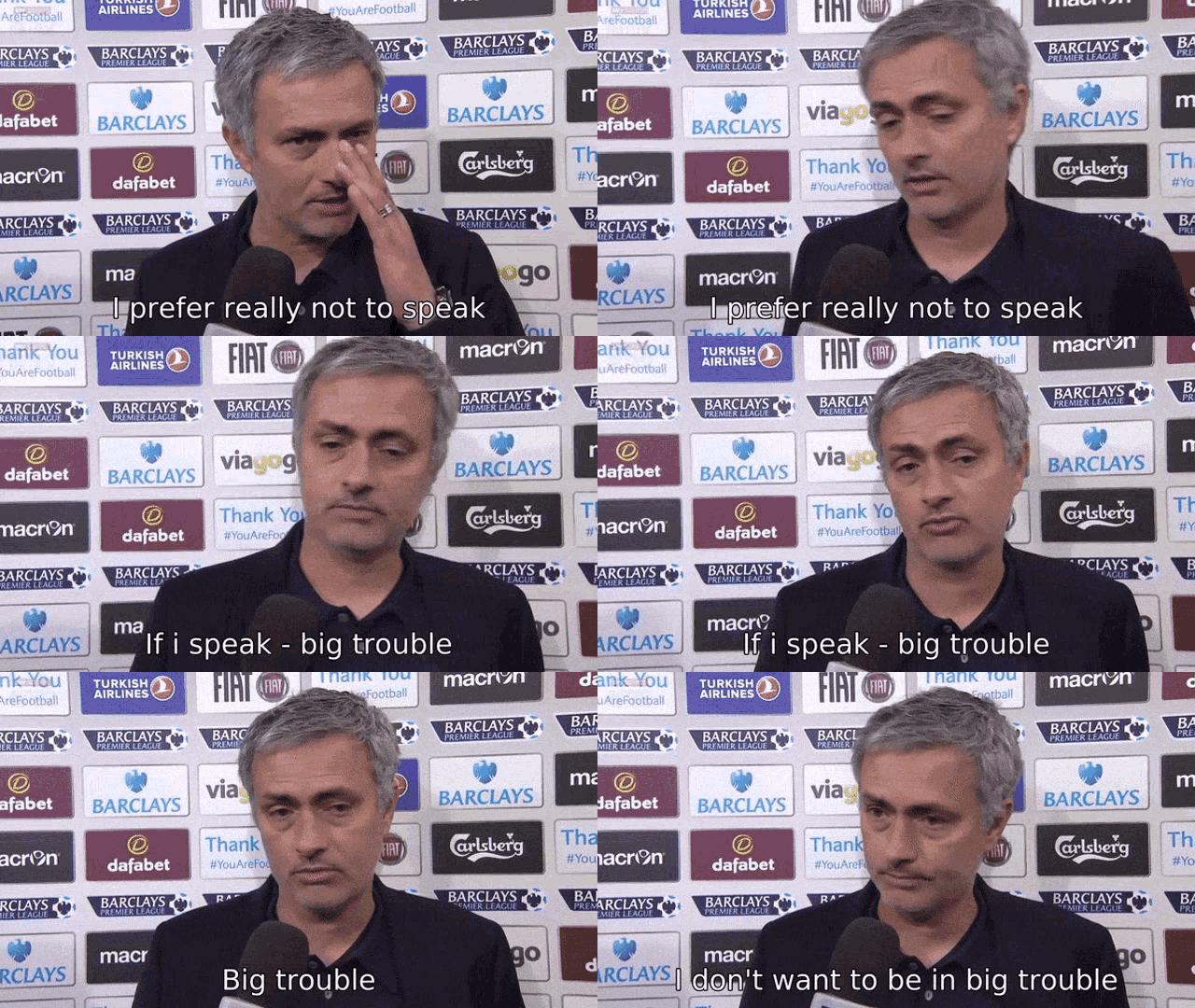
I have a few more choice words for the level of retardation but instead i will just leave this here for now

big-trouble-if-i-speak.gif
 
Are the Iranians sunny or shiites? Pretty sure this will be welcomed by a few Saffer muslims depending
 
Do we have anyone who ticks both boxes ?

1. Genocide is happening in Gaza
2. Genocide is happening in South Africa
 
Do we have anyone who ticks both boxes ?

1. Genocide is happening in Gaza
2. Genocide is happening in South Africa

Poepols can shove the genocide card up their arses together with the racism/islamaphobia/anti-semitism/transphobia/insert victimhood of choice card
 
Status
Not open for further replies.
Top
Sign up to the MyBroadband newsletter
X