The BMW-Mini Thread

Mini’s all-electric future a step closer as BMW makes big investment in UK plants

BMW has announced that it will invest 600 million pounds (R14 billion) in its UK plants to take its Mini brand all-electric by 2030, giving afresh boost to Britain's car industry after years of Brexit-related uncertainty.

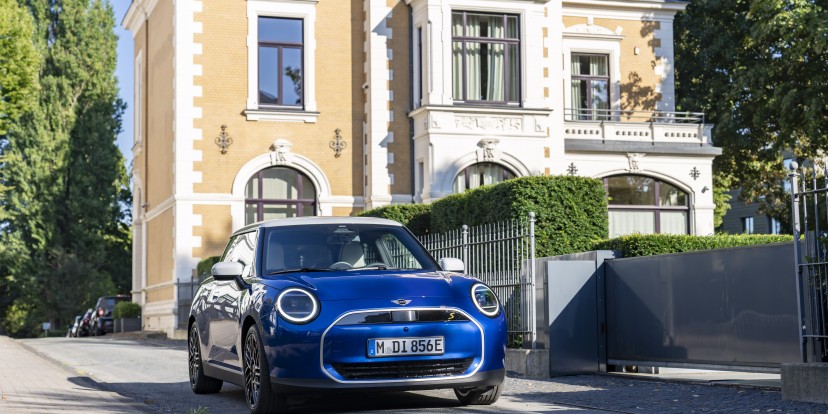
From 2026, the German premium carmaker will make two electric models at its Mini plant in Oxford - namely the newly revealed Mini Cooper 3-door hatchback and an upcoming compact crossover called the Mini Aceman.

The plant will make only electric models as of 2030 and many of those cars will be exported to markets around the world, BMW production chief Milan Nedeljkovic said.

Speaking to journalists in Oxford, Nedeljkovic said the company wants to use batteries made in Europe in the new models made in Oxford, but did not specify whether they would come from the UK, saying it depending on the attractiveness of the market for its suppliers.The same two models will also be made in China and exports of those cars will begin in 2024.

Also speaking in Oxford, British business minister Kemi Badenoch said: "We want auto manufacturing not just to stay in the UK, but to be the best in the world, and this is part of that story".
 
Hurrah! It looks like another bonkers Mini GP is a possibility

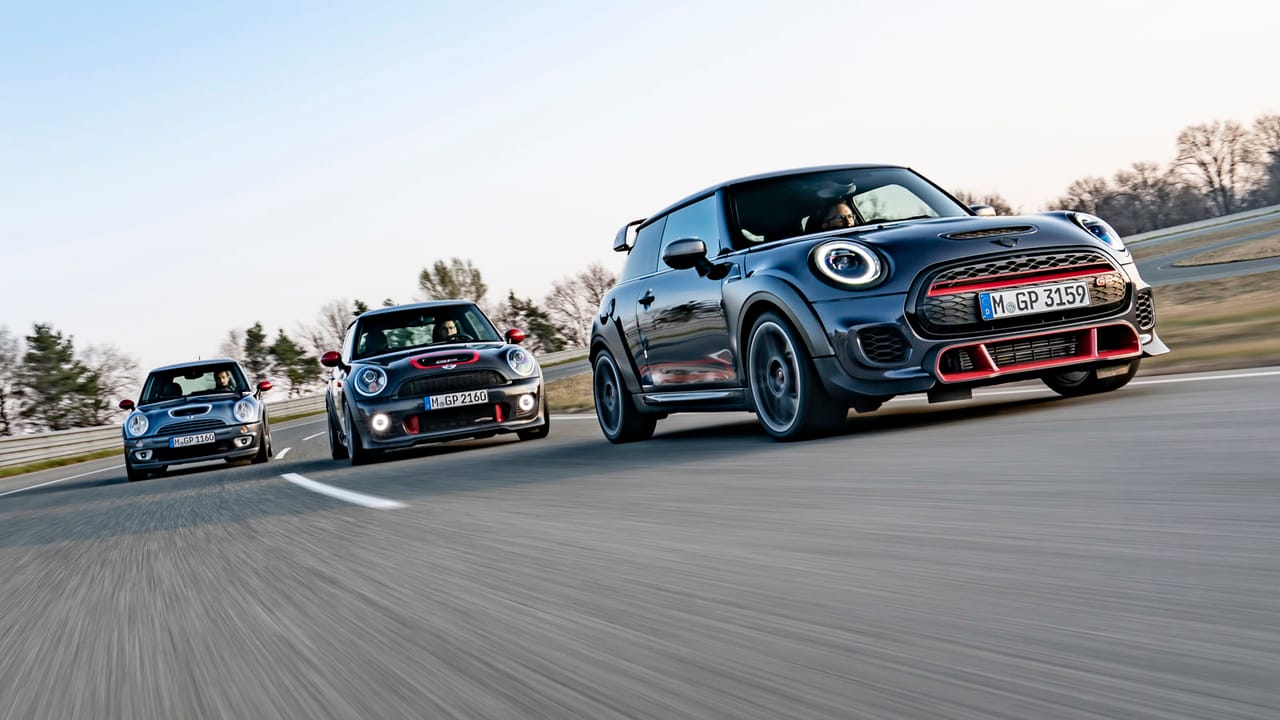
Mini boss tells TG there is “definitely” a future for the bodykitted hot hatch

With Mini dropping the manual gearbox and pledging to go all-electric by 2030, it’d be fair to say we’ve been worried about its hot hatch future.

No need, it seems. When asked about whether we could expect another bewinged Mini GP in the future, boss Stefanie Wurst told TG: “Yes, definitely.

“We don’t know when or how, but I would love it,” she continued. “I was driving the current GP during the week of the Nürburgring 24 Hours this year and I just love it. I think there is a future for that nameplate, and I think it makes it even more credible that we have teams racing at the Nürburgring.”

This is an excellent development. We weren’t completely sold on the most recent 302bhp GP, but it was certainly rapid and those wild stick-on wheel arches attracted some serious attention. It was rare too, with just 3,000 made in total and 575 landing in the UK.

 
Mini Oxford plant to transition to pure electric car production by 2030

BMW Group, Mini's parent company, has disclosed an impressive investment north of €690 million earmarked for Mini factories in Oxford and Swindon. Milan Nedeljković, a bigwig over at BMW AG, stated that this significant cash injection would pave the way for the next generation of electric Minis and firmly establish the trajectory for future electric car manufacturing. And just for emphasis – we're not just talking about hybrid vehicles; we're talking fully electric.

Scheduled to roll out in 2026 from Oxford are two electric delights: the Mini Cooper 3-door and the compact crossover Mini Aceman. And by the time we greet 2030, Mini's production capacity at the Oxford plant will have phased out those old-school combustion engines entirely. For those keeping tabs, since the year 2000, the BMW Group's investment in their Swindon, Hams Hall, and Oxford plants will tally up to a whopping €3 billion.

 
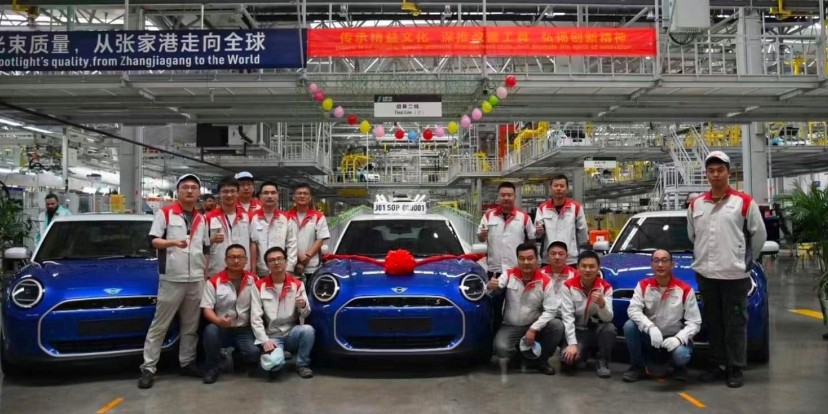
First electric Mini Cooper rolls off production line in China

The very first units of the all-new electric Mini Cooper drove off the assembly line at Spotlight Automotive’s manufacturing facility on October 14. Located in the bustling city of Zhangjiagang in China’s Jiangsu Province, this facility isn't just another car factory. It's the result of an ambitious collaboration between Great Wall Motor (GWM) and BMW, conceived back in 2019.

This joint venture was started with a whopping RMB 1.7 billion (equivalent to a staggering €216.84million). Interestingly, while the companies are jointly developing and producing the cars, they have agreed to sell them separately through their individual sales channels. A rare case of "joint venture without joint venture", as the business pundits would say.

The plant's standard capacity is set to churn out up to 160,000 vehicles annually, and the two pure electric Mini models will be emerging from this factory. Alongside the three-door Mini Cooper, the plant also has plans for a compact Mini crossover to satisfy the appetites of both international and Chinese customers.

The revamped Mini Cooper doesn't stray too far from its roots. At first glance, the quintessential round headlights and oval front grille remain untouched. The rear is adorned with triangular tail lights - a modern take on the Union Jack lights that were a signature of previous models.


IMG_8052.jpeg
 
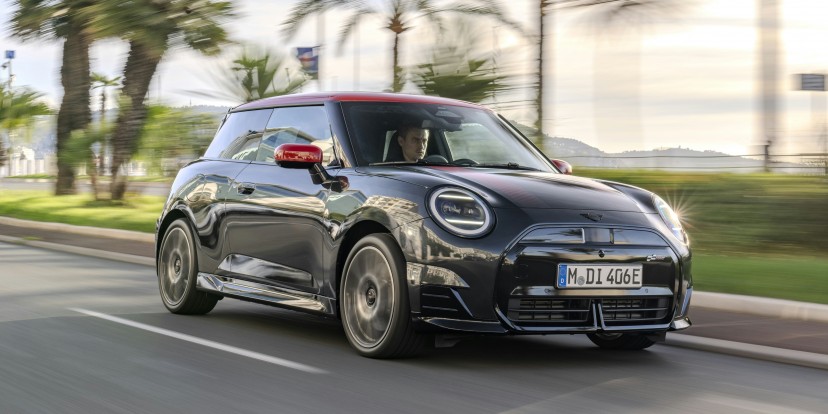
Mini Cooper SE JCW Trim

With 218 electrically generated hp (160 kW) and 330 Newton metres of maximum torque, the MINI Cooper SE is way out in front with zero emissions, especially with its ability to sprint from 0 to 100 km/h in 6.7 seconds. The high-voltage battery installed in the MINI Cooper SE with an energy content of 54.2 kWh enables a range of up to 402 kilometres as determined in the WLTP test cycle. To give your MINI a particularly sporty look it can be ordered in John Cooper Works Trim. With many details the equipment variant emphasises the brand's motorsport genes - achieved through numerous racing successes, including three victories at the Monte Carlo Rally in the 1960s.

"The all-electric MINI Cooper SE in the new John Cooper Works Trim combines a passion for iconic design, legendary performance and sustainable mobility. It is the epitome of efficiency and driving pleasure", says Stefanie Wurst, Head of the MINI brand.

Individual front and rear design with a motorsport look

The new John Cooper Works logo, which is characterised by clear outlines, stands out particularly well with its traditional red, white and black colour scheme and the symbolised chequered flag on the octagonal front grille. The powerful appearance of the MINI Cooper SE in JCW Trim is achieved, among other things, by 18-inch wheels in Lap Spoke 2-tone design with ten spokes each and JCW brake callipers in eye-catching red. Bonnet stripes on the body emphasise the sporty character.


IMG_8362.jpegIMG_8363.jpegIMG_8364.jpegIMG_8365.jpegIMG_8366.jpeg
 
Mini Cooper SE JCW unveiled with more hype than horsepower

Mini's latest offering, the Mini Cooper SE JCW, may have a sporty look, but it's nothing more than a sheep in wolf's clothing. The hype surrounding this new release may have you thinking it's a powerhouse, but the reality is quite different. Once you strip away the marketing gloss and take a closer look at what the “new” Mini has to offer, you may be left looking elsewhere for driving fun.

First, the numbers: boasting 218 horsepower and 330 Newton meters of torque, the Mini Cooper SE JCW can sprint from 0 to 100 km/h in 6.7 seconds. Certainly decent, but it's no different from the standard Mini SE. That's right - the only changes are cosmetic. It's like putting lipstick on a pig and calling it a supermodel.

John Cooper Works (JCW) has a rich history of delivering high-performance vehicles. In fact, having a JCW badge on a Mini always meant the driver was the proud owner of a missile wrapped up in a car’s body. But this time, Mini slapped the JCW badge on a car that's barely different from a standard model.

Sure, the Mini Cooper SE with the JCW sticker (or as Mini likes to call it - JCW Trim) comes with a few cosmetic tweaks. It sports a new bumper, new colors, and some fancy trim inside. But these are superficial changes that don't transform this car into a true performance beast. The JCW legacy deserves better than this.


Mini Cooper S

The fifth generation of the MINI Cooper stands for simplicity at its charismatic best. Typical MINI proportions evoke the brand's history. Together with the striking front grille, they give the new model its distinctive face. Minimalist design, digital innovations and an immersive user experience are the hallmarks of the interior.

Within the new model family, MINI designates the performance levels of its petrol engines for the MINI Cooper using the letter C and for the performance-enhanced model using the letter S. The attractive powertrain portfolio of the new three-door MINI is thus complemented by two efficient petrol engines with a choice of three or four cylinders. The brand's iconic go-kart feeling is brought to the road in the new generation MINI. The MINI Cooper's minimalist design is a combination of traditional brand values and impressive clarity.

"At MINI, 'Power of Choice" means that in addition to all-electric MINI models, we also offer models such as the new MINI Cooper with petrol engine. The car is ideal for all those people who want to drive a classic MINI 3-door and appreciate the traditional performance and characteristic sound of a combustion engine," says Stefanie Wurst, Head of MINI.

The interior focuses on typical MINI, minimalist design and new materials. Technical innovations such as the MINI Operating System 9, the new MINI Experience Modes and a wide range of digital functions create an immersive user experience.


IMG_8733.jpegIMG_8734.jpegIMG_8735.jpegIMG_8736.jpegIMG_8737.jpegIMG_8738.jpegIMG_8739.jpegIMG_8740.jpegIMG_8741.jpegIMG_8742.jpeg
 
This is the new petrol-powered Mini Cooper

Sitting alongside the electric Mini comes a pair of ICE variants

Mini has revealed two new petrol-powered Cooper models to accompany the all-electric version, called the Cooper ‘C’ and… ‘S’. Aside from a mild styling update, the interior has been given a thorough refresh led by an all-controlling OLED screen. But more on that shortly.

The entry-level C has a 156bhp three-cylinder engine, while the S is given a more spirited 204-horsepower four-pot - good for a 6.6s sprint to 60. Both will be given upgraded damping and braking systems over the outgoing car, so it'll still be a hoot to chuck around.

The new ICE Mini retains its short overhangs and a short bonnet, while there's a new octagonal grille up front flanked by a pair of spherical LED headlights - just as the Cooper has done for the last 1,500 years. Though, we’re still getting accustomed to the revised matrix taillight design out back, which was introduced with the release of the fourth generation late last year.

You've got a choice of three trim levels - ‘Classic, ‘Exclusive’, and ‘Sport’ - and aside from the latter gaining a brawnier transmission and shift paddles, most of the differences between the trim levels are characterised by different body/roof finish combinations and corresponding alloys, which range between 17 and 18in.

 
Top
Sign up to the MyBroadband newsletter
X