The F-35 thread

So apparently the F-35 is still not in full rate production even though everybody is flying them. I am confused.

The Pentagon has yet to approve a new schedule laying out when F-35 Joint Strike Fighter goes into full rate production, but it won’t be until after summer 2023 at the very earliest, the Pentagon’s program executive said today.


At the heart of the issue is the Joint Simulation Environment — a virtual testbed that allows the F-35 to go up against the most high-end Russian and Chinese threats. Only after the Lockheed Martin-made F-35 conducts 64 test runs in the JSE will it be allowed to proceed from operational tests to a “Milestone C” decision, where the Pentagon’s top acquisition authority declares the jet ready for full rate production.


After multiple delays due to technical problems and the COVID-19 pandemic, the Pentagon is finally conducting component validation of the JSE, which should wrap up this May, F-35 program executive officer Lt. Gen. Eric Fick told reporters at a roundtable. System verification tests are slated to occur through this fall, allowing the F-35 to finally conduct its 64 JSE tests in the summer of 2023.

Source
 
So apparently the F-35 is still not in full rate production even though everybody is flying them. I am confused.


Source

American business terms are screwed up, they've been building them as LRIP (Low Rate Initial Production) even though they have built more than some other military aircraft have had built in total. (Around 750 built so far iirc).

Covid supposedly pushed FRP-1 (Full Rate Production) back and it's supposed to be starting this year now.
 
After years of dilly-dallying the German defence ministry announced today that the Luftwaffe will acquire the F-35A to replace its ageing Tornado nuclear strike fighters.
 
Good use for the original non-upgradeable first tranche jets.


“Due to the growing threat posed by [Chinese] fifth and sixth-gen fighter development, we must use a portion of our daily fifth-generation aircraft today at Langley, Elmendorf, Hill, Eielson, and now Nellis, to replicate adversary fifth-generation capabilities,” Kelly said, according to a release. “Precisely because we have this credible threat, when we do replicate a fifth-gen. adversary, it has to be done professionally. That’s the Aggressors.”

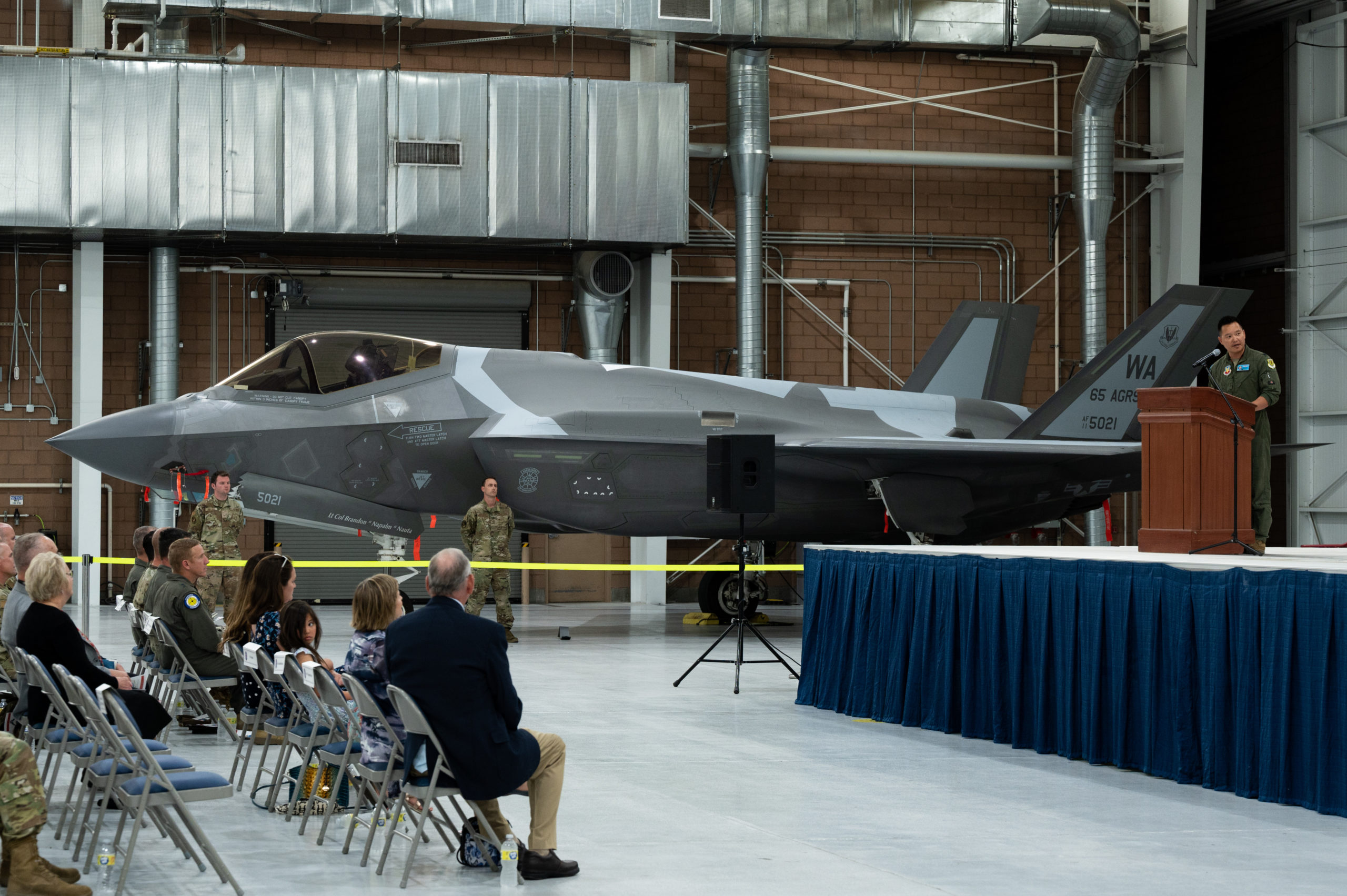
The 65th AS will provide USAF with fifth-generation “red air” to replicate the advanced threats posed by other fifth-gen fighters from China and Russia.

“Using the F-35 as an aggressor allows pilots to train against low-observable threats similar to what adversaries are developing,” Col. Scott Mills, 57th Operations Group commander, said in a statement.

The F-35s that will make up the 65th Aggressor Squadron are slated to be non-combat-coded aircraft—original plans called for nine to transfer from Eglin Air Force Base, Fla.

At Nellis, the fifth-gen fighters will help train students at the Air Force Weapons School and also assist in Red Flag exercises, among other exercises and training events. In doing so, they’ll also help train pilots from other services and allies, Mills said.

 
Some bad news for the F-35 but it is US military wide.

The crown jewel of the Air Force fighter fleet has been sidelined for an indeterminate amount of time as the service inspects most of its F-35 fighter jet ejection seats for faulty launch cartridges, service officials said on Friday. The news marks the latest difficult headline for the beleaguered fighter, which U.S. military officials have placed at the forefront of their airpower strategy despite a long list of maintenance issues.Source

The Navy said in a statement on Tuesday that the cartridge problem affected aircraft in its and the Marine Corps’ F/A-18B/C/D Hornets, F/A-18E/F Super Hornets, E/A-18G Growlers, T-45 Goshawk and F-5 Tiger II training aircraft fleets, but the service did not share exact numbers due to operational security concerns.

The grounded aircraft included 203 T-38 Talons and 76 T-6 Texan IIs, which represents about a third of the service’s total training fleet, Air Force Times reported.

Source
 
Some bad news for the F-35 but it is US military wide.


Source

According to an RAF pilot it isn't the big issue the press are making it to be.

The issue is with a specific batch of Martin Baker cartridges and the serials are known. The RAF planes that were affected were checked and put back into service in less than 48 hours.
 
According to an RAF pilot it isn't the big issue the press are making it to be.

The issue is with a specific batch of Martin Baker cartridges and the serials are known. The RAF planes that were affected were checked and put back into service in less than 48 hours.
It is not a big issue until you have to eject.
 
Sucks to be the pilot that found the problem. It is a easy fix though.

Fortunately discovered in a routine service and not a bang out by a pilot.


ACC said it has known about the potential problem since April, when a routine inspection found a defective cartridge at Hill Air Force Base, Utah.

The general stand-down was ordered July 29 “to expedite the inspection process,” the spokeswoman said. The command could not say how long it expected the inspections to take, as a count of how many had already been inspected was not immediately available. The Air Force has about 475 F-35s.

A USAF spokesperson said “this is properly called a stand-down” rather than a grounding because the aircraft can resume flying after an inspection shows that they’re safe to operate.

During the Hill inspection in April, a single cartridge-actuated device, or CAD, on an F-35 seat was found to have an insufficient amount of explosive powder, a Martin-Baker spokesman said.

“It was incomplete; it was not finished,” he noted.

Since then, factory records and lots have been checked, and USAF F-35As have subsequently been inspected “out of an abundance of caution.”

The process requires taking a jet out of service for about a day, as the seat must be fully removed from the aircraft to get at the parts, which can then be accessed “in a few seconds,” the spokesman said. Each seat has two CADs, which help propel the seat out of the aircraft if the pilot commands an ejection.

There are ways to determine from a visual inspection whether the CAD is defective, the Martin-Baker spokesman said. If maintainers are still in doubt, they can perform an X-ray to establish that the proper amount of powder is in the cartridge.

Aircraft found not to have faulty cartridges can return to flying immediately. If a cartridge is suspect, a replacement is installed.

“They’ve done about 70 percent of the fleet already,” the Martin-Baker spokesman said of USAF’s F-35s. “Only a very small number” of problematic cartridges have been identified, and “they have plenty to replace them.”
 
Not the most relevant thread since this opinion includes the F-22 and general Ford class carriers so I just posted here since he mentions a lot of interesting issues on the F-35.


I tend to think the author hasn't really done their homework when the "f-35 has short legs" statement is made and then wonder what else is just opinion or incorrect.

No one complained about the FA-18 combat range and yet the F-35 exceeds it...

1663442500863.gif
 
Top
Sign up to the MyBroadband newsletter
X