The Islamic State Thread

why are they suffering, what is the cause of this suffering & conflict, could this deity perhaps have something to do with the ongoing conflict, suffering & misery across the entire region.

this deity deserves nothing by scorn, not praise for tossing it's followers an occasional bone in the sand, or do you feel this deity deserves praise & worship 5 times a day given the circumstances of it's followers ?

so now its gods fault ? George Bush and Tony Blair must be relieved.
 
What does Grantza's geographic location have to do with their god having abandonded them?

It's not a blessing to be alive with one's loved ones and celebrate an important occasion despite there being an escalation of a civil war? I guess when you live in a PEACEFUL area irrespective of geography you won't know that.
 
why are they suffering, what is the cause of this suffering & conflict, could this deity perhaps have something to do with the ongoing conflict, suffering & misery across the entire region.

Problems there are multi-factorial. But it takes a certain kind of inhumane attitude to take it out on freaking innocent refugee civilians.
 
http://observers.france24.com/content/20140702-jets-iraq-iran-sukhoi-video

Image analysis shows Iraq's new jets are from Iran

A Sukhoi fighter jet in Iran's fleet.

iran-jet.png

The Iraqi air force appears to be using Sukhoi fighter jets camouflaged to hide the fact that they were sent from Iran.

A video released by the Iraqi defence ministry on Tuesday shows off several of these recently acquired jets, which an official says will be used in the fight against the Islamist group ISIS. No mention is made of their provenance. However, image analysis shows the same exact same markings on these planes as on photos previously taken of Sukhois in Iran’s fleet – minus the country’s flag and the Iranian Revolutionary Guard logo, which appear to have been painted over. ...


==
I thought something was fishy. There is no way those Russian aircraft could have been reassembled and repainted so fast. It also may explain the mysterious bombing, which the Syrians denied.
 
http://observers.france24.com/content/20140702-jets-iraq-iran-sukhoi-video

Image analysis shows Iraq's new jets are from Iran

A Sukhoi fighter jet in Iran's fleet.

View attachment 129475

The Iraqi air force appears to be using Sukhoi fighter jets camouflaged to hide the fact that they were sent from Iran.

A video released by the Iraqi defence ministry on Tuesday shows off several of these recently acquired jets, which an official says will be used in the fight against the Islamist group ISIS. No mention is made of their provenance. However, image analysis shows the same exact same markings on these planes as on photos previously taken of Sukhois in Iran’s fleet – minus the country’s flag and the Iranian Revolutionary Guard logo, which appear to have been painted over. ...


==
I thought something was fishy. There is no way those Russian aircraft could have been reassembled and repainted so fast. It also may explain the mysterious bombing, which the Syrians denied.

Let's hope they have some nice smart bombs on those otherwise they'll be massacring civilians too.
 
IRAQ STRUGGLES TO DRIVE BACK SUNNI MILITANTS
by W.G. Dunlop

Baghdad's forces struggled Thursday to break a military stalemate with Sunni militants, as US officials reached out to key leaders to push for an end to political chaos in Iraq.

Prime Minister Nuri al-Maliki meanwhile extended an amnesty aimed at undercutting support for the militants who have overrun large areas of Iraq, after the new parliament's first session ended in farce, with MPs walking out instead of working on government formation.

On the ground, Iraqi forces were struggling to break a stalemate with militants after initially wilting before the onslaught. They have since performed better, albeit with limited offensive success.

A police lieutenant colonel said security forces on Thursday clashed with militants near Tikrit, the hometown of Saddam Hussein, which they have been unsuccessfully fighting to retake in a highly-touted operation for over a week.

West of the northern city of Kirkuk, meanwhile, a roadside bomb on Thursday killed one Kurdish peshmerga fighter and wounded four others.

The cost of the conflict has been high for Iraq's forces, with nearly 900 security personnel among 2,400 people killed in June, the highest figure in years, according to the United Nations.

The day before, Salaheddin province's governor, Ahmed Abdullah Juburi, said security forces were "advancing slowly because all of the houses and burned vehicles (en route to Tikrit) have been rigged with explosives, and militants have deployed lots of roadside bombs and car bombs."

Juburi said it would be days before security forces could make a concerted push into the city, the capital of Salaheddin province.

Maliki's security spokesman also told reporters that loyalists had clashed with militants south of Baghdad.

In an effort to break the stand-off, the government has bought more than a dozen Sukhoi warplanes from Russia, announcing on Tuesday that a second group of five aircraft had arrived in Iraq, implicitly as part of that deal.

But the London-based International Institute for Strategic Studies said the three Sukhoi Su-25 ground attack jets shown landing in Iraq in a video released Tuesday by the defence ministry are likely from Iran, which has pledged to aid Iraq against the militants.

IISS also noted that most of Iran's Su-25s are actually from Saddam Hussein's air force. Defecting pilots had flown seven planes across the border during the Gulf War in 1991.

As calls for politicians to unite remained unheeded, Washington contacted Iraqi and regional players individually, with President Barack Obama calling Saudi Arabia's King Abdullah and Vice President Joe Biden talking to former Iraqi parliament speaker Osama al-Nujaifi, a prominent Sunni leader.

The White House said Biden and Nujaifi agreed on the importance of Iraqis "moving expeditiously to form a new government capable of uniting the country".

Secretary of State John Kerry meanwhile phoned Kurdish leader Massud Barzani and stressed the important role the Kurds could play in a new unity government in Baghdad, seen as vital to meeting the challenge of Islamic State (IS) jihadists, who have led the militant offensive, spokeswoman Jen Psaki said.

Maliki's amnesty call appeared to be a bid to split the broad alliance of jihadists, loyalists of executed dictator Saddam Hussein and anti-government tribes waging the offensive.

"I announce the provision of amnesty for all tribes and all people who were involved in actions against the state" but who now "return to their senses," Maliki said on Wednesday, excluding those involved in killings.

He later issued a statement adding former military officers in the amnesty offer, in a clear effort to break up the insurgent coalition.

Maliki's announcement came a day after an eagerly awaited opening to the Council of Representatives descended into chaos and ended in disarray without a speaker being elected.

UN special envoy Nickolay Mladenov said Iraqi politicians "need to realise that it is no longer business as usual."

Under a de facto agreement, Iraq's premier is a Shiite Arab, the speaker Sunni Arab and the president a Kurd.

Presiding MP Mahdi Hafez said the legislature would reconvene on July 8 if leaders were able to agree on senior posts.

In another sign of political discord, Maliki on Wednesday rejected an assertion by the autonomous Kurdish region that its control of disputed territory is here to stay.

Barzani has said Kurdish forces would maintain control of disputed areas into which they have moved during the militant offensive, and that a referendum will be held in the coming months on independence for Kurdish region.


Source : Sapa-AFP /mjs
Date : 03 Jul 2014 12:51
 
IRAQI AIRSTRIKES TARGET SUNNI MILITANTS
by Qassim Abdul-Zahra

A spokesman for Iraqi counterterrorism forces says government airstrikes have targeted a group of Sunni militants trying to overrun the country's largest oil refinery, and claims as many as 30 insurgents were killed.

Sabah al-Nuaman says a government plane targeted around eight vehicles attacking military forces defending the Beiji oil refinery north of Baghdad early Friday. Fighters from the Islamic State extremist group have been trying to capture the Beiji facility from some two weeks.

Al-Nuaman also says a helicopter gunship hit a house in the town of Qaim near the Syrian border where a gathering of the jihadi group's local leaders was taking place. He says there were several casualties, but did not have a concrete figure.

An official in the Anbar province operational command confirmed the Qaim airstrike.


Source : Sapa-AP /gq
Date : 04 Jul 2014 11:17
 
SISI WARNS IRAQI KURD SECESSION WOULD SPLINTER MIDEAST

Egypt's President Abdel Fattah al-Sisi warned the independence of Iraq's Kurdish region would be "catastrophic" and cause the Middle East to splinter along ethnic and religious lines, newspapers reported Monday.

A Sunni militant offensive that drove soldiers out of northern Iraq last month has emboldened leaders of the country's three-province Kurdish region to push for an independence referendum.

But Sisi said such a move would be a disaster for the region.

"The referendum currently demanded by Kurds is nothing... but the catastrophic beginning of the division of Iraq into small rival states, starting with a Kurdish state that will grow to include lands in Syria on which Kurds are living," Sisi told Egyptian newspapers.

The move was part of a "terrible plot" that was aimed at "redrawing the region on religious and ethnic grounds," he said in the remarks published on Monday.

The president of Iraq's autonomous Kurdish region, Massud Barzani, asked its parliament on Thursday to start organising a referendum on the long-held dream of independence.

The Kurdistan region has long been at odds with Iraq's federal government over numerous issues, especially what Kurdish politicians say are delayed and insufficient budget payments to the region this year.

Sisi was sworn in as president of Egypt, the most populous Sunni Arab country, on June 8 after he overwhelmingly won an election riding on a wave of popularity after ousting Islamist leader Mohamed Morsi in July 2013.


Source : Sapa-AFP /ar
Date : 07 Jul 2014 11:57
 
IRAQ ARMY GENERAL KILLED BY SHELLING: SPOKESMAN

Shelling west of Baghdad killed the commander of the Iraqi army's 6th division on Monday, Prime Minister Nuri al-Maliki's security spokesman said.

Major General Najm Abdullah Sudan "was killed by hostile shelling in Ibrahim bin Ali," Lieutenant General Qassem Atta told AFP by text message.

Ibrahim bin Ali lies in the Abu Ghraib area, just west of Baghdad, near where security forces have been locked in a months-long standoff with militants who have seized control of the city of Fallujah.

The government lost control of Fallujah and parts of nearby Ramadi in January, and Iraqi forces have struggled to retake both cities.

More recently, a jihadist-led offensive overran swathes of four other provinces north of Baghdad, displacing hundreds of thousands of people, alarming the international community and heaping pressure on Maliki as he bids for a third term as premier.


Source : Sapa-AFP /ar
Date : 07 Jul 2014 12:41
 
IRAQ POLITICAL AND MILITARY FIGHTBACK STUMBLES
by Jean Marc MOJON

Iraqi forces struggled to regain ground lost last month to jihadist-led militants and politicians remained divided Monday despite mounting pressure to unite and agree on a new leadership.

Nearly a month after militants led by the group now calling itself the Islamic State (IS) swept through northern Iraq, plunging the country into one of its worst crises in years, the prospect of either a military or a political solution still looked distant.

Iraqi forces have regrouped after the debacle that saw some soldiers abandon their positions, weapons and uniforms as militants conquered Iraq's second city of Mosul and advanced to within about 80 kilometres (50 miles) of the capital Baghdad.

The government has received fighter jets from Russia and Iran, intelligence from Washington and enlisted the help of Shiite militias it once shunned or fought to strike back at the loose alliance of IS fighters, other jihadist groups and former Saddam Hussein loyalists who now control swathes of territory.

It has for more than a week attempted to wrest back the Sunni stronghold of Tikrit seized by IS fighters in their lightning onslaught last month but has so far failed to achieve a breakthrough.

According to analysts, a dearth of intelligence in Sunni areas -- due largely to distrust of the Shiite-led authorities among minority Sunni Arabs -- and a lack of combat experience have hamstrung Iraqi forces.

"The army and the police are seen as sectarian... and therefore the Sunni community doesn't provide support or, crucially, intelligence to the security forces," said John Drake, an analyst at the AKE Group security company.

"If you don't have good intelligence on the ground, your strikes are not precise, they involve collateral damage and casualties ... making everything worse," he added Drake.

While most observers have argued that Baghdad was not about to fall, violence and suicide bombings have continued.

The latest struck a cafe in a predominantly-Shiite neighbourhood in western Baghdad on Sunday, killing at least four people and wounding 12, according to security and medical officials.

An IS-linked Twitter account on Monday posted a picture purported to be of the suicide bomber, apparently a Lebanese national, posing in front of the black Islamic flag before his operation, holding a sword and surrounded by assault rifles and rocket launchers. The authenticity of the image could not immediately be verified.

Despite omnipresent war propaganda in Iraqi media and tough talk from government and military officials, forces loyal to Prime Minister Nuri al-Maliki are still looking for a major victory on the ground.

The Islamic State appeared to be brimming with confidence however.

A few days after declaring the restoration of the caliphate, nearly a century after the last one died with the Ottoman empire, the group's leader Abu Bakr al-Baghdadi stepped out of the shadows to deliver a Friday sermon in Mosul's largest mosque.

Analysts have described the sudden public appearance by the self-proclaimed "caliph" -- second only to Al-Qaeda chief Ayman al-Zawahiri on the US most wanted list -- as a daring stunt reinforcing Baghdadi's status as the new strongman in the world of global jihad.

The offensive has exacerbated ethno-religious tensions in Iraq and deepened divisions in its already fractious parliament.

More than two months after elections Maliki's camp won comfortably, parliament has yet to begin the process of choosing the country's top three officials, which according to an unofficial deal are split between the Shiite Arab, Sunni Arab and Kurdish communities.

Deputies had been due to kick start the political process last week by electing a speaker but the Council of Representatives' opening session ended in chaos, with MPs trading heckles and threats before some of them eventually walked out, forcing an adjournment.

The interim speaker had suggested the chamber reconvene on Tuesday for a fresh attempt at yanking the country out of political limbo.

Despite telling AFP in a 2011 interview he would not seek a third term, Maliki vowed last week he would not bow to mounting international and domestic pressure to step aside and allow a broader consensus.

The UN's top envoy in Iraq, Nickolay Mladenov, said last week Iraqi politicians should treat the planned July 8 session as a deadline for the election of a parliament session or risking plunging the country into "Syria-like" chaos.


Source : Sapa-AFP /ar
Date : 07 Jul 2014 12:32
 
CRISIS-HIT IRAQIS FEEL BETRAYED BY BICKERING LEADERS
by Mohammed ABBAS

Iraq may be fracturing along sectarian and ethnic lines, but its people are uniting in anger and disbelief at protracted political haggling over government posts amid a raging Sunni Islamist insurgency.

Bickering lawmakers on Monday delayed for almost five weeks a parliamentary session meant to decide a new government aimed at countering the militant onslaught, before moving the date forward again to July 13, still more than two months after April elections.

After years of legislative paralysis and accusations of sectarianism, a new unity government is seen as one of the best ways of draining the resentment that has poisoned politics and allowed militants led by the Islamic State (IS) jihadist group to overrun vast tracts of the country at lightning speed.

"The postponement of the parliamentary session was a shock to Iraqis living amid a sea of blood and a lack of services and jobs," said Essam al-Bayati, a professor at the University of Kirkuk in northern Iraq.

The first parliamentary session after April 30 polls ended in farce last week when most Sunni Arab and Kurdish lawmakers stormed out after bitter exchanges, dismaying Washington, which has made greater political unity a condition for more military aid.

Even taciturn cleric Grand Ayatollah Ali al-Sistani, revered by Iraq's majority Shiites, labelled the episode a "regrettable failure".

Order was restored shortly after the chaotic session, however, when lawmakers lined up to register for their substantial parliamentary privileges, which include armed guards and a salary many times that of the average Iraqi.

"The country is on the way to the abyss and they only care about positions and privileges," said Imad Khalaf, 38, a port worker in the mainly Shiite southern city of Basra.

The formation of Iraq's last government took about nine months, time the current crop of lawmakers do not have given a Sunni Islamist insurgency many consider an existential threat.

"The insurgents will take advantage of the absence of active authority in the country to expand their attacks with the aim of control over larger areas of the country," said a policeman who declined to be named in the ethnically mixed central city of Baquba.

IS militants may not have reached the capital, but low-level attacks continue, stoking tensions in a city divided in many districts into sectarian enclaves traumatised by years of bloodletting.

The golden-domed Al-Askari mosque in Samarra north of Baghdad, one of Shiite Islam's holiest shrines, is within artillery range of IS insurgents, and its 2006 bombing by Sunni militants triggered one of the most brutal rounds of sectarian slaughter in Iraqi history.

For months bound and blindfolded bodies -- often bearing signs of torture -- were found dumped on roadsides or bloated and floating down the Euphrates and Tigris rivers as Shiite death squads and Sunni militants ran amok.

"Why do I have to keep my children at home and out of school? Why after we break our fast do we sit at home scared instead of visiting each other?" asked exasperated Baghdad seamstress Umm Ahad, referring to the holy Muslim fasting month of Ramadan.

"These leaders have shipped their families abroad, so its the poor people who are the victims," added the mother-of-six.

Even when parliament reconvenes, prospects for a speedy formation of a new consensus government appear slim.

Prime Minister Nuri al-Maliki, a Shiite seen by many as a divisive and sectarian leader, on Friday vowed to continue to seek a third term despite eroding political support both domestically and overseas, with Washington in particular making clear its frustrations with the premier.

The 64-year-old leader and his coalition partners dominated April elections, and there is no obvious consensus candidate to replace him or guarantee a successor will not be subject to the same pressures that have long hamstrung decision-making.

The Kurds, meanwhile, have taken control of disputed areas bordering their autonomous northern region after Iraqi troops retreated in the face of the IS onslaught, and have since called for a vote on outright independence.

The UN has warned of Iraq descending into "Syria-like chaos", and according to an unverified video posted online, IS leader Abu Bakr al-Baghdadi has felt confident enough to make an audacious public appearance at one of Iraq's grandest mosques.

"We have a crisis," said 31-year-old Baghdad grocer Abu Mussa, "and this postponement for calculations and deals between politicians is the biggest betrayal of the Iraqi people who went out to vote for them."


Source : Sapa-AFP /mjs
Date : 08 Jul 2014 11:46
 
[video=youtube;ZI_88ChjQtU]https://www.youtube.com/watch?v=ZI_88ChjQtU[/video]

Very hectic documentary.

One of the interesting parts in the video is when the Iranians are talking about a village and its people. You hear the one Iranian say "there used to be no humans in this village" (while pointing at some people walking past). So another Iranian responds, "there still are no humans, only arabs". This highlights the huge divide between Arabs and Persians.

Its so strange how quickly the geopolitics in that part of the world has changed. What started out as a civil war has now become full blown land grabs in a great Sunni vs Shia geopolitical conflict. Saudi Arabia took advantage of the instability in the region caused by Syria and the USA (in Iraq). Now all of a sudden, America realizes it has to support the moderate Shia muslims and its been on the wrong side. Just super interesting how quickly the reasons change.
 
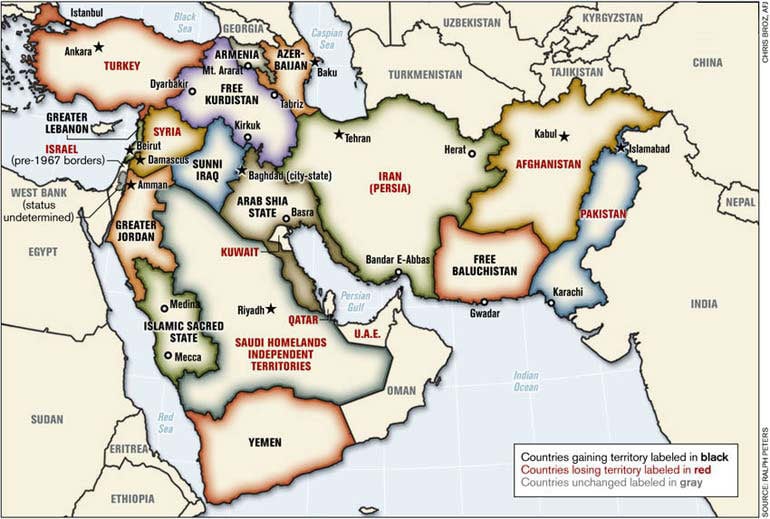
Maybe the world needs to wake up and rethink the Middle East and its Borders:

The%20Project%20for%20the%20New%20Middle%20East.jpg


International borders are never completely just. But the degree of injustice they inflict upon those whom frontiers force together or separate makes an enormous difference — often the difference between freedom and oppression, tolerance and atrocity, the rule of law and terrorism, or even peace and war.

The most arbitrary and distorted borders in the world are in Africa and the Middle East. Drawn by self-interested Europeans (who have had sufficient trouble defining their own frontiers), Africa’s borders continue to provoke the deaths of millions of local inhabitants. But the unjust borders in the Middle East — to borrow from Churchill — generate more trouble than can be consumed locally.

While the Middle East has far more problems than dysfunctional borders alone — from cultural stagnation through scandalous inequality to deadly religious extremism — the greatest taboo in striving to understand the region’s comprehensive failure isn’t Islam, but the awful-but-sacrosanct international boundaries worshipped by our own diplomats.

Of course, no adjustment of borders, however draconian, could make every minority in the Middle East happy. In some instances, ethnic and religious groups live intermingled and have intermarried. Elsewhere, reunions based on blood or belief might not prove quite as joyous as their current proponents expect. The boundaries projected in the maps accompanying this article redress the wrongs suffered by the most significant “cheated” population groups, such as the Kurds, Baluch and Arab Shia [Muslims], but still fail to account adequately for Middle Eastern Christians, Bahais, Ismailis, Naqshbandis and many another numerically lesser minorities. And one haunting wrong can never be redressed with a reward of territory: the genocide perpetrated against the Armenians by the dying Ottoman Empire.

Yet, for all the injustices the borders re-imagined here leave unaddressed, without such major boundary revisions, we shall never see a more peaceful Middle East.

Even those who abhor the topic of altering borders would be well-served to engage in an exercise that attempts to conceive a fairer, if still imperfect, amendment of national boundaries between the Bosphorus and the Indus. Accepting that international statecraft has never developed effective tools — short of war — for readjusting faulty borders, a mental effort to grasp the Middle East’s “organic” frontiers nonetheless helps us understand the extent of the difficulties we face and will continue to face. We are dealing with colossal, man-made deformities that will not stop generating hatred and violence until they are corrected.

from “Blood Borders: How a Better Middle East Would Look”, Armed Forces Journal (AFJ), June 2006”, by Lieutenant-Colonel Ralph Peters

http://www.armedforcesjournal.com/blood-borders/

http://www.globalresearch.ca/plans-...e-east-the-project-for-a-new-middle-east/3882
http://www.counterpunch.org/2013/08/28/borders-without-scruples/
 
Now all of a sudden, America realizes it has to support the moderate Shia muslims and its been on the wrong side. Just super interesting how quickly the reasons change.

All of that assumes that the situation is not itself orchestrated or at least going according to someone's plan.
 
'TERRORIST GROUPS' SEIZE FORMER CHEMICAL WEAPONS SITE: IRAQ

The Iraqi government has told the United Nations that militants have seized one of Saddam Hussein's former chemical weapons factories, confirming an earlier claim by Washington.

In a letter to UN Secretary General Ban Ki-moon dated July 1 and made public Tuesday, Baghdad's UN Ambassador Mohamed Ali Alhakim said "armed terrorist groups" entered the Muthanna project site on the night of June 11 after disarming the soldiers guarding it.

As a result, Baghdad was currently unable to "fulfill its obligations to destroy chemical weapons," Alhakim wrote, adding that "remnants of the (country's) former chemical weapons program" are kept at the site.

"The government will resume its efforts with regards to its obligations as soon as the security situation has improved and control of the facility has been regained," he added.

At dawn on June 12, the site's surveillance system, disabled by "the terrorists," showed there was "looting of some equipment and appliances," he wrote.

The letter confirms a June 19 claim by Washington that Sunni radicals had taken control of the facility.

State Department spokeswoman Jen Psaki said at the time that she didn't think the Islamic State of Iraq and the Levant (ISIL) militants would be able to produce usable chemical weapons there because any materials remaining there were old and unwieldy.

The militants have led a month-old crisis that has seen a jihadist-led alliance overrun large swaths of northern and north-central Iraq, displacing hundreds of thousands.

The complex, located just 45 miles (72 kilometers) northwest of the Iraqi capital, began producing mustard gas and other nerve agents, including sarin, in the early 1980s soon after Saddam took power, according to a CIA factsheet.

The program expanded to its height during the Iran-Iraq war later that decade, and produced 209 and 394 tons of sarin in 1987 and 1988 respectively.

But the CIA writes that the facility shut down after the first Gulf war, when UN resolutions "proscribed Iraq's ability to produce chemical weapons."

In the early 1990s, the site was used to oversee efforts to destroy Iraq's chemical weapons stockpile.


Source : Sapa-AFP /kd
Date : 09 Jul 2014 03:13
 
50 BODIES FOUND IN IRAQ, RAISING SECTARIAN WORRIES
By SINAN SALAHEDDIN and QASSIM ABDUL-ZAHRA

Iraqi officials discovered 50 bodies, many of them blindfolded and with their hands bound, in an agricultural area outside a city south of Baghdad on Wednesday, raising concerns over a possible sectarian killing amid the battle against a Sunni insurgency.

The lightning sweep by the insurgents over much of northern and western Iraq the past month has dramatically hiked tensions between the country's Shiite majority and Sunni minority. At the same time, splits have grown between the Shiite-led government in Baghdad and the Kurdish autonomy region in the north.

In an address on Wednesday, Prime Minister Nouri al-Maliki accused the Kurdish zone of being a haven for the Islamic extremists and other Sunni insurgents. He did not provide any evidence, and the claims are likely to only further strain Baghdad's ties which the Kurds, whose fighters have been battling the militant advance in the north.

The bodies, all of them with gunshot wounds, were found in the predominantly Shiite village of Khamissiya outside the city of Hillah, located some 95 kilometers (60 miles) south of Baghdad, said military spokesman Brig. Gen. Saad Maan Ibrahim. He said an investigation was underway to determine the identities of the dead as well as the circumstances of the killings.

The dead were all men between the ages of 25 and 40, and it appeared they had been killed a few days earlier and then dumped in the remote area, said a local police officer and a medical official. They spoke on condition of anonymity because they were not authorized to brief the media.

The area south of Hillah is predominantly Shiite, but there is a belt of Sunni-majority towns north of the city.

While the motives remain unclear, such grisly killings harken back to the worst days of Iraq's sectarian bloodletting in 2006 and 2007. At that time, with a Sunni insurgency raging, Shiite militias and Sunni militant groups were notorious for slayings of members of the other sect, and bodies were frequently dumped along roadsides, in empty lots, ditches and canals. As the levels of violence dropped over time, such discoveries became rare.

But sectarian tensions have soared once more, and authorities have once again begun to find unidentified bodies since the Sunni militant offensive that swept across much of northern and western Iraq over the past month.

The militant surge is led by the Islamic State extremist group, but other Sunni insurgents have joined, feeding of anger in their minority community against the Shiite-led government. On the other side, Shiite militias have rallied around al-Maliki's government to fight back against the militant advance.

In the far north, meanwhile, Iraq's Kurds have taken advantage of the mayhem in the country to seize disputed territory - including the city of Kirkuk, a major oil center - and move closer to a long-held dream of their own state.

Kurdish fighters, known as peshmerga, say they only want to protect the areas from the Sunni militants. Many of the areas have significant Kurdish populations that the Kurds have demanded for years be incorporated into their territory, making them unlikely to give them up.

These moves have infuriated al-Maliki, who is under pressure from opponents as well as former allies to step down.

Al-Maliki lashed out at the Kurds in his weekly televised statement Wednesday, saying "everything that has been changed on the ground must be returned" - a clear reference to the disputed territory that fighters loyal to the Kurdish regional government, which is based in the city of Irbil, have taken.

He even went a step farther, saying: "We can't stay silent over Irbil being a headquarters for Daesh, Baath, al-Qaida and the terrorists." Daesh is the acronym in Arabic for the Islamic State group, often used as a pejorative by its opponents, while the Baath was the party of former dictator Saddam Hussein.

But al-Maliki provided no evidence to back up his claims, which are sure to be rejected by Kurdish leaders in Irbil. Evidence on the ground also contradicts al-Maliki's allegations.

Kurdish peshmerga forces have clashed repeatedly with the Sunni militants led by the Islamic State extremist group in recent weeks. Tens of thousands of Iraqi civilians have fled to the Kurdish-controlled areas to escape the militant onslaught.

Shiite-dominated Iran, a close ally of al-Maliki, has also been helping Iraq's military - help that is believed to include military advisers.

This week, an Iranian military adviser who was helping coordinate among Shiite militias was killed by a roadside bomb north of Baghdad, two Shiite militia commanders said Wednesday.

The officer was killed Sunday in Salahuddin province while helping organize Shiite militias in the defense of a revered Shiite shrine in the city of Samarra, 95 kilometers (60 miles) north of Baghdad.

The militia commanders spoke on condition of anonymity because they weren't authorized to brief the media.

Previously, only one Iranian has been confirmed killed in Iraq's recent crisis - a pilot who Iran's state news agency said died defending holy sites in Samarra. It was not clear how he was killed, or in what capacity in was fighting in Iraq.


Source : Sapa-AP /nsm
Date : 09 Jul 2014 16:21
 
Top
Sign up to the MyBroadband newsletter
X