The Renault Duster Thread

New Duster Pickup Revealed as Compact Bakkie

Developed in partnership with a Romanian coachbuilder, Renault has whipped the wraps off the new Duster bakkie.

Recently, the new Renault (or Dacia) Duster entered the UK light commercial vehicle (LCV) market with the introduction of the Cargo panel van derivative. However, that’s not the only commercial-oriented Duster the French firm has released. Indeed, developed in partnership with Romanian coachbuilding company Romturingia, the automaker has now unveiled a bakkie version of the latest generation.

Revealed in Romania, the double-cab Duster shares its exterior dimensions with the compact SUV it is based on – 4 343 mm long, front to rear, and 1 921 mm in width, with a wheelbase spanning 2 657 mm. So, in essence, the Duster-based bakkie ditches the crossover’s rear luggage compartment for a compact load bed, the latter measuring 1 050 mm in length and 1 000 mm wide. The payload matches the recently-revealed Duster Cargo’s, at 430 kg. A quartet of anchoring points and two metal rails have been fitted to the load bed.


 
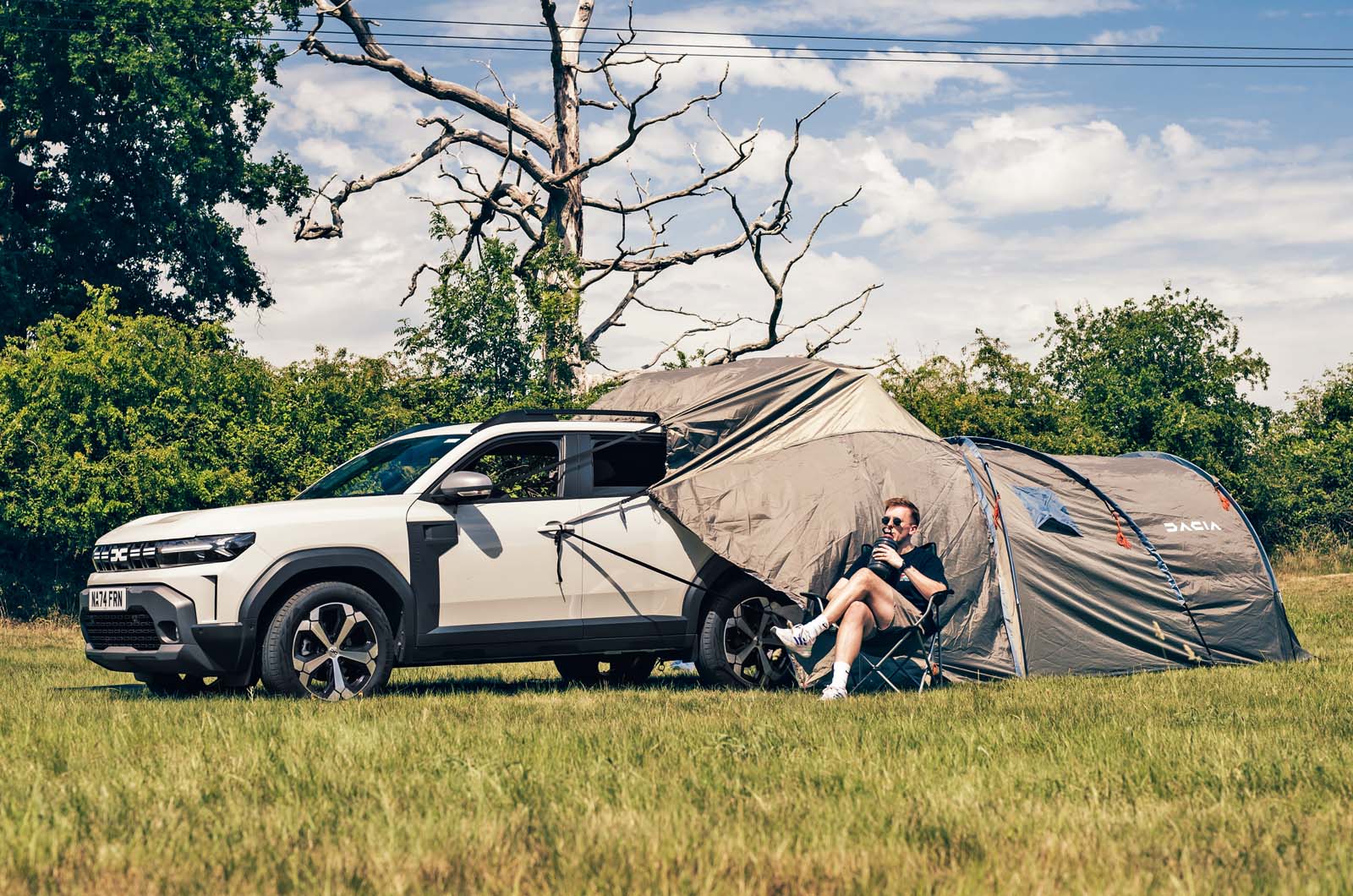
Glastonbury glamping has nothing on my Duster

Our 4x4 enhances its go-anywhere vibe with some built-in camping kit

If a recently married man tells people he’s going to be sleeping in his car one night, concern, it seems, is the immediate reaction. “No,” I tell them, “this is for fun.”

Little do they know that the Dacia Duster I've been running for the past few months has been fitted with a fold-out bed, a double(ish) mattress and a tent, all of which combine to create a set-up that is poised to turn even the most bougie of Glastonbury glampers a shade of jealous green.

Am I about to experience the future of camping? Is this the camper van killer? We’re all about to find out with a night in a New Forest field.

We hit the first obstacle before I’ve even turned the engine on: there’s no boot space. When getting the carry-on-camping accessories fitted, I didn’t really think about how much room it would all take up. Insert face-palm emoji here. The new Duster has a pretty cavernous 517-litre load space, yet the Sleep Pack takes up the lot.

There is some space under the bed’s supporting structure, but that’s needed for the tent itself. Luckily, though, tonight it’s just me – the wife laughed and said “no thanks” – so my overnight bag, some food and basic survival equipment can go on the back seats.

I arrive at my base for the night about 45 minutes later. Despite the extra weight in the back, the Duster doesn’t drive any differently, and there’s no sign of the economy dropping from my regular 56mpg.


1762674187742.png

1762674205518.png

1762674218061.png
 
Renault Duster (2018-2025) Buyer’s Guide

Lack of a turbodiesel option putting you off the new Renault Duster? You may want to consider a used 2nd-gen version of the brand’s rugged compact family vehicle instead…

The original Renault Duster was an absolute hit. Affordable, spacious and not at all shy to get its boots dirty, this Dacia-built compact family vehicle was the epitome of honest motoring – even if that made it a little too rough around the edges for some tastes.

The 2nd-generation Duster stuck resolutely to its forebear’s winning formula, riding on a revised version of that model’s B0 platform and again employing the ubiquitous 1.5 dCi turbodiesel motor. However, it also upgraded to slightly smarter exterior styling and higher-quality interior materials, all while remaining excellent value for money.

With the diesel-powered derivatives having developed a particularly loyal following in South Africa, it’s perhaps a pity the new 3rd-gen Renault Duster is available exclusively in turbopetrol guise. Still, since there are plenty of oil-burning Mk2 examples on the used market, we thought it pertinent to take a closer look.

For the record, the budget-friendly Duster was conceived by Renault’s Romanian subsidiary, Dacia. All SA-spec versions of the 2nd-gen model were built at Dacia’s Mioveni factory in Romania (as a reminder, early examples of the 1st-gen model were imported from India).


1765804572405.png
 
1769496944781.png

1769496958243.png

1769497093872.png

1769496972643.png

1769496985118.png

1769497134168.png

1769497148076.png

1. 163 PS turbo petrol engine (segment-leading power)
2. 160 PS strong hybrid E-Tech engine
3. 100 PS, 1.0L turbo petrol engine
4. 6-speed wet-clutch DCT

> Electric Panoramic Sunroof
> Electric Powered Tailgate
> Camera based ADAS
> Panoramic sunroof
> Google built in
>700 litres of boot space till roof
> Front seats 6-way power adjust
> 360-degree camera with 3D camera
> Automatic Emergency Braking System
> Adaptive Cruise Control
> Gets an all-LED lighting, black body cladding and black roof rails.
> Features include dual digital screens, panoramic sunroof.
> 7 Year warranty

Its safety suite consists of six airbags (as standard), a 360-degree camera, front and rear parking sensors, a tyre pressure monitoring system (TPMS), level 2 ADAS, an electronic parking brake and disc brakes on all four wheels.

Notably, the Duster is the first Renault car in India to get an ADAS suite.


Full specification details from Renault India here.
 
Updated (India-built) Renault Duster revealed and confirmed for SA

Confirmed for South Africa, Renault has whipped the wraps off the updated, India-built Duster.

The updated Renault Duster will be assembled in India, at Renault’s Chennai production facility, where the SA-bound Nissan Tekton, which shares its underpinnings with the Duster, will also be built.

Based on the Renault-Nissan Alliance CMF-B platform, in India, the refreshed Duster will be available with the choice of three powertrain options, spearheaded by the E-Tech 160 unit. The latter, petrol-electric powertrain pairs a 1.8-litre, four-cylinder Atkinson-cycle petrol internal combustion engine (ICE) with two electric motors, fed by a 1.4 kWh battery pack. Coupled with a ‘multimode’ automatic transmission, the hybrid setup produces 118 kW (the automaker has yet to release the torque output). Renault claims a combined driving range of “approximately” 998 km.

The remaining two engine options are internal combustion-only. This includes a 1.0-litre turbo-triple petrol (Turbo TCe 100) and 1.3-litre turbocharged four-cylinder petrol (Turbo TCe 160). Exclusively coupled with a six-speed manual gearbox, the Turbo TCe 100 produces 74 kW and 160 N.m of torque. Available with either a six-speed manual or dual-clutch transmission with the same number of cogs, the Turbo TCe 160 is endowed with 118 kW and 280 N.m.

As a reminder, in SA, the current Duster is available with two powertrain options: 113 kW/250 N.m 1.3-litre, four-cylinder petrol and 96 kW/230 N.m 1.2-litre hybrid, which is paired with an all-wheel drivetrain. We sampled the petrol-electric model in 2025.

Updated Renault Duster for SA

Although Renault’s local arm has yet to announce an official SA launch date, the press release states that the updated Duster “will go on sale in India in spring 2026, with subsequent launches planned for South Africa and the Gulf States”.

 
SA to switch to new Indian-built Renault Duster

Renault South Africa will switch from the Euro-spec Duster to this new Indian-built model, which sports revised styling, a revamped cabin and fresh engine options…

- Indian-built Duster coming to SA later in 2026
- Revised exterior styling, cabin and powertrains
- Nissan will base Tekton on Indian-spec Duster

Back in March 2025, the 3rd-generation Renault Duster arrived in South Africa, with the French brand’s local distributor Motus importing these initial units from Europe. However, a revised Indian-built version has just been revealed in the world’s most populous nation. And it’s coming to Mzansi.

Yes, the Boulogne-Billancourt-based automaker’s local arm has confirmed to Cars.co.za that this latest Chennai-sourced version of the Duster is “anticipated to be introduced in the latter part of this year [2026]”.

So, how do the European- and Indian-spec models differ? Well, look closely and you’ll notice various styling tweaks, from revised headlamps, a redesigned grille (which interestingly switches from “Renault” to “Duster” lettering) and an updated front bumper.

Round back, the taillamps gain an LED bar, while the rear bumper has been overhauled, too. From what we can tell, the European- and Indian-built models share a 4 343 mm length and 2 657 mm wheelbase, though the newer version is seemingly a little narrower. As a reminder, the Euro-spec Duster was revealed in Dacia guise back in November 2023.

What about powertrains? Well, first note the current Duster offered in South Africa can be specified with either a turbocharged 1.3-litre, 4-cylinder petrol engine (113 kW and 250 Nm) driving the front wheels via a 7-speed dual-clutch transmission or a turbocharged 1.2-litre, 3-cylinder petrol unit (96 kW/230 Nm) featuring a mild-hybrid system, all-wheel drive and a 6-speed manual gearbox.

In contrast, the freshly revealed Indian version can be ordered with any of a trio of powertrains, all in front-wheel-drive flavour. The initial motor is a turbocharged 1.0-litre, 3-cylinder petrol mill generating 74 kW and 160 Nm, peak outputs that are delivered to the front wheels through a 6-speed manual gearbox as standard.


1769509618820.png
 
SA to switch to new Indian-built Renault Duster

Renault South Africa will switch from the Euro-spec Duster to this new Indian-built model, which sports revised styling, a revamped cabin and fresh engine options…

- Indian-built Duster coming to SA later in 2026
- Revised exterior styling, cabin and powertrains
- Nissan will base Tekton on Indian-spec Duster

Back in March 2025, the 3rd-generation Renault Duster arrived in South Africa, with the French brand’s local distributor Motus importing these initial units from Europe. However, a revised Indian-built version has just been revealed in the world’s most populous nation. And it’s coming to Mzansi.

Yes, the Boulogne-Billancourt-based automaker’s local arm has confirmed to Cars.co.za that this latest Chennai-sourced version of the Duster is “anticipated to be introduced in the latter part of this year [2026]”.

So, how do the European- and Indian-spec models differ? Well, look closely and you’ll notice various styling tweaks, from revised headlamps, a redesigned grille (which interestingly switches from “Renault” to “Duster” lettering) and an updated front bumper.

Round back, the taillamps gain an LED bar, while the rear bumper has been overhauled, too. From what we can tell, the European- and Indian-built models share a 4 343 mm length and 2 657 mm wheelbase, though the newer version is seemingly a little narrower. As a reminder, the Euro-spec Duster was revealed in Dacia guise back in November 2023.

What about powertrains? Well, first note the current Duster offered in South Africa can be specified with either a turbocharged 1.3-litre, 4-cylinder petrol engine (113 kW and 250 Nm) driving the front wheels via a 7-speed dual-clutch transmission or a turbocharged 1.2-litre, 3-cylinder petrol unit (96 kW/230 Nm) featuring a mild-hybrid system, all-wheel drive and a 6-speed manual gearbox.

In contrast, the freshly revealed Indian version can be ordered with any of a trio of powertrains, all in front-wheel-drive flavour. The initial motor is a turbocharged 1.0-litre, 3-cylinder petrol mill generating 74 kW and 160 Nm, peak outputs that are delivered to the front wheels through a 6-speed manual gearbox as standard.


View attachment 1881675
The 1l motor from the triber, magnite and kiger
 
Top
Sign up to the MyBroadband newsletter
X