The Toyota Hilux Thread

Toyota Hilux

The new Toyota Hilux combines a striking new design, the addition of a powerful 2.8 litre powertrain and improvements to both its on- and off-road performance with greater comfort, upgraded equipment and an expanded model range targeting Europe's growing dual-usage, leisure markets.

A new, range-topping 'Invincible' grade offers customers bespoke styling and premium levels of equipment, without sacrificing any of the toughness, robustness and legendary Quality, Durability and Reliability (QDR) that have made Hilux the world's favourite pick-up.

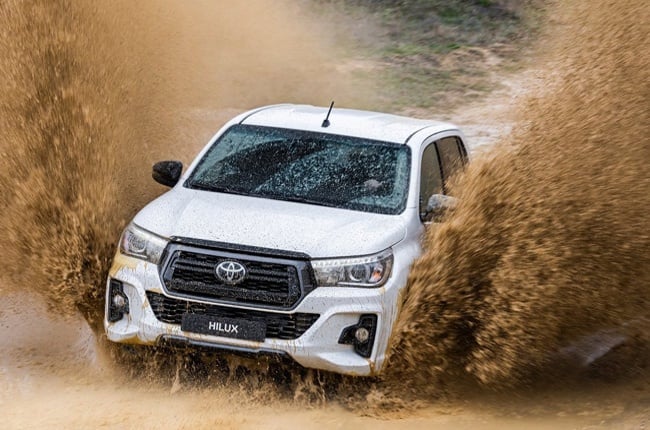
Since its launch in 1968, the unstoppable Toyota Hilux has proved its invincibility time and again, having conquered the North Pole, Icelandic volcanoes, the Antarctic and a win in the Dakar Rally in 2019.

Hilux's 1 tonne payload and 3.5 tonne towing capability has now been expanded to all 4-wheel drive body types (Single Cab, Extra Cab and Double Cab).


Toyota-Hilux-2021-800-08.jpgToyota-Hilux-2021-800-02.jpgToyota-Hilux-2021-800-04.jpgToyota-Hilux-2021-800-06.jpgToyota-Hilux-2021-800-1a.jpgToyota-Hilux-2021-800-10.jpgToyota-Hilux-2021-800-1c.jpgToyota-Hilux-2021-800-1d.jpgToyota-Hilux-2021-800-1f.jpgToyota-Hilux-2021-800-2f.jpg
 
Refreshed Toyota Hilux bakkie (finally) revealed ... with extra power!

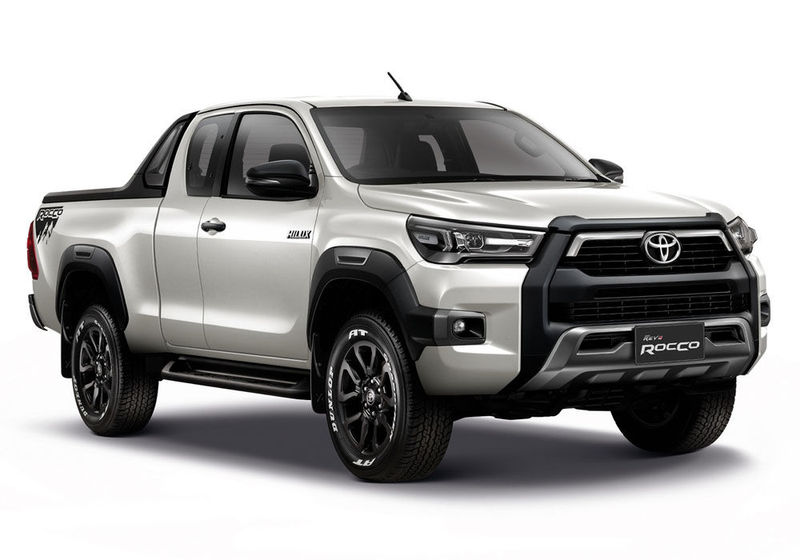
The facelifted Toyota Hilux has been officially revealed, with the popular bakkie sporting a fresh look and more grunt from its 2,8-litre turbodiesel heart.

Unveiled in Thailand, it’s worth pointing out the images here show the bakkie built for that market. The version eventually offered in South Africa will likely sport a handful of spec differences.

According to the Japanese firm, the 2,8 GD-6 oil-burning engine boasts “multiple new components and enhanced cooling”. As a result, maximum power has been increased from 130 kW to 150 kW, while peak torque on automatic models has been hiked from 450 N.m to 500 N.m (but remains at 420 N.m for manual variants).

Toyota furthermore claims fuel consumption has been improved by “up to 11,1 percent”, while “tuned accelerator response delivers greater driver control”. From what we understand, the 2,4-litre turbodiesel motor and naturally aspirated 2,7-litre petrol engine solider on unchanged. No word yet on whether the 4,0-litre V6 petrol unit will carry over to the facelifted range.


143941841_5.jpg143941841_4.jpg143941841_3.jpg143941841_2.jpgimage_preview.jpeg143941841_1.jpg
 
Toyota Hilux facelift 'still some months away' from SA introduction

Toyota South Africa Motors says the facelifted Hilux is “still some months away” from a local introduction.

The updated Hilux was officially revealed in Thailand, with the popular bakkie sporting a fresh look and more grunt from its 2,8-litre turbodiesel heart. Other upgrades include a revised suspension setup and the adoption of a larger touchscreen with Apple CarPlay and Android Auto functionality.

The Japanese firm’s local arm told CARmag.co.za the popular bakkie’s lifecycle in SA was different to that of other markets.

“IMV [the platform than underpins the Hilux and Fortuner] timing differs between distributors and our local South African lifecycle is different to other markets such as Australia and Thailand,” Toyota SA said.

 
Here's what the new Toyota Hilux looks like in base form

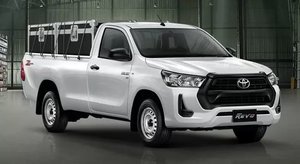
Toyota’s Thai division pulled the wraps off the facelifted Toyota Hilux on Thursday morning, and while all the excitement has centred around the range-topping variants, there is also a full range of base and mid-spec variants, which form the backbone of the range.

Do note however, that what you see here is the Thailand-spec Hilux and at this stage we don’t know how the South African models may differ, but this is likely a good indication.

As with the flagship models, the facelifted base and mid models get a new, and somewhat bigger, front grille and a fresh bumper design, except that for cost and practicality purposes you’re just seeing more black plastic and less flashy chrome.

And while the fancier models get a revised 2.8-litre turbodiesel engine with 150kW and 500Nm, the base Hilux variants, as expected, soldier on with the same 2.4-litre turbodiesel engine, which makes sense from a cost perspective. The engine produces 110kW and 400Nm, when paired with a six-speed manual gearbox, and 343Nm when the six-speed autobox applies.


Hilux 1.JPGHilux 2.JPGHilux 3.JPGHilux 4.JPGHilux 5.JPG
 
Refreshed (150 kW) Toyota Hilux’s claimed 0-100 km/h time revealed

Toyota has released the claimed 0-100 km/h time for its facelifted Hilux, which employs an uprated version of the brand's 2,8-litre GD-6 turbodiesel engine.

As a reminder, in self-shifting form the refreshed Hilux draws 150 kW and 500 N.m from its oil-burning four-cylinder (which features “multiple new components and enhanced cooling”), up from the pre-facelift version’s 130 kW and 450 N.m.

The Japanese firm’s European arm lists a 0-100 km/h time of 10,0 seconds in the case of the 4x4 double-cab variant equipped with an automatic transmission. For the sake of comparison, the Hilux GR Sport derivative in the current local range is some eight-tenths slower to the mark, according to Toyota.

While that makes the facelifted Hilux faster to three figures than Ford’s Ranger Raptor (which completes the sprint in a claimed 10,5 seconds), it’s not the quickest Hilux. No, the model powered by Toyota’s naturally aspirated 4,0-litre V6 petrol engine boasts a claimed time of 9,4 seconds, though it’s not yet clear whether this unit will carry over to the facelifted range.

Of course, Volkswagen’s 165 kW flagship Amarok V6 will hit 100 km/h from standstill in a claimed 8,0 seconds (with a faster 190 kW version on the way), while the discontinued-but-still-listed Mercedes-Benz X350d boasts a claimed time of 7,9 seconds.

 
More details: Facelifted 2020 Toyota Hilux

Okay, the updated Toyota Hilux range is coming to South Africa, but just how fast is the flagship derivative powered by the beefed-up 2.8-litre turbodiesel motor? And, what will the single- and Xtra-cab derivatives look like in more affordable specifications?

Toyota unveiled its updated bakkie's new look last week and although the newcomer is expected to go on sale in overseas markets in a couple of months' time, the South African market will have to wait a little longer, because Toyota SA, which produces the Hilux (and its Fortuner sibling) at its Prospecton plant, has a different product cycle.

When reports of the new-look Hilux began to surface, Toyota SA told us: "We will be getting those models, but not immediately. Our timing is quite different to Australia's; they don’t source their vehicles from South Africa. Unique-to-SA derivatives such as the Legend 50 and Dakar bridge the gap and extend the life of our current Hilux offerings." When we pushed for a date, it was suggested that whereas Australia was likely to receive this facelifted Hilux in August, South Africa's units would follow "months" later.

From a mechanical point of view, the biggest development is the upgrade of the range-topping 2.8-litre 4-cylinder (GD-6) turbodiesel engine through the introduction of "multiple new components" as well as "enhanced cooling" measures. As a result, the motor, which produces 130 kW and 420 Nm (manual) or 450 Nm(automatic) in current guise, will deliver a maximum power output of 150 kW, but while the 3-pedal version's peak torque remains unchanged, the self-shifter will churn out a peak torque figure of 500 Nm.


Hilux 1.jpgHilux 2.jpgHilux 3.jpgHilux 4.jpgHilux 5.jpg
 
Refreshed Toyota Hilux already kitted out in range of accessories

Toyota in Thailand has already listed a range of accessories for its facelifted (more powerful) Hilux, handing the bakkie upgraded exterior styling.

Listed on Toyota Thailand’s website, the accessories include a range of chrome-effect pieces, such as a (Hilux-branded) strip for the grille and shiny trim for the headlamps, foglamps, taillamps and tailgate.

The bakkie’s front skidplate can furthermore be fitted with new decorative trim (in either red or silver), an effect repeated at the peak of the wheel arches and along the vehicle’s doors.

Toyota’s Thai division also offers a polyurethane finish for the fuel cap, adding decorative trim and the Hilux badge, along with a styling bar fashioned from stainless steel and ABS plastic. There’s also a spare tyre cover, mud-guard shields (fitted in the wheel arches) and black 17-inch alloys wrapped in 265/65 R17 rubber.


Hliux 1.jpgHliux 2.jpg
 
2020 Ford Ranger vs Toyota Hilux Comparison Review | 4x4 utes on and off road | Caradvice


2020 Ford Ranger v Toyota Hilux: Tug of War | Australia's favourite utes battle it out! | CarAdvice

 
Used car buying guide: Toyota Hilux

Workhorses don’t come much more dependable than the Toyota Hilux pick-up, especially in this seventh-generation form. We take a closer look

Among the many, many achievements to which it can lay claim, the Toyota Hilux can perhaps declare itself to be one of the most appropriately named vehicles of all time. High? You betcha. Luxurious? Darned straight. Well, if you compare it with its somewhat minimalist contemporaries, that is. It’s still no Bentley Bentayga.

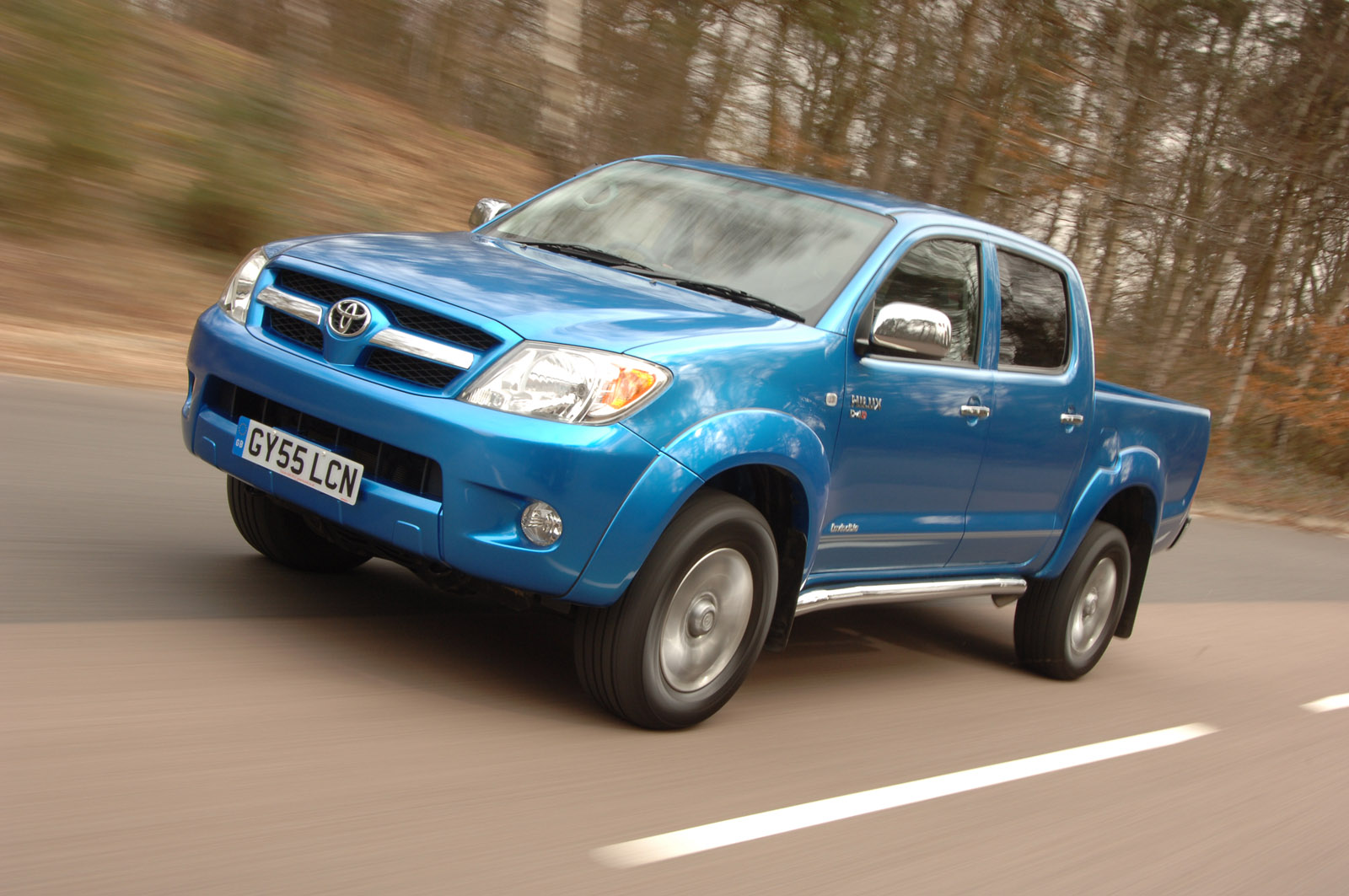
But what the Hilux – and more specifically the notably hard-wearing seventh-generation version that was made from 2004 to 2015 – lacks in opulence, it more than makes up for in sheer reliability and ease of use.

This Hilux – with its rounded front end and more recognisably car-like dynamics than earlier iterations – is still commanding strong money on the second-hand market. Whether you’re after two seats or five, a 2.5-litre or 3.0-litre diesel engine, bog-spec farm hauler or blingy urban cruiser, there’s a good selection of clean trucks to choose from, ranging in price from around £6000 to £22,000.


Hilux 1.jpgHilux 2.jpgHilux 3.jpgHilux 4.jpgHilux 5.jpgHilux 6.jpg
 
Refreshed Toyota Hilux will thrive on 'strong competition', says exec

A Toyota executive from Australia says “strong competition” for the refreshed Hilux means the Japanese firm won’t rest on its laurels.

Sean Hanley, Toyota Australia’s vice-president of sales and marketing, acknowledged to motoring.com.au the updated bakkie would face increased competition in the coming months and years.

“It’s healthy to have strong competition. Hilux has always performed extremely well. But we never take leadership in that segment for granted,” said Hanley, referencing the fact the bakkie is the best-selling vehicle in Australia (as it is in South Africa).

“It’s always been a really tough segment to win over many years, and the competition has only got tougher in the last few years,” he added.

 
Meet the man who made the Toyota Hilux bakkie so good

Experiencing the bakkie like a user

For South African Hilux customers, two of the most profound upgrades between the seventh and eighth-generation bakkies regarded drivetrain and power delivery. A six-speed replaced the five-speed manual, and this was not simply an issue of keeping trend with Hilux rivals.

"In New Zealand, the issue of gear ratio was raised. On a certain farm, an old 4.0-litre Hilux was idling at first gear as the harvest was loaded onto the cargo bed, but with the seventh generation, even in the same gear, the speed was greater, and the harvesters couldn't keep up, so they wanted us to address this."

Instead of merely adjusting the five-speed gearbox's ratios, which would have increased overall fuel consumption, Maeda decided Hilux now truly needed a six-speed option.

High-speed cruising was another unexpected customer requirement, which Maeda discovered.

"In Argentina, we were told that the torque was fine, but they wanted more engine power. We had thought that torque was important with a diesel engine, but in the field, to overtake the car ahead, the vehicle needed to accelerate instantaneously, to reach a speed of 130 km/h to overtake in the opposite lane. I realised that instantaneous power was necessary, even at high speed."

From his university days as an admirer of the boxy fourth-generation Hilux, Maeda's dream came true in his position as chief engineer for the current Toyota global bakkie platform.

If you were wondering why your current Hilux is so good, it is because a proper Japanese bakkie enthusiast, in the guise of Masahiko Maeda, was the engineering mindfulness behind it.

Today Maeda is Toyota's chief technology officer, which bodes well for the future of any Hilux development for the ninth-generation bakkie.

 
Refreshed Toyota Hilux bakkie's unladen ride quality 'vastly improved'

Toyota says its refreshed Hilux bakkie boasts both “sharper handling” and a “vastly improved” unladen ride quality.

The updated version of the Japanese firm’s popular bakkie has officially launched in Australia, sporting a fresh look and more grunt from its 2,8-litre turbodiesel heart. In June 2020, Toyota South Africa Motors told CARmag.co.za the launch in South Africa was “still some months away”.

Sean Hanley, Toyota Australia vice-president for sales and marketing, said the first major updates to the eighth-generation Hilux came about thanks to customer feedback.

"Hilux fans will appreciate the bold new look as well as the performance boost from our biggest-selling engine that makes towing and overtaking even easier in all conditions, including heading up a hill on a 40-degree summer's day," he said.

 
Refreshed Toyota Hilux bakkie gains Gazoo Racing parts in Japan

Toyota has launched the refreshed Hilux is Japan, also rolling out a range of Gazoo Racing accessories for its updated bakkie.

Revealed in Thailand in June 2020, the updated Hilux is “still some months away” from launching in South Africa, according to Toyota’s local division.

So, what about those Gazoo Racing parts for Japan? Well, first we should point out there are real no mechanical changes, which means the Hilux’s engine options remain unchanged (as a reminder, the facelifted Hilux gains an uprated 150 kW version of the 2,8-litre turbodiesel in some markets).

Still, the GR parts catalogue is broad, featuring items such as a front bumper upgrade, a front skidplate (interestingly reducing ground clearance by some 35 mm), chunky GR-branded side steps, a matte-black sports bar, twin 100 mm tailpipes and mudflaps (in either black or red). In Japan, these parts are offered either as part of a package or individually.


Hilux 1.jpgHilux 2.jpg
 
Toyota Hilux facelift: design options that didn’t make it to production

Toyota in Australia has released a handful of images showing a range of Hilux facelift design options that didn’t make it to production.

The folks over at CarAdvice.com.au published screenshots from an official Toyota video showing some of the styling options that were considered but ultimately scrapped.

Interestingly, the refreshed Hilux was styled Down Under, with Toyota Australia's product design manager Peter Elliott saying the brief was to develop a “simple and strong, athletic” version of the popular bakkie.

"From the beginning, our sketches investigated bold and tough themes that centred on a larger, more vertical trapezoid grille enhanced by an upper bonnet moulding and lower bumper components that lock into the grille surround," Elliott said.

"The headlamps have been moved outboard and they now connect with the distinctly chiselled bumper corners, linking the design. We progressed through clay models and CAD, evolving the idea to be cohesive with the rest of the vehicle, while maintaining maximum visual impact.


Design 1.jpgDesign 2.jpgDesign 3.jpgDesign 4.jpgDesign 5.jpg
 
Toyota Hilux hybrid on the road ‘before the end of 2021’, says exec

The head of Toyota in New Zealand has suggested a hybrid version of the Hilux bakkie will be on the road before the end of 2021.

According to Driven, Toyota New Zealand chief executive Neeraj Lala made the comments during a recent virtual media conference.

“We expect this [hybrid] trend to continue and even expand into commercials,” Lala said. “We hope to have Hilux hybrid enter the market before the end of next year.”

Interestingly, this latest report from Driven claims the Japanese company has confirmed the electrified Hilux will debut in mild-hybrid form, adding it will still “do everything a Hilux needs to do”.

 
Top
Sign up to the MyBroadband newsletter
X