The ZAR Exchange Rate Thread

Status
Not open for further replies.
It was already factored in, which is why the rand has been plummeting the last few months in anticipation. Now the SARB just has to raise our own rates over the coming months to stabilise it even further. Won't be surprised if it's at R10/$ somewhere Q3/Q4 2016.

I don't think it need to have been factored in. Look the recent minister change fiasco depreciated the currency further. Now instead of picking up more, it's not doing that. But at least it's not going down further which is a good thing. I guess R15 will be the new equilibrium.

It's extremely pathetic, given how it was R7-R7.50 not so long ago. A 50% depreciation.
 
I like your analogy precisely because it is possible to know exactly how many straws will break the camels back and describe exactly how and why it will happen. Zerohedge is more like Chicken Little, the sky is perpetually falling but can't really say why, when or how.

The bottom line is you find their line of thought compelling and I have no interest in trying to change your mind. For me, I will just say what I said to the peak oil alarmists from all those years ago - let's see how this one plays out.
Nicely put.

I don't think it need to have been factored in. Look the recent minister change fiasco depreciated the currency further. Now instead of picking up more, it's not doing that. But at least it's not going down further which is a good thing. I guess R15 will be the new equilibrium.

It's extremely pathetic, given how it was R7-R7.50 not so long ago. A 50% depreciation.
It needed have been but I think it was. Everyone was expecting a fed interest rate hike and I think it had an influence over the last couple of months. Now it turned out to be .25% where I think everyone expected something like .50%. Couple that with our own SARB raising interest rates it will strengthen a bit more.
 
I notice yesterday's drop has turned around and it's been steadily climbing again, the psychological 15 mark is breached again.
 
It was already factored in, which is why the rand has been plummeting the last few months in anticipation. Now the SARB just has to raise our own rates over the coming months to stabilise it even further. Won't be surprised if it's at R10/$ somewhere Q3/Q4 2016.
Ain't gonna happen. I'm willing to bet big on it. R15 is the new R10.

mPC will increase rates next year but as they saw last month, it doesn't do jack **** for the Rand when it's driven by Fed decisions and political issues.

It will be very interesting when they meet next as the recession risk is here. Increasing rates will kill growth further.
 
Keep in mind the Fed will increase rates till 1.4/5% next year and 2.5 the year after. ie SA interest rates will go up by that minimum
 
I don't think it need to have been factored in. Look the recent minister change fiasco depreciated the currency further. Now instead of picking up more, it's not doing that. But at least it's not going down further which is a good thing. I guess R15 will be the new equilibrium.

It's extremely pathetic, given how it was R7-R7.50 not so long ago. A 50% depreciation.

and next year R20 :cool:
 
Who is taking bets on the fed rate hike?

I moved more Rand's into USD yesterday at R15 on the dot. Weighted average still just over R12. Come on Feds, put us out of our misery.

How do u do it?
Need advice please.
 
http://journal-neo.org/2015/04/17/the-next-financial-tsunami-just-began-in-texas/

Now as oil prices hover around $49 a barrel, the shale oil companies that indebted themselves with junk bonds to finance more drilling are themselves facing bankruptcy or default more and more every additional day the US crude oil price remains this low. Their shale projects were calculated when oil was $100 a barrel, less than a year ago. Their minimum price of oil to avoid bankruptcy in most cases was $65 a barrel to $80 a barrel. Shale oil extraction is unconventional and more costly than conventional oil. Douglas-Westwood, an energy advisory firm, estimates that nearly half of the US oil projects under development need oil prices greater than $120 per barrel in order to achieve positive cash flow.

Now as the Saudi oil price operation enters its eighth month with no end in sight, the shale oil dominoes are beginning to fall. US shale oil producers Quicksilver Resources, American Eagle Energy, Saratoga Resources and BPZ Resources all missed interest payments this year. Houston oil field service firm Cal Dive International just filed for Chapter 11 bankruptcy. Moody’s Investors Service just downgraded Swiss oil rig contractor Transocean’s $9.1 billion in debt.

The US energy sector’s high-yield bonds – so-called “junk bonds” considered at risk of default – have climbed to $247 billion. But the implosion of the shale oil bubble and its debt is just beginning. Because the shale oil producers are desperately trying to stay afloat and hope for higher oil prices to stay alive they are forced into the paradoxical position of pumping as much oil as possible in order to service their debt to the banks to avoid default. That has meant record volumes of oil flooding the US market in recent months, pushing prices even lower.


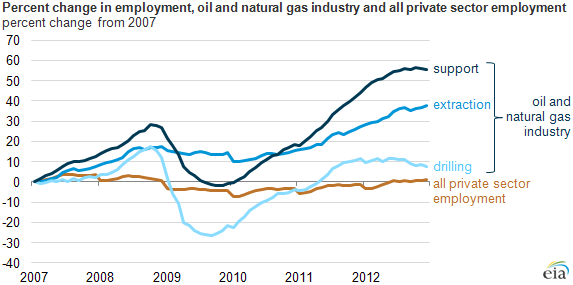
https://www.eia.gov/todayinenergy/detail.cfm?id=12451
jobpercent.png
http://www.zerohedge.com/news/2014-12-23/20-stunning-facts-about-energy-jobs-us
texas%20shale.gif


20141202_shalejobs_0.jpg


Punchline #1:

The $300–$400 billion overall annual economic gain from the oil & gas boom has been greater than the average annual GDP growth of $200–$300 billion in recent years—in other words, the economy would have continued in recession if it were not for the unplanned expansion of the oil & gas sector.

Punchline #2:

Hydrocarbon jobs have provided a greater single boost to the U.S. economy than any other sector, without requiring any special taxpayer subsidies—instead generating tax receipts from individual incomes and business growth.

And the final punchline:

The National Association of Manufacturers estimated that the shale revolution will lead to 1 million manufacturing jobs over the coming decade. Manufacturing jobs pay nearly 30 percent more than the industrial average and generate $1.48 of economic activity for every $1 spent, making manufacturing the highest economic multiplier of all industrial sectors.

Can you say debt contagion? Does anyone think that raising interest rates considering the above is going to do anything but spark another recession?

The rest of the world's stock markets saw massive losses this year. The US stock market is about the only exception but the fact remains that the stocks are heavily overvalued relative to the dividends they pay and the only reason the corporations have been able to pay dividends in the first place is because of cheap debt and faux profits based on stock buybacks. (http://fortune.com/2015/11/18/stock-market-buybacks/)

This entire system is going to start unravelling because these kinds of behaviours become impossible as the interest rate rises.

And the world economy is already facing oversupply in commodities such as iron and coal and gas. There's no demand left anywhere to pick up the slack. The pool of economic interaction is drying up and the only thing that could provide the illusion of depth of liquidity was to dramatically expand the money supply (which did nothing but create huge asset bubbles which will have to deflate at some point). Those contractions have been putting mines all over the world under severe pressure, and that in turn has knock-on effects because the people employed in the mines who no longer have a job because the mines aren't profitable are no longer earning a salary to buy consumer goods which in turn is what is needed in order to improve demand. It's a vicious circle.

The Rand is a commodity sensitive currency. Soon no one is going to want to buy what we produce. We're up **** creek without a paddle.
 
I bought a lot of gold. I should have bought bitcoins as I could have made 65% not 50%. Things are going to go to worse soon enough when people find out their R***** a month grant does not cover food let alone other necessities.
 
Volatility is name of game for rand

London - It has been a horrible year for the rand as US Federal Reserve tightening, commodity prices and China’s slowdown combined with a dire domestic situation to weaken the currency.

And while 2016 will see some improvement in the macro picture, South Africa’s economy remains structurally flawed, pointing towards more rand weakness.

The macro concerns have not gone away, but the most acute period of pain is probably over. The US has made the initial leap in raising interest rates and given a more certain outlook for the path of rate hikes next year. The genuine worry about China’s growth prospects is priced into the market. While plunging energy prices mean South Africa’s terms of trade have remained relatively stable over the past five months compared with oil exporters such as Russia. That’s the good news.

The bad news is that the economy’s structural flaws are here to stay. Unemployment remains stubbornly above 25 percent. Political issues, including a power struggle at the top of the ANC, are weighing on international credibility.

More at:http://sbeta.iol.co.za/business/news/volatility-is-name-of-game-for-rand-1964047
 
Rand weakens 1% in post-holiday slump

Johannesburg - The rand slipped more than 1% to its softest in two weeks early on Monday following the long Christmas weekend, as thin trade volumes globally and a firmer dollar erased the previous week's modest gains.

In the equities market, the JSE securities exchange's Top-40 futures index was up marginally, pointing to a flat open for the index at 09:00.

By 08:45, the rand had softened 0.98% to R15.30/$, after dipping more than 1% to its weakest level since December 14.

The unit is due to drift lower with little domestically and abroad to drive trade as some markets remain closed on Monday.

More at:http://www.fin24.com/Markets/Currencies/rand-weakens-1-in-post-holiday-slump-20151228
 
Status
Not open for further replies.
Top
Sign up to the MyBroadband newsletter
X