


Shayd
Expert Member
I don't mean to rattle your cage Effkay but the industry terms for this kind of power supply is "passive" or "fanless". This may not be correct by an engineers definition but neither is "fat free" just let it go.
South Africa’s biggest forum. Discuss, discover, and connect with thousands of members.

Shayd:
To be technically correct, you have to say "passively cooled power supply" or "power supply with passive cooling" and not just a "passive power supply"
Here's a description of "passive" in Engineering/Electronic terms: http://en.wikipedia.org/wiki/Passivity_(engineering)
You can really trust the posts of EffKay. He has made numerous technical posts on Sybaritic's forum...
...yea, that looks like a winner all right: you don't get a much better endorsement than the nutters in the biz choosing to use it in their own equipment!9. LONG TERM, FULL POWER, THERMAL TORTURE TEST
This is a test we have never run on any PSU before: Long-term, full load test without an exhaust fan in our PSU hotbox. It was mentioned earlier that even running this box without the exhaust fan is not normal. Commercially manufactured PSU load testers have non-defeatable, multiple high speed fans to keep themselves cool. This is a major reason why we use our custom-cobbled load tester: It lets us turn the fans off entirely when measuring or recording PSU noise. So why run this test on the X-400 Fanless? Well, almost on a dare.
In direct discussions about the X-400 Fanless, Seasonic reps were brimming with confidence that their new baby could not only perform just like a fan-cooled 400-watter, but even deliver full power under extremely low airflow conditions, such as one might find in a fanless (or single fan) silent PC. The parts in the X-400 FL are apparently robust enough that if it was fan cooled, it could easily be rated for 700W. This led to our running the normal tests without an exhaust fan. When our Seasonic rep found out the 30 minute duration of the 400W test load, he wanted us to try running it at full power for 24 hours, as is often done for testing of mission-critical server PSUs — which are never fanless.
The challenge was on. So, the X-400 Fanless was set to full load without any exhaust fan in the test hotbox, and left to run as long as possible. It was decided early on that 24 hours continuous was not going to be practical. For safety reasons, the test would be monitored regularly (about once every half hour) by a physically present person. That's your author. The test was begun at about 8 AM with 22~23°C ambient room temperature, and left to run until 11 PM that night, a total of 15 hours. The ambient temperature in the room climbed to 26~27°C by 1 PM, stayed around there for several hours, and only declined down to 24°C at 11 PM.
The temperature in the hotbox directly beneath the PSU ranged 56~60°C. Spot checks with the aforementioned infrared thermometer showed temperatures inside the X-400 as high as 82~84°C; mostly it hovered close to but under 80°C. The efficiency dropped as the PSU heated up. The 444W AC input seen after half an hour rose gradually about 10~12W higher during the hottest part of the day.
The end result after 15 hours: The X-400 Fanless survived the test. Furthermore, it worked perfectly the next day — and ran another 12 hours at the same load and conditions. At the end of the second day, a 1500W hair dryer was brought into play while the PSU was at full load, blowing the hot air down into the open grill cover of the X-400 to see what would happen with thermal overload. In a minute, the PSU shut down with a little click, the Over Temperature Protection finally kicking in. The IR thermometer showed temperatures of over 90°C around the main heatsinks. The AC cord was unplugged, the power switched off for a few minutes, then it was turned back on — with no change to the load settings: The X-400 powered back up without a hitch and kept running. The hair dryer was used several times to force OTP, just to check on the protection function. It worked without a flaw about half a dozen times. The X-400 sample is now powering a new system being set up for use in the lab.

OK, *fantastic* find there! And, as far as I've seen, only available from them: I've had no luck at Communica, Mantech or RS-Electronics' sites!... the Mean Well ATX-100 PSU from www.rectifier.co.za or somewhere else.

Seriously, keep you caps lock off or expect a certain amount of rudeness in peoples replies. No need to shout in here.snip
Except for the cooling of it... so thats something, which means its not nothing as you seem to think it is. And see, I didnt even have to shout.snip...
And a Laptop power brick is typically Switchmode regulator power supply and neither a passive nor linear nor resistive voltage regulator. There's nothing PASSIVE about it... Stop using Passive.
Shayd, you can always try contacting Graham from Sybaritic and ask him if they can import that Seasonic X400, which Effkay mentioned.
Otherwise, see if you can source the Mean Well ATX-100 PSU from www.rectifier.co.za or somewhere else.
This one won't work if you have installed a graphics card that requires external power OR if your CPU requires the 4-pin power connector.
Especially with the small amount of power over the 12V line
Did anyone make any progress on this? The stock cooler on my 2100T is WAY too loud, and I can't find a "passive" cooler to fit inside the CoolerMaster Elite 100, so I'm thinking of getting a CoolerMaster Elite 360 (I want a desktop form factor) and using a Thermalright heatsink without a fan. That just leaves the PSU. So, has anyone found a fanless PSU locally, to complete my no-moving-parts PC.
Only passives I know of are Seasonic 80plus gold PSUs. Bought one myself a few days ago (Seasonic X-750) and its fan only spins up at 400W (well under the poower draw for most single GPU configs).
Alternatively, try a PicoPSU: http://www.mini-box.co.za/ProductDescription.aspx?id=846714

NOOOOOOOOOOOooooooooooooooooo!!!!!!!! They're only available for Sybaritic *spits*. I can't bring myself to buy from them. I just can't. Any other options (low wattage preferred).
I see. No, I lied, I don't see. How do these work? Do I get a backplate to plug the brick into, which has slots for SATA power and Board power? Must I get the backplate made?


NOOOOOOOOOOOooooooooooooooooo!!!!!!!! They're only available for Sybaritic *spits*. I can't bring myself to buy from them. I just can't. Any other options (low wattage preferred).
I see. No, I lied, I don't see. How do these work? Do I get a backplate to plug the brick into, which has slots for SATA power and Board power? Must I get the backplate made?
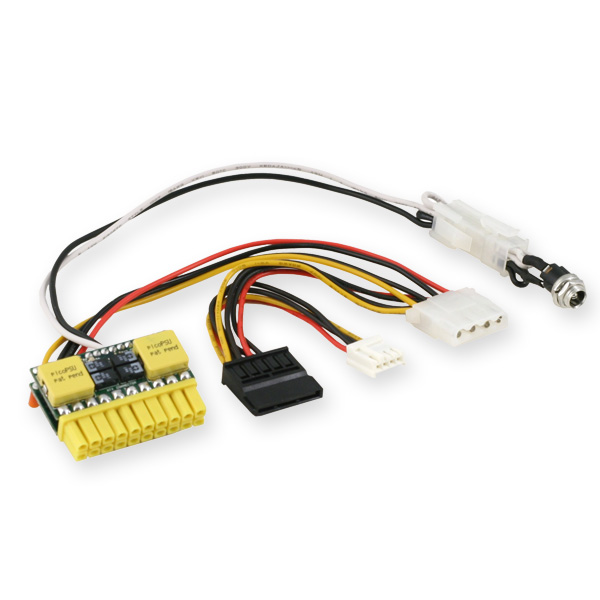
It's hard not to be delighted with the picoPSU. It's quiet (fanless, in fact), efficient, small, cool... the list goes on. Although it is targeted at systems using VIA's embedded EPIA technology, it can easily be used in a desktop system with a low-powered Athlon 64, to say nothing of a laptop processor such as a Core Duo or a Turion 64.
Its only real disadvantage is its size: 120W isn't quite enough for a system with a decent (read: power-hungry) graphics card. Its limited cable length and connectors may also cause difficulties. But these are small gripes about what is otherwise an excellent power supply.

The smaller the components it seems the bigger the wallet needs to be... :{
