Why Solar and Wind cannot power Germany

So I am willing to make this bet with you @Johnatan56, in the next 5-10 years Renewable energies is going to expand at a fast scale and they will probably get cheaper (especially batteries), in 10-20 years from now , the world is going to realize the enormous societal cost, not just in terms of electricity cost, but development, spatial cost, etc and they are going to start pivoting towards Nuclear Energy.

My guide for this rather lame prophesy is the historical fact that development came when we moved from less Energy Density technologies to Higher dense technologies.

I would be great to get Fusion ready, but I don't see that in my lifetime. Fission is our best shot at reducing climate change (to make it clear the cost of transferring from Fossil Fuels to fission will probably also require the cost of a wartime mobilization).
 
Last edited:
The cheaper an energy source the more dense it tends to be, that is why we use Fossil Fuels, because it is highly efficient.
Yes and no, nuclear is definitely not cheaper than coal, yet it's definitely more dense.
The cheap costs of Solar and wind is due to a high scale production cost and you tend to get that down by applying energy more dense. How do you think we manufacture at a higher scale? By applying more efficient methods (ie more energy density).
Yes? But that's not the full argument, again.
The reason why prices cannot fall forever for a given technology is because we reach Physical limits, ie. there is a theoretical efficiency at which Solar Panels and Wind can supply electricity and beyond that you cannot get more out of it.
Yep, definitely, that's for everything. Good thing we're moving away from Silicon only as nearing the ~25% theoretical limit, new stuff is already at 35%+. Wind turbines are definitely also getting more efficient, I think it was Blitz or Betz or something's limit at 60%, current turbines are at 30-40%, still some way to go. Yet it's already cheaper per MW already, which is what matters.
Your comment just shows me a complete ignorance of developmental economics.
No, it shows that you don't have a full grasp of it.
Look mate, you might try and use those lame attacks to try and get me to keep quiet, but I get that feeling that your irritation is because I am exposing your underlying doubts.
Not trying to get you to keep quiet, I am asking you to research it first. The problem I have is that some ignorant people will come across the forum and be misled by your posts as most people make up their mind pretty quick when given some source and then require way more to change it than it should have. You're a prime example of that.
Here is a good source to understand how power density effects development.


The point is that it isn't just as simple as use more land, use renewables etc, what you're inherently asking for is a fundamental restructuring/revolution of how the modern economy works on fuels that are less dense. That simply hasn't occurred yet in the past and we are attempting something that goes against how countries historically have developed. Potentially possible?

If you understand how power density effects development then then you will see why so many people are skeptical.

People such as MIT Prof Robbin Pollin shows that a renewable transition can be done, but the cost of it (which he is prepared to pay) is equivalent to a war time mobilization.
You missed the rest of the quote:
Smil explains that modern civilization has evolved as a direct expression of the high power densities of fossil fuel extraction. He argues that our inevitable (and desirable) move to new energy arrangements involving conversions of lower-density renewable energy sources will require our society—currently dominated by megacities and concentrated industrial production—to undergo a profound spatial restructuring of its energy system.
So I am willing to make this bet with you @Johnatan56, in the next 5-10 years Renewable energies is going to expand at a fast scale and they will probably get cheaper (especially batteries), in 10-20 years from now , the world is going to realize the enormous societal cost, not just in terms of electricity cost, but development, spatial cost, etc and they are going to start pivoting towards Nuclear Energy.

My guide for this rather lame prophesy is the historical fact that development came when we moved from less Energy Density technologies to Higher dense technologies.

I would be great to get Fusion ready, but I don't see that in my lifetime. Fission is our best shot at reducing climate change (to make it clear the cost of transferring from Fossil Fuels to fission will probably also require the cost of a wartime mobilization).
I doubt they will go for nuclear, I think the pivot will be more towards hydrogen. Land mass is not really an issue, I bet more along the lines of we'll start seeing solar panels that can easily be put on people's roofs for very cheap, and that people will start setting up wind blades on their properties, with the most important thing being grid operators rather with lots of small operators producing power and selling it through that, we'll start seeing less of a monopoly of power generation in places, it will be lots of smaller players combined that will then get bought out and make medium sized players in a region.
 
Nuclear's cost has to do with the bloated construction cost, but that will reduce with modular technologies, it's already happening with the startups around the world. The operational cost is cheap, Koeberg only has to refuel once every 1.5 years.

What you also tend to forget is that the cost of simulation has significantly dropped with the introduction of finite element and discrete element modelling. You can essentially use the same FE model and only correct for the environmental conditions and therefore the planning phase is significantly reduced.

The costs of these power stations went up, because for a while we stopped building them.
Once you get a working modular SMR model, it will essentially be copying and pasting.

Let's not forget that Nasa is going to use Nuclear Power on the Moon, you might get them to sell a Solar Panel.
Wind would be great for the aesthetics up there, but it blows less than on earth.

I doubt they will go for nuclear, I think the pivot will be more towards hydrogen. Land mass is not really an issue, I bet more along the lines of we'll start seeing solar panels that can easily be put on people's roofs for very cheap, and that people will start setting up wind blades on their properties, with the most important thing being grid operators rather with lots of small operators producing power and selling it through that, we'll start seeing less of a monopoly of power generation in places, it will be lots of smaller players combined that will then get bought out and make medium sized players in a region.

Are you willing to take my bet on a Nuclear vs the Sunny Hamsterwheel future?


Here is why I say Nuclear Expansion will continue, because despite the German retardedness post Fukushima, there has been a steady increase in new builds since 2011.
1606408686768.png


And Nuclear still makes up a higher proportion than the renewables (excluding hydro) combined. Hydro is wonderful, but it is limited by the geography.
1606408745934.png

China and India is heavily looking into new reactor designs. The initial Capex will be high, it will go over budget, but this is the same argument that you used for Germany. The difference is that once you install Nuclear, you don't need a new coal plant.

In IEO-2016, nuclear power and renewable energy are forecast to be the world's fastest-growing energy sources from 2012 to 2040. Renewables increase 2.6% per year, from 22% to 29% of total. Nuclear increases by 2.3% per year, from 4% of total to 6%, 2.3 PWh to 4.5 PWh. Generation from non-hydro renewables increases by 5.7% each year. Net nuclear capacity increase is all in non-OECD countries (growth in South Korea is offset by decrease in Canada and Europe), and China accounts for 61% of the capacity growth.

You missed the rest of the quote:
Smil explains that modern civilization has evolved as a direct expression of the high power densities of fossil fuel extraction. He argues that our inevitable (and desirable) move to new energy arrangements involving conversions of lower-density renewable energy sources will require our society—currently dominated by megacities and concentrated industrial production—to undergo a profound spatial restructuring of its energy system.

No, I didn't miss it, the issue is that a shift to renewables require inevitable a total reorganization of society on a spatial level, it goes into housing transport etc. I am not as sure as you are that the public is going to accept that price to pay.

Also I am still waiting to see what Renewable plant or Battery is going to supply infrastructure projects n the scale of Lonmin. (wait for the dust wind to blow).

so the more the idiots go for renewables, the more money we make to overcome the inherent inefficient intermittency.

Not trying to get you to keep quiet, I am asking you to research it first. The problem I have is that some ignorant people will come across the forum and be misled by your posts as most people make up their mind pretty quick when given some source and then require way more to change it than it should have. You're a prime example of that

Last point on Renewables, well fortunately the company that I work for also operates in the oil and gas sector

It is rather more along the lines of "I don't like your opinion, therefore I don't like your sources, they are all biased etc etc". Then you go on with cheap insults, which shows me that you don't really have the convictions of your own arguments. I am all tolerant if you disagree with me, but I don't get the impression that it goes the other way around.
 
Last edited:
Id definitely take that bet. There will be more kwh from solar than nuclear fission in 50 years time.


Right now its about say 800GW, but only 4 hr/day effective so 125 GW (effective)
Nuclear has 398.9 say 400 effective according to EIA - Ill assume that includes down time.

Solar growing by 3x (currently compounding at 30% = 3.7x in 5 years!) and nuclear staying still would do that - in general I'd say they are closing about as quick as they build new, but maybe I'm wrong? And that ignores wind!

Everyone underestimates the power of compounding, so don't be ashamed :)
 
Aahh - now I get it.

All the argument about density, renewables being small is because of the confusion between Energy and Electricity.

Im sure no one is arguing that solar will power your car as its driving along...

But also if energy density is so important to life / economic growth etc, they why isn't your phone oil powered?
 
Aahh - now I get it.

All the argument about density, renewables being small is because of the confusion between Energy and Electricity.
I please do enlighten me, electricity is electrical energy, unless I missed something in physics


Im sure no one is arguing that solar will power your car as its driving along...

But also if energy density is so important to life / economic growth etc, they why isn't your phone oil powered?

Look at it this way in terms of development.
For power generation we went from Wood to Peat to Coal, to Nuclear (some of us did), all in the direction of energy density.

For Transport we went from Walking, to Huskeys and camels, to horses, to the combustion engine, batteries only started being competitive this year when they could reduce their weight (i.e. become more energy dense).

Hydrogen is energy dense by mass, but not volume dense, for for transport it will inherently limit the amount of kms that you can travel, unless you put up a bigger tank. Oil has the advantage that it fits the sweetspot between energy density by mass and volume.

because batteries at a smaller scale provide a far more dense/efficient energy than oil?
Communication followed the same road, we went from delivering postage (i.e. walking) to telegrams (slightly faster) to telephones (even better) to the internet and cellphones, in each step of the way the amount of energy that you use went in the direction of a more dense fuel.

Solar growing by 3x (currently compounding at 30% = 3.7x in 5 years!) and nuclear staying still would do that - in general I'd say they are closing about as quick as they build new, but maybe I'm wrong? And that ignores wind!

Pessimists tend to underestimate exponential growth and optimist tend to forget that all exponential curves are actually just S curves. Solar panels and batteries are predicted to hit their S curves soon, Nuclear isn't there yet.

I agree that solar will expand, but it will peak much faster than most optimists are prepared to admit, because eventually as you start expanding to "empty land", you're going to start inflecting the S curve. People will buy up land around new developments, maintenance costs will sink in, gas availability will become an issue, etc etc. All these economic factors will eventually result in diminishing returns.

o and by the way, what do you think we have S Curves in development? Because eventually we hit physical limits.


Thank you though for being brave enough to make that bet. My position is that all the hype around Solar and Wind is eventually going to meet reality in the next 5-10 years, afterwards Nuclrear's slow expansion will be seen as the obvious way forward.

I am putting my money with Bill Gates on Nuclear.

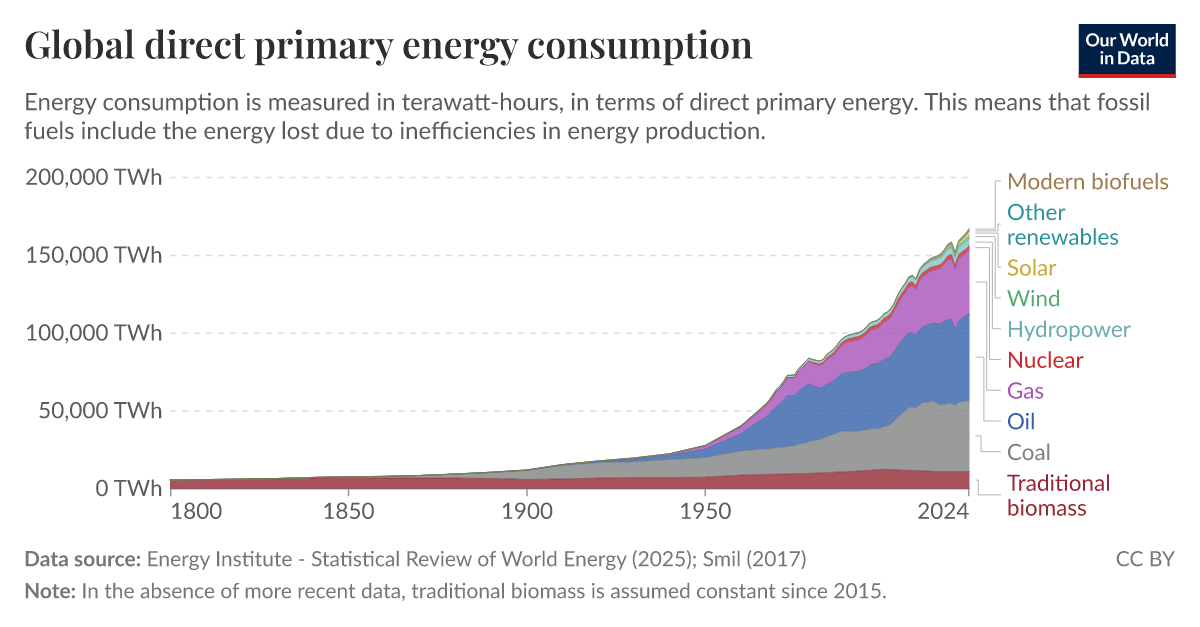
To make the bet fair ,please look at Energy Consumption and not Generation, its all good and well to have a ton of panels lying around generating energy, but its rather pointless if no one uses that power.

I am talking about this graph.
 
Last edited:
To just further prove my point on my skepticism,


In 1990s the world consumed 17.07% of its electricity from renewables, today it stands at 18.05, that includes hydro.
 
I please do enlighten me, electricity is electrical energy, unless I missed something in physics
Electricity is only about 20% of total energy consumption.

Most energy is used to heat things, move things (rocket fuel, jet fuel, diesel, petrol), reduce things (i.e. cement, steel). Thats why renewables are so small in your graph, because its TOTAL energy by primary use. Im surprised Biomass isnt much bigger, then again it is BPs graph :)

We were talking about GRID i.e. ELECTRICITY.
 
Electricity is only about 20% of total energy consumption.

Most energy is used to heat things, move things (rocket fuel, jet fuel, diesel, petrol), reduce things (i.e. cement, steel). Thats why renewables are so small in your graph, because its TOTAL energy by primary use. Im surprised Biomass isnt much bigger, then again it is BPs graph :)

We were talking about GRID i.e. ELECTRICITY.

You still don't get it, we heat our homes with gas, because its more efficient and dense than electricity from other sources. You can replace gas with electricity heats tomorrow, but it will increase the cost, because those heaters have efficiency losses.

You can make steel from electrolysis, but its less expensive than using fuel.

we use cars as opposed to trains, because its more efficient and it offers a greater mobility.

The price that you pay for stuff is ultimately linked to the amount of energy that you use, that is why GDP per capita links to well with oil consumption.
 
Last edited:
On the "we went from x to y" points that just stories and anecdotes not data. "We went from peat to coal", yes and then we went to oil, then natural gas (after a stop in town gas). Its just not a simple path... there is no 'direction' of travel here.
E.g. steam engines were BETTER than internal combustion, but internal combustion was smaller/simpler. Electricity infrastructure is expensive and huge space inefficient (overall) cs a local engine, but its simpler to implement. Its VHS vs Beta max... Its a spoon when all you need is a knife :)

We do go relentlessly towards cheaper - not denser. And when one thing starts to run out, we move to alternatives that are cheaper.

Solar IS cheaper per kwh than coal now, for the marginal extra kwh. Once we get up to higher %ages there will be obstacles to overcome - tariffs / demand management and local backup can do some of the work though, it doesn't have to be all on the supply side.
 
You still don't get it, we heat our homes with gas,
No "WE" don't...

Where do you live? Somewhere with natural gas pipes to the home, I presume?

Heating with electricity is cheaper than gas in MY country (ZA), even without using a heat pump. Using aircon/heat pump to heat makes it half the price of gas
 
On the "we went from x to y" points that just stories and anecdotes not data. "We went from peat to coal", yes and then we went to oil, then natural gas (after a stop in town gas). Its just not a simple path... there is no 'direction' of travel here.
E.g. steam engines were BETTER than internal combustion, but internal combustion was smaller/simpler. Electricity infrastructure is expensive and huge space inefficient (overall) cs a local engine, but its simpler to implement. Its VHS vs Beta max... Its a spoon when all you need is a knife :)

We do go relentlessly towards cheaper - not denser. And when one thing starts to run out, we move to alternatives that are cheaper.

Solar IS cheaper per kwh than coal now, for the marginal extra kwh. Once we get up to higher %ages there will be obstacles to overcome - tariffs / demand management and local backup can do some of the work though, it doesn't have to be all on the supply side.


Read Vaclav Smil's book Energy and Civilization and you will see that the direction is in terms of denser fuels, (until now when the renewable crowd gets on board).

But here is my bet though, show me your favorite consumption graph (electricity, total energy etc), I will bet that Nuclear will make a bigger share of the consumption in 10 years as opposed to Solar and Wind.
 
In SA I also heated my home with a gas heater, it worked at cheaper (and Eskom...)
Not true sorry. I wrote a thing a while ago about this for our energy savings blog.
In short though, at the time at least, the controlled price of gas was higher than eskom per kwh of raw energy. With a heat pump you get 3 units of heat per unit of electricity so you end up miles ahead.
 
Not true sorry. I wrote a thing a while ago about this for our energy savings blog.
In short though, at the time at least, the controlled price of gas was higher than eskom per kwh of raw energy. With a heat pump you get 3 units of heat per unit of electricity so you end up miles ahead.

You're probably correct, I never went deep into it. My irritation was not heaving heat when the lights was out.
 
Let me position a different angle. Forget density for a minute, maybe we are just abstracting and getting further away from the dirt.

First we walked then we used animals, then we burned fuels (coal-steam etc.), then we refined those fuels somewhere else (oil), now increasingly electricity generated at the other end of the country (or a different country!).

Same with telecoms - first we spoke to people face to face, then we went to phones, then mobile phones, then asynchronous (like this).

The move to electricity is a thing, but I dont buy that space efficiency matters. The world is a very empty place and power lines can move power from those empty places to cities pretty easily.

Ps - would need to dig into those costs of wind you cite; could be politics still - i.e. wind is so good you need to pay my buddies not to produce power... Not a reason against wind per se, just a lesson in entrenched interests and state capture.

To me the future of grid electricity is like VOIP phones vs old land lines.
-- a bit worse (often failing, cutting out), but so much cheaper, we dont care / make a plan.
 
Missed all the stuff about modular builds etc.
Completely agree - this is why solar panels keep getting cheaper. When you make 100s, 1000s of something in a factory you can move up the experience curve, invest in automation, process improvement etc.

If we could do that for nuclear, great! (I think Gates did invest in a startup on that, not sure what happened?). Modular little nuclear containers, brilliant!

Instead every new plant is a new learning experience and needs 10-15 years of planning, cost overrun, dithering etc.
 

on the modular reactors, they are going to start production soon, the USA regulatory authorities held them up (as expected).

Gates put his money in large Breeder Reactors, https://www.terrapower.com/

their advantage is that you don't need to post process the fuel, hence the decommissioning cost drops dramatically.

Either way, we are living in exciting times with lots of energy ideas, let's see who wins.
 
No "WE" don't...

Where do you live? Somewhere with natural gas pipes to the home, I presume?

Heating with electricity is cheaper than gas in MY country (ZA), even without using a heat pump. Using aircon/heat pump to heat makes it half the price of gas
Actually there are quite a few places in Johannesburg covered by Egoli gas that make it cheaper to heat with gas, but it's not a lot of areas within Johannesburg :-(.
 
You still don't get it, we heat our homes with gas, because its more efficient and dense than electricity from other sources. You can replace gas with electricity heats tomorrow, but it will increase the cost, because those heaters have efficiency losses.

You can make steel from electrolysis, but its less expensive than using fuel.

we use cars as opposed to trains, because its more efficient and it offers a greater mobility.

The price that you pay for stuff is ultimately linked to the amount of energy that you use, that is why GDP per capita links to well with oil consumption.

Electric resistance heating is close to being 100% energy efficient.
The generation of said electricity is unlikely to be anywhere near that.

The key is actually to think though. Insulating a home properly is cheaper over long term than paying for heating, and thats where your money should be invested.


Energy use is actually decreasing per capita. We're moving away from inefficient usage, towards more efficiency - I would argue that this is being driven by costs.

In the 60's and early 70s' (pre-oil pricing wars) energy was cheap, and things were inefficient. Lighting took up a huge portion of supply, as did other inefficient things like heating drafty houses, with no insulation!

We've moved on from that, and lighting is taking an ever decreasing % of demand, and houses are getting insulated.

I would calculate in my house, its less than 1% of usage for lighting.
Insulation and double or triple glazing is becoming standard, at least oversea's.
 
Last edited:
Top
Sign up to the MyBroadband newsletter
X