Why Solar and Wind cannot power Germany

Here is a visual image of the land required for the Wind Turbine, so that we know what we are talking about. (they are probably more efficient along the coast).

As I say, I would like to get back on this after 5 years, since every 2nd company is on the let's go solar, let's go wind sauce train.

We've been here before, but I remain skeptical that we can just rapidly expand it on an area that size.
You keep pulling interesting graphics with dubious or no sources, would be nice if you could actually take the 5 minutes to research your own sources to see if they're valid, since that one is definitely not if you know anything about wind.
 
Just do a basic calculation here before you pee in your pants again.

You keep pulling interesting graphics with dubious or no sources, would be nice if you could actually take the 5 minutes to research your own sources to see if they're valid, since that one is definitely not if you know anything about wind.

Google tells you get 4MW per km2.

8000MW*1km2/4MW= 2000km2

That graph uses 5000m2 and assumes that the wind blows at least 40% of the time.
2000/5000 = 40%
 
Last edited:
Just do a basic calculation here before you pee in your pants again.


Google tells you get 4MW per km2.

8000GW*1km2/4MW= 2000km2

That graph uses 5000m2 and assumes that the wind blows at least 40% of the time.
2000/5000 = 40%
8000MW, not 8000GW.

192000km2 times 4MW = 768000MW divide 40% = 307200MW. :eek:
 
Where did you pull that from?

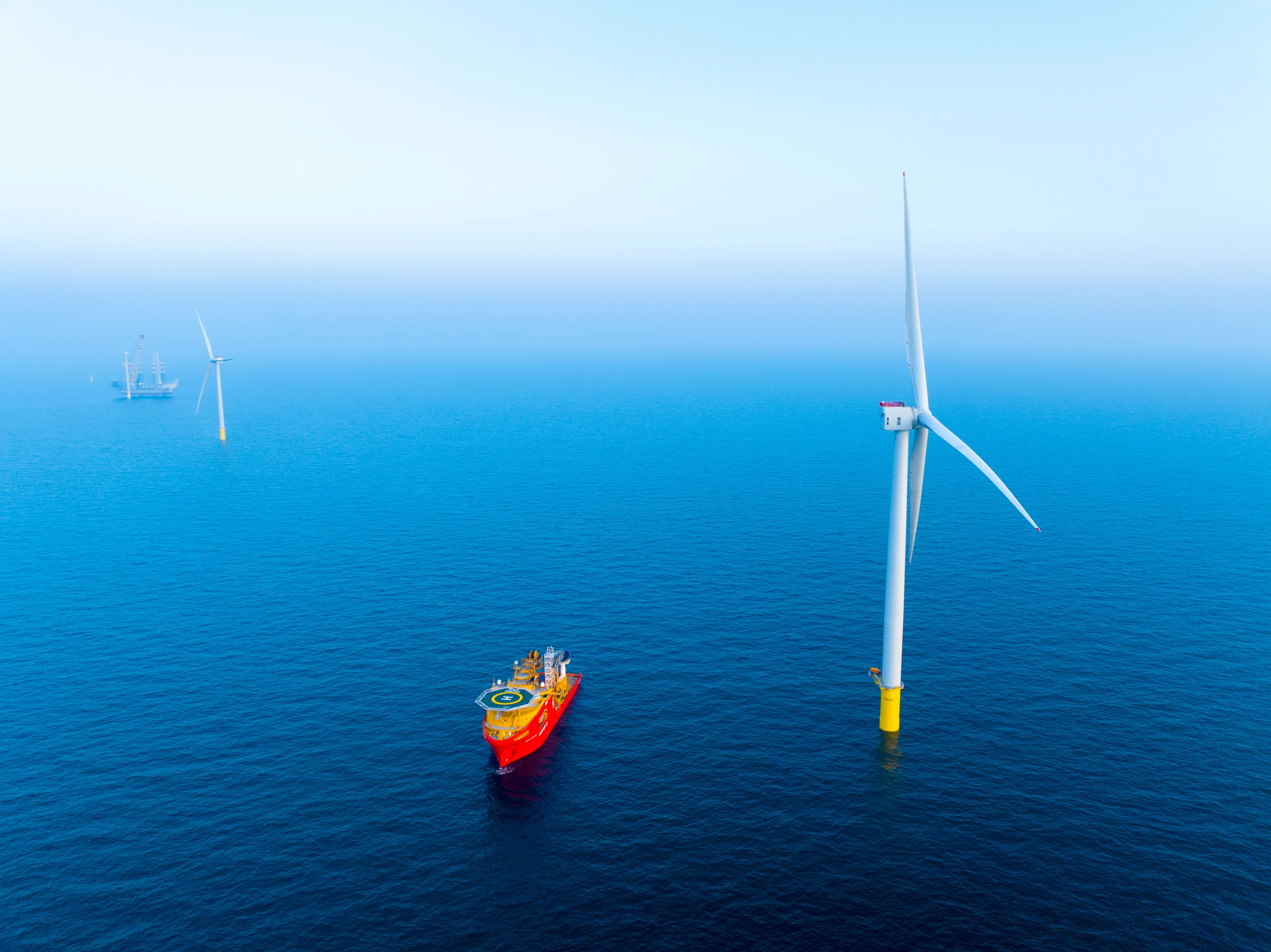
8GW could be done with a total of 620 offshore 13MW turbines.
GE claim capacity factor of 60-64%, which is lower to than Koebergs high 70%.

Koeberg on the other hand is 1.8GW. Apples to apples for 1.8GW you'd need 140 turbines. Or 165 turbines to be equivalent to the same capacity factor as Koeberg. 1km distance recommended distance turbine to turbine, so you wouldn't need that much space.

The point wasn't to show a Koeberg comparison, but what 8GW would mean in space.

For comparison the worlds largest farm is Jiuquan Wind Power Base in China, with a planned installed capacity of 20GW and 7000 turbines.

So that graphic is more than a little bit bogus.

The other important point is that the land (or sea) is still usable now, and in the future even with a turbine on it.

So far only 8GW works, but be that as it may,

it takes a massive amount of space and it makes the landscape ugly.

1607251628757.png
 
Google tells you get 4MW per km2.
Google is a search engine, not a source, and do you know that Jiuquan is a city, right?
1607251361128.png
The average installed wind turbine is ~2.5MW at the very least, and you really need to quote your numbers of when those wind farms were built.
A wind farm pre 2000 was <25% capacity factor, anything between 2014 and 2017 is about 42%: http://css.umich.edu/factsheets/wind-energy-factsheet
And it's higher now than it was then, with new stuff still in testing, so it will probably increase more (since currently strong storms would shut down wind turbines, there are attempts to address that for example).

Here is a study from 2018, not sure it would pick 2017 farms etc. would guess the study it relies on would be older wind farms, but:

Direct Land Use​


Rules of thumb are just that: simplified expressions to get a rough idea of system requirements. To find out what's happening in the real world, researchers at the National Renewable Energy Laboratory, NREL, surveyed 172 large-scale wind power projects to see how much land they're really using. The direct land use is a measure of the area of such things as the concrete tower pad, the power substations and new access roads. In the United States, the direct land use for wind turbines comes in at three-quarters of an acre per megawatt of rated capacity. That is, a 2-megawatt wind turbine would require 1.5 acres of land.
1607251717664.png
And the area can be used for other things.

Now actually follow your links past the google search results page, I thought you at least visited the site.

I wish downvotes were a thing, your posts where you spew literal Google search results without following any of those links are even worse than not giving a source tbh.
 
Google is a search engine, not a source, and do you know that Jiuquan is a city, right?
View attachment 967808
no I didn't I suppose that you win there.

The average installed wind turbine is ~2.5MW at the very least, and you really need to quote your numbers of when those wind farms were built.
A wind farm pre 2000 was <25% capacity factor, anything between 2014 and 2017 is about 42%: http://css.umich.edu/factsheets/wind-energy-factsheet
And it's higher now than it was then, with new stuff still in testing, so it will probably increase more (since currently strong storms would shut down wind turbines, there are attempts to address that for example).

That is a prediction and they can be like prophesies. Eventually all these technologies hit physical limits, 40% isn't to bad of an estimate, but you know what let's make it 70%, you still use a lot of land.

Here is a study from 2018, not sure it would pick 2017 farms etc. would guess the study it relies on would be older wind farms, but:

View attachment 967816
And the area can be used for other things.

Now actually follow your links past the google search results page, I thought you at least visited the site.

Your calculation is a bit dishonest,

Direct Land Use​

Rules of thumb are just that: simplified expressions to get a rough idea of system requirements. To find out what's happening in the real world, researchers at the National Renewable Energy Laboratory, NREL, surveyed 172 large-scale wind power projects to see how much land they're really using. The direct land use is a measure of the area of such things as the concrete tower pad, the power substations and new access roads. In the United States, the direct land use for wind turbines comes in at three-quarters of an acre per megawatt of rated capacity. That is, a 2-megawatt wind turbine would require 1.5 acres of land.
you are correct, but

Read the next paragraph,

Total Wind Farm Area​

In any wind farm there is a lot of space between turbines. Some of that space is to minimize turbulence, but some is to follow ridge lines or avoid other obstacles. Much of this area is used for other purposes, such as agricultural farms. The NREL researchers also surveyed this total land use. They found a rough average of 4 megawatts per square kilometer (about 10 megawatts per square mile). So a 2-megawatt wind turbine would require a total area of about half a square kilometer (about two-tenths of a square mile)."

So the same article, says that you need that amount of land.

What you're doing is like me saying that the Nuclear Reactor takes X space and therefore the rest of the plant doesn't matter.

As for the argument that you can use the land for something else, what are the facts on that, are the chinese really doing that?

I wish downvotes were a thing, your posts where you spew literal Google search results without following any of those links are even worse than not giving a source tbh.

More ad hominen nonsense from you for disagreement. It kind of shows your age and I am actually smiling every time that you end up reacting like a teenager.
 
That is a prediction and they can be like prophesies.
Prediction based on papers that are currently going through testing phases.
So the same article, says that you need that amount of land.

What you're doing is like me saying that the Nuclear Reactor takes X space and therefore the rest of the plant doesn't matter.
I said how much one needs, not what the average would be if you follow contours etc.
You're quite dishonest there again. You keep quoting as though a wind turbine removes any other use for the land around it vs nuclear which actually does that.
More ad hominen nonsense from you for disagreement. It kind of shows your age and I am actually smiling every time that you end up reacting like a teenager.
That's very sad of you, I just get saddening that you keep posting stuff that has been disproven/misleading (like power generation cost without taking construction into account), there are so many other places you could get good nuclear power info from, it is actually a very well researched field.
 
Prediction based on papers that are currently going through testing phases.
People tend to be optimistic, you have to work with what exists right now.

I said how much one needs, not what the average would be if you follow contours etc.
You're quite dishonest there again. You keep quoting as though a wind turbine removes any other use for the land around it vs nuclear which actually does that.
Sure you can use the land for something else, who actually does that? No one wants to be close to that noisy thing. Take a drive though Germany and show me how many people actually do that, it's one of this great in theory arguments.

as I said before, I am buying my popcorn and in 5 years time we are going to see how this works out, experience tells me that a project on that size, in SA in particular is going to be a cesspool for corruption, bad implementation, money stolen, NIMBY attitudes etc, in simple English a F-up is waiting to happen.

That's very sad of you, I just get saddening that you keep posting stuff that has been disproven/misleading (like power generation cost without taking construction into account), there are so many other places you could get good nuclear power info from, it is actually a very well researched field.

No I think that you need to grow up a little bit when someone disagrees with you and not take everything so personal.
 
Last edited:
No one wants to be close to that noisy thing.
Farm land, and you don't really hear wind turbine noise at 300m about, and I don't think I've seen it closer to towns than about 1km.
Take a drive though Germany and show me how many people actually do that
Sorry, last drove through Germany in 2015, unless you count crossing through the south of Bavaria for a hundred km as driving through Germany, then 2017.
Austria on the other hand I can point to 2019, and have seen quite a few towns with wind turbines about a kilometer from the next house without issue. It's usually placed in the middle of farm land, as said.

I don't know about you, but most of those google images are farm land:
1607253118301.png

There's even a picture of wind farms close to a town.

That link is actually interesting:
  • Target: 100% of its electricity from local, renewable sources by 2020
  • Status: Achieved - Burgenland managed to supply 100% of its electricity needs through wind power by 2013.
  • RES: Wind power and biomass energy.
  • Implementation: Burgenland is the seventh largest of Austria's nine states. It borders the Austrian states of Styria and Lower Austria, as well as Hungary, Slovakia and Slovenia. Today, this region in eastern Austria gets 100% of its electricity from local, renewable sources . It all began in 1992, when a local citizen wanted to install a wind turbine on his property and contacts a wind power consultancy. The consultancy recommended to build a large farm in view of the site’s high wind power potential. In the following year, the owner and the consultancy presented the project to the Zurndorf town council. Between 1993 and 1995, planning and wind measurements were undertaken. In 1994, the municipality decided to create a company for managing the project (where the municipality has a 98% stake). By 1995, the membership of Austria to the European Union, meant that the Burgenland could benefit from EU Structural Funds to carry out infrastructure projects, such as energy. By 1997, the Austrian government decided to increase the share of renewable energy to 3% of final energy use, beginning with the construction of the Zurndorf wind farm. In 2001 the Austrian electricity market was open, and in 2002 Burgenland developed a regional wind power plan. In 2003 the Green Power Act was adopted. By 2009, the Burgenland Energieteam was established to set an energy self-sufficiency target by 2050, accompanied by an action plan. By 2013 self-sufficiency in electricity was already achieved. It is estimated that 4,500 jobs have been created through the development of wind power in Burgenland.
  • Population: 284,900
  • Area: 3,961.80 km2 (1,529.66 sq mi)
No I think that you need to grow up a little bit when someone disagrees with you and not take everything so personal.
I think you need to stop posting BS all the time, it's not personal, it's just you're like a Malema of nuclear, say stuff that harms a select group with no basis on facts.
 
Here is my "prediction " of what I think is going to happen in SA.

 
Whilst we're talking about "land area" BETWEEN sites... how close can you actually put nuclear sites?
You can't put them right next to each other surely.
I'm going to go with 2600sqkm between each nuclear site - here's my source*

So for 8GW of Nuclear (with Koeberg being 70% effective, it's 1.9GW = 1.33GW so we need 6!)
6 x 2600sqkm = 15600 sqkm; so that's 3 times the amount of space than wind!!!?

Oh... but you can use that land for something else... umm... wildlife perseveration, short-term niche tourism?


*https://lmgtfy.app/?q=chernobyl+restricted+zone+size
1607257425753.png
 
Whilst we're talking about "land area" BETWEEN sites... how close can you actually put nuclear sites?
You can't put them right next to each other surely.
I'm going to go with 2600sqkm between each nuclear site - here's my source*

So for 8GW of Nuclear (with Koeberg being 70% effective, it's 1.9GW = 1.33GW so we need 6!)
6 x 2600sqkm = 15600 sqkm; so that's 3 times the amount of space than wind!!!?

Oh... but you can use that land for something else... umm... wildlife perseveration, short-term niche tourism?
Koeberg does that, the Nuclear Site is on a nature reserve, great compromise.


You can put them all across the shore line, but it isn't really comparable. For one the maintenance will be located at 2 maybe 3 locations where with windfarms and solar farms you're going to have a guy driving a bakkie up and down having to clean them.

The guys building access roads are going to make a killing.

As I mentioned before I am not against this experiment, I just see a lot more obstacles than some people want to admit.
 
Koeberg does that, the Nuclear Site is on a nature reserve, great compromise.


You can put them all across the shore line, but it isn't really comparable. For one the maintenance will be located at 2 maybe 3 locations where with windfarms and solar farms you're going to have a guy driving a bakkie up and down having to clean them.

The guys building access roads are going to make a killing.

As I mentioned before I am not against this experiment, I just see a lot more obstacles than some people want to admit.

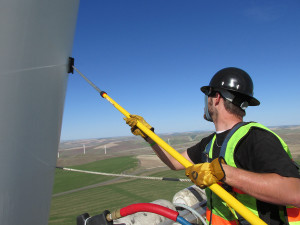
Cleaning and Inspection​


Studies indicate that on average a wind turbine should be cleaned every 5 to 7 years to achieve maximum performance.

Huge environmental impact...
Solar I think was every 6 months norm, but dependent on location etc.
 
Im sure the guys who have been running these plants since REIPP1 know how often and how much it costs to clean and how often things needs to be maintained

Did you know coal and nuclear plants have to put in "FUEL" ... I bet they never thought of that in their cost calculations...
/End sarcasm
 
The point wasn't to show a Koeberg comparison, but what 8GW would mean in space.


So far only 8GW works, but be that as it may,

it takes a massive amount of space and it makes the landscape ugly.

View attachment 967814

Really? Is that why it had an image of Koeberg on there, space usage for Koeberg, then many many wind turbine graphics.

Thats a tad disingenuous., especially seeing as the rest of the graphic is also quite bogus, considering a little bit of coastline outside Cape Town could likely power the 8GW (based on the calc's using off the shelf product I noted).
 
Top
Sign up to the MyBroadband newsletter
X