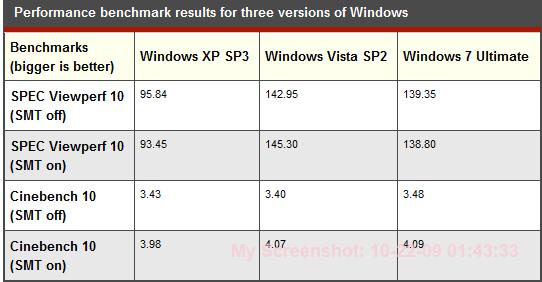
"InfoWorld's Andrew Binstock tests whether Windows 7's threading advances fulfill the promise of improved performance and energy reduction. He runs Windows XP Professional, Vista Ultimate, and Windows 7 Ultimate against Viewperf and Cinebench benchmarks using a Dell Precision T3500 workstation, the price-performance winner of an earlier roundup of Nehalem-based workstations. 'What might be surprising is that Windows 7's multithreading changes did not deliver more of a performance punch,' Binstock writes of the benchmarks, adding that the principal changes to Windows 7 multithreading consist of increased processor affinity, 'a wholly new mechanism that gets rid of the global locking concept and pushes the management of lock access down to the locked resources,' permitting Windows 7 to scale up to 256 processors without performance penalty, but delivering little performance gains for systems with only a few processors. 'Windows 7 performs several tricks to keep threads running on the same execution pipelines so that the underlying Nehalem processor can turn off transistors on lesser-used or inactive pipelines,' Binstock writes. 'The primary benefit of this feature is reduced energy consumption,' with Windows 7 requiring 17 percent less power to run than Windows XP or Vista."
http://tech.slashdot.org/story/09/10/21/1234214/Windows-7-On-Multicore-mdash-How-Much-Faster
Well if that 17% benefit can be significant - if 1. it's under all circumstances not just heavy use in >2 core CPUs and 2. CPU power draw is a significant power draw - then Win 7 is beneficial because it allows laptops to crunch numbers longer while under battery draw and - it's better for the environment and the utilities' bill -it could be a reason to upgrade - the only one so far. However, it's not faster for multiple cores.