Buying a 3D LED TV

Status
Not open for further replies.
Correction:

"With passive your brain puts the two halves together to make it full 1080P. "

With active it also happens as one eye is always blocked and the brain must work harder and then suffers from flickering and sync problems induced by the technology as well.

They actually, as I understand the technology, presents the full 1080p left/right display to each eye at alternative cycles therefore the resolution stays the same at full HD but the available frequency is halved. Therefore the flicker and minimum requirement of 120hz capable tv's to use shutter glasses effectively to present each 3D frame at 60hz.
 
Last edited:
Ai, I don't get why people bother with 3D TVs. I've experienced a variety of 3D TVs, from LG to Samsung. I've tried all the different types of glasses. I've watched movies and played PS3 games in 3D and without 3D on all of them. (after struggling like crazy to get my hands on proper 3D content).

I wouldn't spend the extra money it costs to get a 3D TV. Not yet. There's so little content available at present. Most of the 3D glasses hurt my face/head or don't fit over my glasses. Most of the 3D effects give me a headache and sore eyes almost immediately.

The only TV I experienced it on that didn't suck entirely was the Samsung Series 8 55" 3D LED TV, combined with their top-of-the-range 3D glasses. Not the ones that come with the TV. You have to buy them separately. They were light, comfortable, battery life was great, they fitted easily over my glasses and I didn't get a headache when using them and the Samsung 3D TV.

Still, that's just me. I don't think 3D is worth it. I think it's overrated and gimmicky. I can't wait for the 3D fad to die out.
 
I can't wait for the 3D fad to die out.

Unfortunately it won't. Report back in 5 years time. Whether people would use the 3D capability that would be inherent in all new video based devices is another issue. Considering the quality of the 2D display on my friends 47" LG and the 2D to 3D conversion I would say that 3D is here to stay. Considering that my friend did not really pay more for the 3D capability than any of the other non 3D TV's available in the range that "extra" price fallacy will be gone soon.
 
They actually, as I understand the technology, presents the full 1080p left/right display to each eye at alternative cycles therefore the resolution stays the same at full HD but the available frequency is halved. Therefore the flicker and minimum requirement of 120hz capable tv's to use shutter glasses effectively to present each 3D frame at 60hz.

Yes, as I said passive is therefore better as it does not do this. Cinema 3D from LG therefore rocks as its cristal clear, bright and no flicker, wide angle of viewing range, cheap cinema 3D glasses and yes full 1080p 3D HD. The TV is also a lot cheaper as the technology is much simpler. Also you instantly can watch everything you want in 3D without a 3D BlueRay Player with the 2D-3D conversion, I really enjoy the News Broadcasts (and everything) in 3D. You can of course buy a 3D BlueRay Player at any time and watch the "specially recorded" 3D movies on BlueRay as well.
Simpler-Better-Clearer-Cheaper-Robust
 
Last edited:
Yes, as I said passive is therefore better as it does not do this. Cinema 3D from LG therefore rocks as its cristal clear, sharp and no flicker, wide angle of viewing range, cheap cinema 3D glasses and yes full 1080p 3D HD.
Yes passive 3D is less stain on the eyes as there are no filckering shutters, but it still only provides half the resolution of active 3D.

In a 24Hz cycle (Bluray playback) active 3D will present the viewer 2160 lines of (spacially discrete) information. Passive 3D on the other hand can only provide a total of 1080 lines, as alternate lines are polarized to each eye.
 
Yes passive 3D is less stain on the eyes as there are no filckering shutters, but it still only provides half the resolution of active 3D.

In a 24Hz cycle (Bluray playback) active 3D will present the viewer 2160 lines of (spacially discrete) information. Passive 3D on the other hand can only provide a total of 1080 lines, as alternate lines are polarized to each eye.

I have really not heard of 2160p HD before, so 1080p is fine for me. Also in an active shutter when one eye sees 1080 lines, then the other eye sees nothing, ziltch, blackness. So seeing 1080 with each eye alternately is no better than seeing 1080 with two simultaneously with no "cycles". Put in other words, I see 1080p in both eyes for each same duration cycle for both active and passive, but passive has no flicker etc. This is because active needs 2 cycles to present each eye with 1080p whereas passive will present 2x540 to each eye in 2 cycles which is also 1080. This is independently certified for LG and the info is available from my link in an earlier post in this thread. There is really no other way in which you can explain how LG produces such superior HD 3D pictures, its no magic, simply better and simpler technology. This technology is an improvement from earlier technologies and the polarization is circular and not linear, so you do not really see 540 lines in a cycle but a picture that is more progressively completed in a 2 cycle period up to 1080p.

I refer to a "2 cycle" period above for ease of understanding and simplicity. It really refers to an equal length of time to deliver 1080 lines of picture to both eyes.
 
Last edited:
I see 1080p in both eyes for each same duration cycle for both active and passive
Not the same thing.

With passive 3D each eye is permanently blocked from seeing half the TV panel's lines by polarization. Therefore even though each eye gets 1080 lines of info in each cycle (1st 540 then 2nd 540), the positioning of half the lines has been shifted compared to source i.e. one line higher/lower than it should be. This is an alteration/distortion of the source image which you wont find with active 3D, as it positions all 1080 lines per eye exactly where the source content specifies.

Read the article posted previously properly.
 
Last edited:
enough of the 3D crap. why don't you discuss it when there is enough 3D media around to discuss it. we have only started with the whole hd contents on tv.
 
Not the same thing.

With passive 3D each eye is permanently blocked from seeing half the TV panel's lines by polarization. Therefore even though each eye gets 1080 lines of info in each cycle (1st 540 then 2nd 540), the positioning of half the lines has been shifted compared to source i.e. one line higher/lower than it should be. This is an alteration/distortion of the source image which you wont find with active 3D, as it positions all 1080 lines per eye exactly where the source content specifies.

Read the article posted previously properly.

Roman you are correct with the technical description of passive 3D in general. Therefore LG came up with a different algorithm to compensate for the "problem". Again read the LG description stating that your brain is duped to see to full HD at all times. If you use a high speed camera then yes you will notice the real effect but with their alternating algorithm your mind cannot notice the reduced resolutions. The same difference as viewing a high resolution graphic at either 30 hz or 50 hz.
 
enough of the 3D crap. why don't you discuss it when there is enough 3D media around to discuss it. we have only started with the whole hd contents on tv.
There is enough for a start. 3D movies, gaming, photos, cameras, camcorders, PC software, etc, etc.

2012 will see a lot more. MIB3 3D is coming soon.
 
Bingo i found the article I was looking for

http://www.flatpanelshd.com/news.php?subaction=showfull&id=1313938337

Before the Cinema 3D technology worked like this: During a time period of 1/200 seconds the TV showed 2 frames; 540 lines for the left eye and 540 lines for the right eye.
The new algorithm shows 4 frames instead of 2 during the 1/200 second time frame. It shows 1080i for the left eye and 1080i for the right eye.

When these are combined the two pictures create a 1080p picture according to LG. LG believes that this update improves picture quality on their Cinema 3D TVs to compete directly with the active 3D TVs such as 3D plasma TVs. You need to turn off TruMotion to utilize the new algorithm. See the illustration below.
 
Seems like they've got it a bit better, but the fidelity is still not exactly a match for active 1080p per eye.

This probably won't matter for most, but you also need to take into account you will be paying a premium for the LG Cinema 3D TVs (over & above price diffs of glasses). Strip out the 3D functionality, and rest of the features/performance of the LW range are a bit lacking compared to similar priced models from others likes Samsung.
 
Seems like they've got it a bit better, but the fidelity is still not exactly a match for active 1080p per eye.

This probably won't matter for most, but you also need to take into account you will be paying a premium for the LG Cinema 3D TVs (over & above price diffs of glasses). Strip out the 3D functionality, and rest of the features/performance of the LW range are a bit lacking compared to similar priced models from others likes Samsung.

IMHO the 1080i is a damn good alternative to flickering complex and very expensive shutter glass technology.
 
IMHO the 1080i is a damn good alternative to flickering complex and very expensive shutter glass technology.
Agreed, if extensive use of 3D is important to you. For lengthly use I'd say the comfort factor outweighs absolute best picture fidelity.

As for the price, LG's passive 3D TVs are more expensive (with lesser non-3D features/performance). So if your 3D usage is minimal, they may not represent best value for money.
 
Agreed, if extensive use of 3D is important to you. For lengthly use I'd say the comfort factor outweighs absolute best picture fidelity.

As for the price, LG's passive 3D TVs are more expensive (with lesser non-3D features/performance). So if your 3D usage is minimal, they may not represent best value for money.

I will not bother to search for it but I read a well written technical article that showed that the 2D PQ was actually improved on the 3D engines. Also the 2D to 3D conversion works a charm. I have seen it.
 
I will not bother to search for it but I read a well written technical article that showed that the 2D PQ was actually improved on the 3D engines.
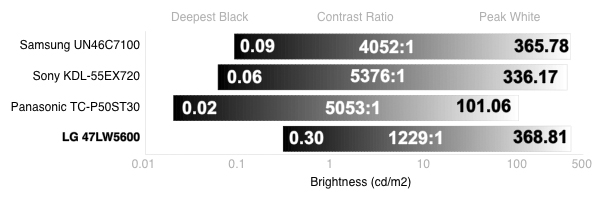
Issue with the LG panels is they're notoriously poor at producing blacks. Thats even compared to budget LCDs, never mind peer LEDs models or Plasmas.
 
Even the 2011 models like the LW series with IPS panel?
Well here's a graph to illustrate in comparison to one of the best Plasmas and some similar LEDs ...

LG-47LW5600-contrast.jpg


From pro review site www.televisioninfo.com
 
Status
Not open for further replies.
Top
Sign up to the MyBroadband newsletter
X