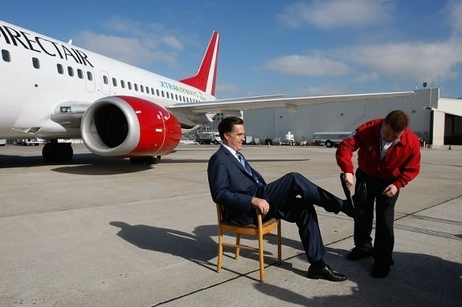
Article: Obama and Romney debate quotes

Romney's tax cuts to stimulate growth sounds all great and well but where are the details to hold him accountable?

Why do they sound great? It's never worked, has it? It didn't work under Bush, Obama continued it, and it still isn't working. Quite amusing, though, because the Republicans love to lambast Obama for not creating jobs, even though he's doing EXACTLY what they're advocating, so it wouldn't work if they do it either, and in fact, hasn't.
 
[video=youtube;6ti2S7Py25w]http://www.youtube.com/watch?feature=player_embedded&v=6ti2S7Py25w[/video]
 
Why do they sound great? It's never worked, has it? It didn't work under Bush, Obama continued it, and it still isn't working. Quite amusing, though, because the Republicans love to lambast Obama for not creating jobs, even though he's doing EXACTLY what they're advocating, so it wouldn't work if they do it either, and in fact, hasn't.

But in a struggling economy raising taxes will have a negative effect, this is an accepted truth, even Bill Clinton said as much.
 
But in a struggling economy raising taxes will have a negative effect, this is an accepted truth, even Bill Clinton said as much.

The people whose taxes need to be raised won't notice it in the slightest. The Buffett Rule would apply to only 0.3% of the population. I find it silly that the mega-rich can hide behind the mantle of being "job creators", but they've had big tax cuts for such a long time, and the jobs aren't coming. They're still outsourcing, dismantling and sometimes completely eliminating jobs. Bain Capital is pretty good at this. So they pay less tax, make more money for a very select few people, and destroy job opportunities by closing down companies or shipping all operations overseas. Doesn't seem right to me. :erm:
 
The people whose taxes need to be raised won't notice it in the slightest. The Buffett Rule would apply to only 0.3% of the population. I find it silly that the mega-rich can hide behind the mantle of being "job creators", but they've had big tax cuts for such a long time, and the jobs aren't coming. They're still outsourcing, dismantling and sometimes completely eliminating jobs. Bain Capital is pretty good at this. So they pay less tax, make more money for a very select few people, and destroy job opportunities by closing down companies or shipping all operations overseas. Doesn't seem right to me. :erm:

Both sides are indirectly on the same page. The way to effectively raise tax on the most sophisticated payers(read: the super rich) is to close the tax loopholes. The super rich are paying single digit tax percentages. Google, if i remember correctly pays something like less than 5%, it might have been as low as 3%, i can't really remember.

At the moment the US has one of the highest corporate tax rates in the world, which isn't a good visual. They could very easily lower that number if they forced everyone to pay the correct amount.

The other thing to consider is that the US has something like 20 million business's (i'm going by memory). Only 15 000 of those employ more than 500 employees. Something like 19.5 million are tiny 1 or two person operations running their business's on the individual tax rate. Giving those people some tax relief could make a difference. Other stuff to consider is: Are banks lending out money to these little business in the correct way and at sufficient levels? Are regulations stifling entrepreneurial pursuits? Are they hurting the ability for small business to hire or seize business opportunities? Etc...

These are all thing that need to be looked at.

For me, if Romney learnt anything from his 25 years at Bain flipping business's left and right, it's how to get small business moving. I have no doubt he intimately understands the business process and knows what hinders small to medium size business because he butt heads with every single bottleneck during his Bain years. Sure he could be evil, which i don;t think he is, but if he has good intent he could make a very big difference. I see him as one of those people everyone loves to hate but is actually intellectually positioned to make a big difference if they choose too - like the new Cell C CEO.
 
Last edited:
Both sides are indirectly on the same page. The way to effectively raise tax on the most sophisticated payers(read: the super rich) is to close the tax loopholes. The super rich are paying single digit tax percentages. Google, if i remember correctly pays something like less than 5%, it might have been as low as 3%, i can't really remember.

At the moment the US has one of the highest corporate tax rates in the world, which isn't a good visual. They could very easily lower that number if they forced everyone to pay the correct amount.

The other thing to consider is that the US has something like 20 million business's (i'm going by memory). Only 15 000 of those employ more than 500 employees. Something like 19.5 million are tiny 1 or two person operations running their business's on the individual tax rate. Giving those people some tax relief could make a difference. Other stuff to consider is: Are banks lending out money to these little business in the correct way and at sufficient levels? Are regulations stifling entrepreneurial pursuits? Are they hurting the ability for small business to hire or seize business opportunities? Etc...

These are all thing that need to be looked at.

Which loopholes? I always hear "close the loopholes", but I've never seen anyone actually say what they are.

It seems odd to me that advocating for "everyone paying their fair share" usually equates to super rich people paying less.

Regarding small businesses: You're right, the majority of employment and potential new employment opportunities is in the small business sector. The same holds true here. Incentivising the industry and making it easy for people to start up businesses and employ people is key. However, the Republicans seem to be pushing for massive corporations and ludicrously rich individuals being allowed to do what they want, and pay less tax while doing it. Their focus isn't the small business sector. Small businesses don't contribute as much to campaign coffers, you see. :p

The problem is there's no binding agreement between the state (ie. the people) and these corporations whereby both have to bring something to the party. The state grants tax cuts, and asks for more employment and investment. When this doesn't happen, the corporations and mega rich just say "oops", and go on as usual, after reaping all the benefits of the tax cuts. They're under no obligation to honour their side of the deal, so to speak. Naturally a global recession, eurozone failures and a tough economic outlook overall isn't helping, but this seems to have been the case after every tax cut.
 
Which loopholes? I always hear "close the loopholes", but I've never seen anyone actually say what they are.

Go do some reading. Tax avoidance by corporates/the super rich is just way too easy, or not, i guess it depends how you look at it. :p

Here is just one method.


Double Irish arrangement

The Double Irish arrangement is a tax avoidance strategy that U.S. based multinational corporations use to lower their corporate tax liability. The idea is to use payments between related entities in a corporate structure to shift income from a higher-tax country to a lower-tax country. It relies on the fact that Irish tax law does not include U.S. transfer pricing rules.[1]

The US need to stiffle similar activity where possible.

Typically, the company arranges for the rights to exploit intellectual property outside the United States to be owned by an offshore company. This is achieved by entering into a cost sharing agreement between the U.S. parent and the offshore company, in the terms of U.S. transfer pricing rules. The offshore company continues to receive all of the profits from exploitation of the rights outside the U.S., without paying U.S. tax on the profits unless and until they are remitted to the U.S.[2]

It is called "The Double Irish" because it requires two Irish companies to complete the structure. The first Irish company is the offshore company which owns the valuable non-U.S. rights. This company is tax resident in a tax haven, such as the Cayman Islands or Bermuda. Irish tax law provides that a company is tax resident where its central management and control is located, not where it is incorporated, so that it is possible for the first Irish company not to be tax resident in Ireland. The first Irish company licenses the rights to a second Irish company, which is tax resident in Ireland, in return for substantial royalties or other fees. The second Irish company receives income from exploitation of the asset in countries outside the U.S., but its taxable profits are low because the royalties or fees paid to the first Irish company are deductible expenses. The remaining profits are taxed at the Irish rate of 12.5%.

For companies whose ultimate ownership is located in the United States, the payments between the two related Irish companies might be non-tax-deferrable and subject to current taxation as Subpart F income under the Internal Revenue Service's Controlled Foreign Corporation regulations if the structure is not set up properly. This is avoided by organizing the second Irish company as a fully owned subsidiary of the first Irish company resident in the tax haven, and then making an entity classification election for the second Irish company to be disregarded as a separate entity from its owner, the first Irish company. The payments between the two Irish companies are then ignored for U.S. tax purposes.[1]
[edit]Dutch Sandwich

The addition of a Dutch Sandwich to the Double Irish scheme further reduces tax liabilities. Ireland does not levy withholding tax on certain receipts from European Union member states. Revenues from income of sales of the products shipped by the second Irish company are first booked by a shell company in the Netherlands, taking advantage of generous tax laws there. Funds needed for production cost incurred in Ireland are transferred there, the remaining profits are transferred to the first Irish company in the Cayman Islands or Bermuda. If the two Irish holding companies are thought of as "bread" and the Netherlands company as "cheese," this scheme is referred to as the "Dutch Sandwich."[3] The Irish authorities never see the full revenues and hence cannot tax them, even at the low Irish corporate tax rates. There are equivalent Luxembourgish and Swiss sandwiches.
[edit]Companies using the arrangement

Major companies known to employ the Double Irish strategy are:
Apple Inc.[4]
Eli Lilly and Company[5]
Facebook[6]
Forest Laboratories[5]
Google[5][6]
Microsoft[5]
Oracle Corp.[5]
Pfizer Inc.[5]
 
Last edited:
It seems odd to me that advocating for "everyone paying their fair share" usually equates to super rich people paying less.

Yeah, the rich are always trying to get out paying their fair share. This is why they use astroturf naive libertarian parties to support their causes :D Romney paid what... 14%? While his staff pay closer to 35%. Should be the other way around dont you think?

561878_10151084802046275_2052722271_n.jpg
 
Last edited:
I watched it and I thought that Romney came across stronger.
 

Stewart marveled at how Obama lost despite Romney’s odd comments about his willingness to cut funding for PBS and Big Bird, whom Stewart deemed “America’s favorite non-fried bird.” Stewart couldn’t figure out why Obama did not look up at Romney that much, until he cut to the president writing a naked picture of Romney a la Rose in Titanic.

Obama was arrogant; he couldn't stand being talked down to by Romney. He needs to understand that he is not King Obama, he's the president and is beholden to the voters and is most certainly not above criticism by anyone. He needs to man-up and leave the ego at home. Quite pathetic really.
 
Obama was arrogant; he couldn't stand being talked down to by Romney. He needs to understand that he is not King Obama, he's the president and is beholden to the voters and is most certainly not above criticism by anyone. He needs to man-up and leave the ego at home. Quite pathetic really.
Not so fast with the judgement there;
http://www.japantoday.com/smartphon...bate-challenge-handling-the-off-script-moment
“If you are Romney, you want to figure out a way to get under Obama’s skin, you want to see him get prickly,” said Dan Schnur, an aide to McCain’s 2000 presidential campaign. “If you’re Obama, you want to be a little unpredictable and throw Romney off his script.”

Recent presidential debates suggest the first debate could be Obama’s toughest.

Three of the last four incumbent presidents to seek a second four-year term - Ronald Reagan in 1984, George H.W. Bush in 1992 and his son George W. Bush in 2004 - suffered difficult first debates, although Reagan and the younger Bush won re-election.

The exception was Bill Clinton, a natural debater, in 1996. Clinton had defeated the elder Bush in 1992, and was a much sharper communicator than Kansas Senator Bob Dole, Clinton’s Republican opponent in 1996.

“An incumbent president is used to having his way and being deferred to. He is not as used to being challenged,” McKinney said. As a result, “they may come across as perturbed. Their job is to defend their record without becoming defensive.”

That could prove tricky for Obama, who also will have to walk a fine line in acknowledging the nation’s high unemployment rate and the economic difficulties faced by most Americans, while offering a more hopeful vision for the future.]
 
Obama was arrogant; he couldn't stand being talked down to by Romney. He needs to understand that he is not King Obama, he's the president and is beholden to the voters and is most certainly not above criticism by anyone. He needs to man-up and leave the ego at home. Quite pathetic really.

romney_wanded.jpg


obama-fist-bumping-white-house-janitor.png


:D
 
10298_10151084071121275_1406266084_n.jpg
:D

Did Romney cheat? Dont know is this is for real but:

[video=youtube;GQZ5_qdHLV8]http://www.youtube.com/watch?v=GQZ5_qdHLV8&feature=player_detailpage[/video]
Apparently the rules state: "No props, notes, charts, diagrams, or other writings or other tangible things may be brought into the debate by any candidate."
 
Last edited:
Not sure I can sit though the whole thing. Will rely on the highlights packages from the various channels... :D

Obama was arrogant; he couldn't stand being talked down to by Romney. He needs to understand that he is not King Obama, he's the president and is beholden to the voters and is most certainly not above criticism by anyone. He needs to man-up and leave the ego at home. Quite pathetic really.

Have you actually watched the debate or are you pulling this view from others like you said you were going to do?
 
Top
Sign up to the MyBroadband newsletter
X