


Colin62
Executive Member
Camber doesn't push the car sideways.
If both wheels are the same as each other, even if they're way out from the specs, then I agree with you.
If both wheels on an axle are at very different cambers, it will push the car.
South Africa’s biggest forum. Discuss, discover, and connect with thousands of members.
Camber doesn't push the car sideways.

If both wheels are the same as each other, even if they're way out from the specs, then I agree with you.
If both wheels on an axle are at very different cambers, it will push the car.
How?
If the camber is out of adjustment, it will cause premature tire wear on one side of the tire's thread. When the camber is out of adjustment it can cause a pulling problem to the side with the more positive camber.
This usually happens when the vehicle has been involved in an accident which has caused structural damage or damage to the strut and / or spindle assembly.
I started trying to explain my understanding of it, but decided that posting a link is probably going to be way quicker, and result in a lot less editing and correction.
http://www.agcoauto.com/content/news/p2_articleid/176
edit:- Here's another article http://www.anewtoronto.com/wheel alignment.html
and a quote from it
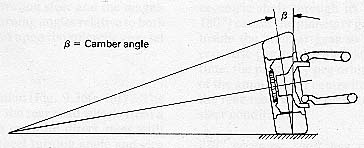
Camber causes our vehicle to pull because of conicity. This means we form a cone if we consider the intersection of the centerline of the wheel and the surface of the road. If we roll a cone, it moves in a circle. The same is true with the cone we form with positive camber. Our vehicle attempts to roll is a circle around the intersection of the wheel centerline and the road.
Sounds like rubbish to me. You can't compare a cambered wheel to a cone.
Yeah, we can get all confrontational and start a flame war if we want, but I'm not really in the mood. I've offered my advice for the OP to follow if he chooses, and I've backed it up with two independent sources, and google will easily find more. If you choose to disagree, that's your right, however, perhaps you'd like to explain for the OP's benefit why camber can't push the car sideways.
Was calling the website rubbish, not you. Just because it's on the internet doesn't mean it's true.

If camber caused the car to pull heavily to one side, how would NASCARs be controllable with their massive amounts of opposite camber? ie, inside wheel with big positive, outside wheel with big negative? By your assertion, they should either go sideways or round in tiny circles?
Thanks, and I agree in principle
Nascar racing is a bit of a special case - they go around in the same direction, on banked tracks, so the alignment setup they use is not transferable to real road users.
It's not the magnitude of the camber that is the problem, it's the difference between wheels that will push a car, although very high (but equal) values of camber will also cause uneven tyre wear. In general any racing car has much higher amounts of camber than road cars do, because they're more concerned with handling around corners than tyre wear. Road users need a balance of the two.
I'd love to be able to explain the conical effect of camber, but using words only and no hands, drawings and a few things lying about to try and illustrate it, it's just not going to work. I'll look for a better explanation of that and post the link if I find one.

That's crazy. Look how much your caster increased, and that's generally not adjustable. I'd say their machine is inaccurate.

