Is this normal?

zizo911

Executive Member
Joined
Dec 24, 2010
Messages
9,414
Reaction score
322
Location
Cape Town
So I recently had my car converted to a manual transmission, because the automatic gearbox was not kinking into the fourth gear and only went up to third.
So now that the car is a manual, i thought that the rpm would drop while changing gears, since it is logic, but although the car now has a 5 speed gearbox the car still runs high on rpm's.
I asked the guy about the conversion and he said its normal for the BMW 316i to run high...

He charged R4500 to do the conversion from auto to manual, labour included, was it worth it?

The car is in 5th gear in the image. (PS I did not take the picture, as I was driving, my friend took it.)

bmw rpm.jpg
 

Attachments

  • 20131221_071038.jpg
    20131221_071038.jpg
    43.3 KB · Views: 897
Last edited:
What's it sitting at when going 120?

I've never driven 120, because as soon as you hit 100 the accelerator pedal starts vibrating and the engine makes a horrible nose as if it's gonna just fall out, but at 100 its sitting at just about 4500rpm
 
At 120km/hr, the normal rotation will be 3750rpm. You did not replace the differential, so I would say this is the incorrect gearbox for the model. On some cars (Alfa-Romeo) you can change the final drive ratio by swapping gears, but I have no knowledge of a BMW box

Either this, or the selector is not engaging the correct gear combination
 
As soon as the rpm gets close to 4000 the accelerator pedal starts vibrating, is this normal?

bmw rpm 2.jpg
 
[video=youtube;fZ7sUSCQsJI]http://www.youtube.com/watch?v=fZ7sUSCQsJI&feature=youtu.be[/video]
 
Considering the amount of labour involved, the parts required to do the conversion, and the amount you paid, I'm surprised the car is even drivable.
 
Yeah... it sounds like you've had a botch job done.. Not everything required was changed...

a 316i should comfortably do 120 in 5th below 4000rpm.
 
They're very definitely wrong :

Thought it was an E30 for some reason.. but that dash is E36 it seems...

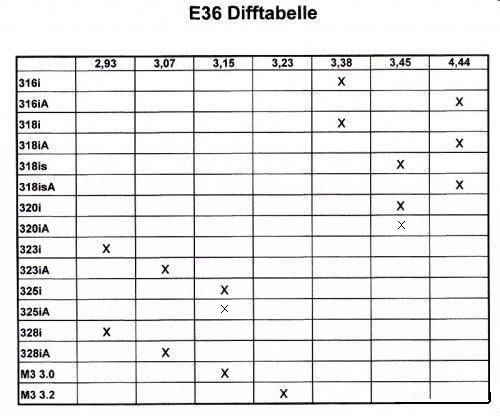
Diff Ratios (Clearest evidence its wrong)
e36dif2.jpg


Gear Ratios
http://www.bokchoys.com/differential/GearRatios.htm

Zizo : Take your car to a BMW specialist before you spend anymore money. You've done the gearbox change, let someone who knows the vehicle tell you what else needs to be changed, and do it ASAP in case you damage other stuff on the vehicle.
 
Last edited:
They're very definitely wrong :

Thought it was an E30 for some reason.. but that dash is E36 it seems...

Zizo : Take your car to a BMW specialist before you spend anymore money. You've done the gearbox change, let someone who knows the vehicle tell you what else needs to be changed, and do it ASAP in case you damage other stuff on the vehicle.
Thank You! Can anyone reccomend a place in CPT?
 
Yes, you definitely have the wrong gearing - should be between 2800 and 3000 at 120.

Did this guy change the diff as well? If not, that's possibly your problem.
 
What's a diff? :embarrassed:

A diff is a differential and that goes hand in hand with the gearbox to get power to the wheels. Here is the technical description of it. If you look under the back of your BMW you will see an oval box like structure on the axle between the wheels - that is where it is situated.

In automobiles and other wheeled vehicles, a differential is the usual way to allow the driving roadwheels to rotate at different speeds. This is necessary when the vehicle turns, making the wheel that is travelling around the outside of the turning curve roll farther and faster than the other. The engine is connected to the shaft rotating at angular velocity \scriptstyle a. The driving wheels are connected to the other two shafts, and \scriptstyle p and \scriptstyle q are equal. If the engine is running at a constant speed, the rotational speed of each driving wheel can vary, but the sum (or average) of the two wheels' speeds can not change. An increase in the speed of one wheel must be balanced by an equal decrease in the speed of the other. (If one wheel is rotating backward, which is possible in very tight turns, its speed should be counted as negative.)
It may seem illogical that the speed of one input shaft can determine the speeds of two output shafts, which are allowed to vary. Logically, the number of inputs should be at least as great as the number of outputs. However, the system has another constraint. Under normal conditions (i.e. only small tyre slip), the ratio of the speeds of the two driving wheels equals the ratio of the radii of the paths around which the two wheels are rolling, which is determined by the track-width of the vehicle (the distance between the driving wheels) and the radius of the turn. Thus the system does not have one input and two independent outputs. It has two inputs and two outputs.

Or this

Why You Need a Differential
Car wheels spin at different speeds, especially when turning. You can see from the animation that each wheel travels a different distance through the turn, and that the inside wheels travel a shorter distance than the outside wheels. Since speed is equal to the distance traveled divided by the time it takes to go that distance, the wheels that travel a shorter distance travel at a lower speed. Also note that the front wheels travel a different distance than the rear wheels.

For the non-driven wheels on your car -- the front wheels on a rear-wheel drive car, the back wheels on a front-wheel drive car -- this is not an issue. There is no connection between them, so they spin independently. But the driven wheels are linked together so that a single engine and transmission can turn both wheels. If your car did not have a differential, the wheels would have to be locked together, forced to spin at the same speed. This would make turning difficult and hard on your car: For the car to be able to turn, one tire would have to slip. With modern tires and concrete roads, a great deal of force is required to make a tire slip. That force would have to be transmitted through the axle from one wheel to another, putting a heavy strain on the axle components.

Long story short, the gearing of the diff must match the gearing in the gearbox - if there is a mismatch you can end up with very "short" gearing which makes the car rev high or "long" gearing which makes it rev very low.

With that in mind, it would appear that the gear ratios have worked out to be too short, and as a result the car is revving too high for any given speed.
 
Last edited:
I think that the ECU thinks it must change gear at that RPM, thats why its so high.
 
Top
Sign up to the MyBroadband newsletter
X