James Webb Telescope Launch (finally)

One of the interesting facts given yesterday:
Just one single photon a second will be collected for some of the dimmest objects... amazing!

(Seeing a bright star means you're getting about a million photons a second from it.)
I'm quite amped for them looking into atmosphere's of habitable planets too. We might even see some basic (or more-than-basic) signs of life. I hope the world is ready for this :D
 
I'm quite amped for them looking into atmosphere's of habitable planets too. We might even see some basic (or more-than-basic) signs of life. I hope the world is ready for this :D
Question is, will they tell us? ;)
That is actually the interesting part, any ETI looking at our planet from many light years away will detect gasses in the atmosphere that should not be naturally occurring for our planet. So the evidence that we are here, is our pollution.
Same for us, by looking at the atmospheres of other planets we should be able to detect different gasses, some of which (at least according to our understanding) should not be naturally occurring.
 
if we see the invading Alien fleet now, I'll consider the price worth it.
I'm quite amped for them looking into atmosphere's of habitable planets too. We might even see some basic (or more-than-basic) signs of life. I hope the world is ready for this :D
Question is, will they tell us? ;)
That is actually the interesting part, any ETI looking at our planet from many light years away will detect gasses in the atmosphere that should not be naturally occurring for our planet. So the evidence that we are here, is our pollution.
Same for us, by looking at the atmospheres of other planets we should be able to detect different gasses, some of which (at least according to our understanding) should not be naturally occurring.
:unsure:
 
well, if we see them stationed on the edge of our Solar system awaiting some "signal" to begin the invasion,
then JWST was worth all that money,

or more likely they will cover it up, build gigantic bunkers for the "worthies" and let the rest of us get enslaved/exterminated by the invaders.
 
well, if we see them stationed on the edge of our Solar system awaiting some "signal" to begin the invasion,
then JWST was worth all that money,

or more likely they will cover it up, build gigantic bunkers for the "worthies" and let the rest of us get enslaved/exterminated by the invaders.
Don't worry, the elite will wipe us out first.
 
One of the interesting facts given yesterday:
Just one single photon a second will be collected for some of the dimmest objects... amazing!

(Seeing a bright star means you're getting about a million photons a second from it.)
That is some of the Lowest resolution I have ever heard of. Man NASA needs some better hardware.
 
So the evidence that we are here, is our pollution.
Same for us, by looking at the atmospheres of other planets we should be able to detect different gasses, some of which (at least according to our understanding) should not be naturally occurring.
I'm not so sure, high carbon dioxide levels aren't just human related. (Anyway I doubt the human factor is as bad as we're told, more likely political abuse IMO.)

That mostly just leaves carbon monoxide AFAIK, and I think quantities may still be too small to detect from so far.
 
I'm not so sure, high carbon dioxide levels aren't just human related. (Anyway I doubt the human factor is as bad as we're told, more likely political abuse IMO.)

That mostly just leaves carbon monoxide AFAIK, and I think quantities may still be too small to detect from so far.
Well, a lot would depend on the sensitivity of the detection equipment and the distances involved. There are various gasses that are the by product of industrial activity and other particles in the atmosphere that could be detected.

Things like radiation from nuclear accidents or detonations could also be picked up in the atmosphere if the detection equipment is sensitive enough.

In the end, those that are looking are subject to their own understanding of planetary sciences and their own biases.
 
In the end, those that are looking are subject to their own understanding of planetary sciences and their own biases.
Of course. Who knows how much more will be understood in just 5 years for instance.

Maybe @Gordon_R can tell us more, he knows a lot about chemistry.
 
Of course. Who knows how much more will be understood in just 5 years for instance.

Maybe @Gordon_R can tell us more, he knows a lot about chemistry.

I have no dog in this fight. Everyone with an agenda wants to get observing time on Webb, even if their ideas are far fetched. Well established fields such as cosmology and astronomy rate higher in the initial priority list, rather than planet detection. The lifetime of Webb allows for a broad range of programs over the next decade.

Edit: Interesting article on the selection process:
 
Last edited:
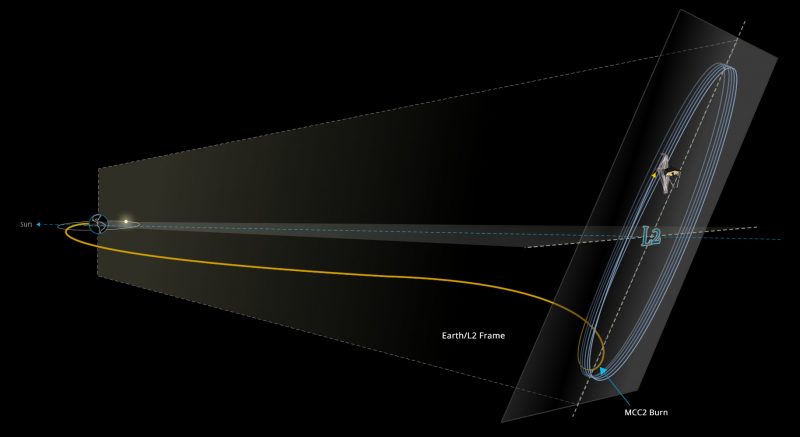
Trajectory-diagram-Webb-L2-NASA-1.jpg


Pedantic mode: Many otherwise well-meaning commentators state that Webb has arrived at 'L2'. This is categorically false, since L2 is in perpetual shadow due to earth's position relative to the sun, and makes a terrible observation point. The strategy is for Webb to slowly 'orbit' at a relatively large distance around L2 so that it can get 24/7 solar power, as well as undisturbed communication without radio interference from the sun. The diagram makes this abundantly clear, even if the headline is misleading.
 
The strategy is for Webb to slowly 'orbit' at a relatively large distance around L2 so that it can get 24/7 solar power, as well as undisturbed communication without radio interference from the sun.
Here's some more detail from Wiki;

The telescope will circle about the Sun-Earth L2 point in a halo orbit, which will be inclined with respect to the ecliptic, have a radius varying between about 250,000 km (160,000 mi) and 832,000 km (517,000 mi), and take about half a year to complete.
 
^^ So at its furthest point, it's actually more than half the distance back to Earth again (in another direction though).
 
So I found this article from a few years back...

https://futurism.com/the-first-targets-of-the-james-webb-telescope-have-been-announced

The Webb will observe the three largest low-albedo asteroids, as well as the Trojan asteroids, allowing us to peer into the origins of our solar system. It will also explore near-Earth objects, which could expand our knowledge and even protect the Earth.

It will also investigate Jupiter’s Great Red Spot, Neptune’s south polar vortex, geological phenomena on Saturn’s moons, and the atmosphere on the planet itself.
Does anyone know if this is still the plan for the first observations?
 
Here's some more detail from Wiki;

I posted a related link in yet another thread on this topic:
 
Top
Sign up to the MyBroadband newsletter
X